

This website is currently being migrated. For the most up-to-date astrobiology news, resources, and community announcements, please visit our new home at science.nasa.gov/astrobiology

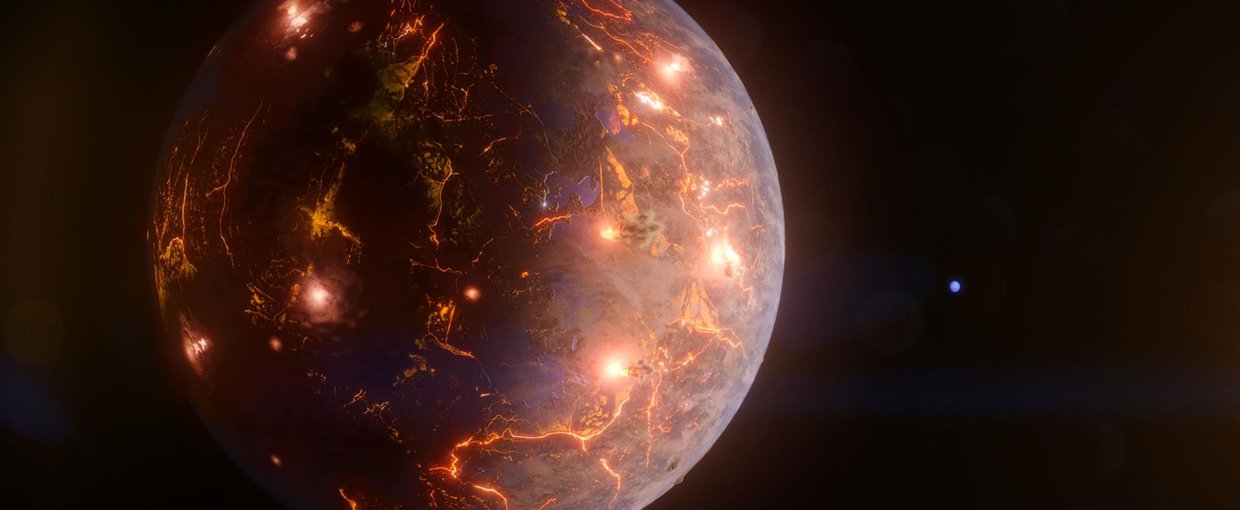
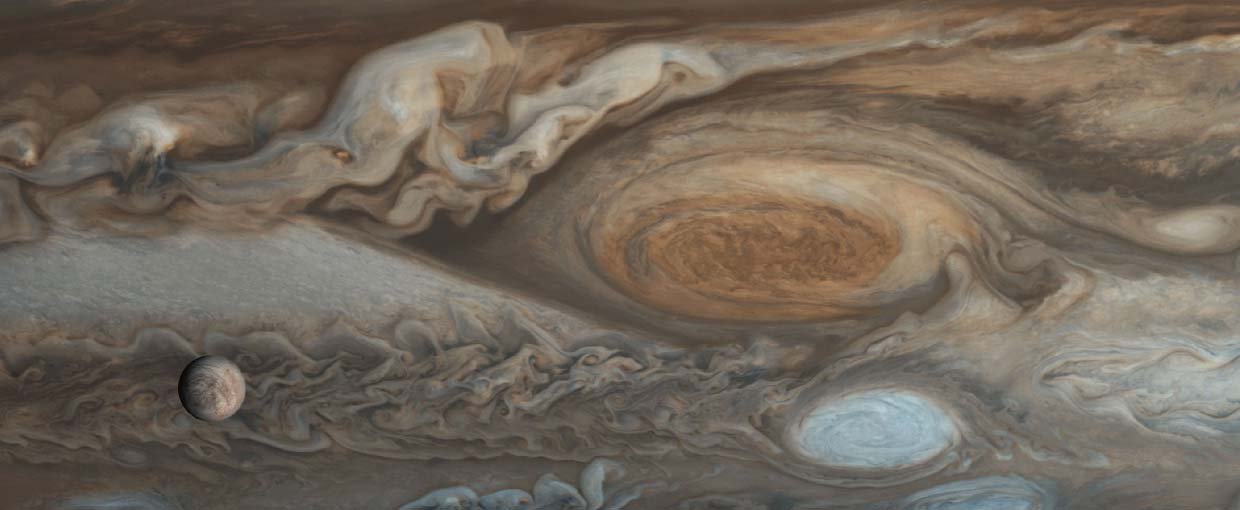
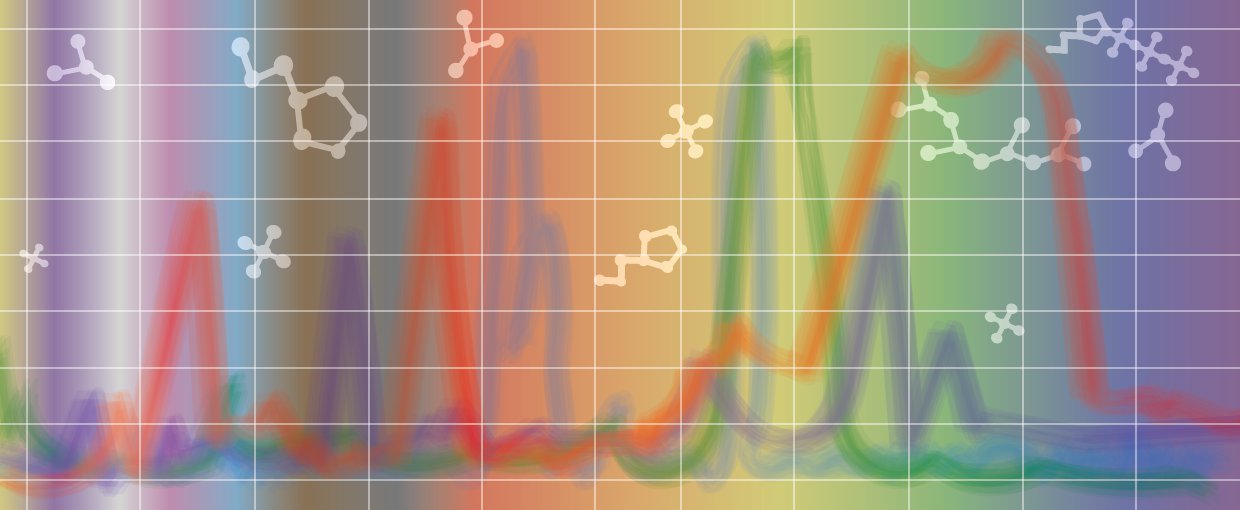
A volcanically active planet is shown in closeup at the left side of the image with glowing eruptions and lines of lava on the surface. To the right and in the distance is a faint blue glowing ball representing the more massive planet in the system.Sixteen frames from Voyager 1's flyby of Jupiter in 1979 were merged to create this image. Jupiter's Great Red Spot is visible in the center. Jupiter's moon Europa can be seen in the foreground at the bottom left of the image.The frame is a horizontal rainbow of color on a grid. Shadows of molecules can be seen through the light as well as the jagged peaks and troughs of spectral lines.
Fizzy Super Earths and Lava Worlds“Fizzy Super-Earths: Impacts of Magma Composition on the Bulk Density and Structure of Lava Worlds.” in The Astrophysical Journal.01/03
Identifying Hydrothermal Activity on Icy Ocean Worlds“Ethene-ethanol ratios as potential indicators of hydrothermal activity at Enceladus, Europa, and other icy ocean worlds.” In Icarus.02/03
NASA Raman Spectroscopic Database"The NASA Raman spectroscopic database: Ramdb version 1.00.” In Icarus.03/03
NextPrevious
Go Explore
December 2011Molecular Evolution of Aminoacyl tRNA Synthetase Proteins in the Early History of Life

Fournier, G. P., Andam, C. P., Alm, E. J., & Peter Gogarten, J. (2011). Orig Life Evol Biosph, 41(6), 621–632. doi:10.1007/s11084-011-9261-2

A HIGH-ECCENTRICITY COMPONENT IN THE DOUBLE-PLANET SYSTEM AROUND HD 163607 AND A PLANET AROUND HD 164509

Giguere, M. J., Fischer, D. A., Howard, A. W., Johnson, J. A., Henry, G. W., Wright, J. T., … Marcy, G. W. (2011). The Astrophysical Journal, 744(1), 4. doi:10.1088/0004-637x/744/1/4

LUMINOSITY DISCREPANCY IN THE EQUAL-MASS, PRE-MAIN-SEQUENCE ECLIPSING BINARY PAR 1802: NON-COEVALITY OR TIDAL HEATING?

Gómez Maqueo Chew, Y., Stassun, K. G., PršA, A., Stempels, E., Hebb, L., Barnes, R., … Heller, R. (2011). The Astrophysical Journal, 745(1), 58. doi:10.1088/0004-637x/745/1/58

CARBON-CHAIN SPECIES IN WARM-UP MODELS

Hassel, G. E., Harada, N., & Herbst, E. (2011). The Astrophysical Journal, 743(2), 182. doi:10.1088/0004-637x/743/2/182

Habitability of Extrasolar Planets and Tidal Spin Evolution

Heller, R., Barnes, R., & Leconte, J. (2011). Orig Life Evol Biosph, 41(6), 539–543. doi:10.1007/s11084-011-9252-3

PDS 144: THE FIRST CONFIRMED Herbig Ae-Herbig Ae WIDE BINARY

Hornbeck, J. B., Grady, C. A., Perrin, M. D., Wisniewski, J. P., Tofflemire, B. M., Brown, A., … Holtzman, J. A. (2011). The Astrophysical Journal, 744(1), 54. doi:10.1088/0004-637x/744/1/54

OPTICAL AND DYNAMICAL CHARACTERIZATION OF COMET-LIKE MAIN-BELT ASTEROID (596) SCHEILA

Hsieh, H. H., Yang, B., & Haghighipour, N. (2011). The Astrophysical Journal, 744(1), 9. doi:10.1088/0004-637x/744/1/9

Cerro Negro volcano, Nicaragua: An assessment of geological and potential biological systems on early Mars

Hynek, B. M., McCollom, T. M., & Rogers, K. L. (2011). Analogs for Planetary Exploration, None(None), 279–285. doi:10.1130/2011.2483(18)

Progress in Studies on the RNA World

Joshi, P. C., Aldersley, M. F., Price, J. D., Zagorevski, D. V., & Ferris, J. P. (2011). Orig Life Evol Biosph, 41(6), 575–579. doi:10.1007/s11084-011-9255-0

Biogeochemical sulfur cycling in the water column of a shallow stratified sea-water lake: Speciation and quadruple sulfur isotope composition

Kamyshny, A., Zerkle, A. L., Mansaray, Z. F., Ciglenečki, I., Bura-Nakić, E., Farquhar, J., & Ferdelman, T. G. (2011). Marine Chemistry, 127(1-4), 144–154. doi:10.1016/j.marchem.2011.09.001