

This website is currently being migrated. For the most up-to-date astrobiology news, resources, and community announcements, please visit our new home at science.nasa.gov/astrobiology

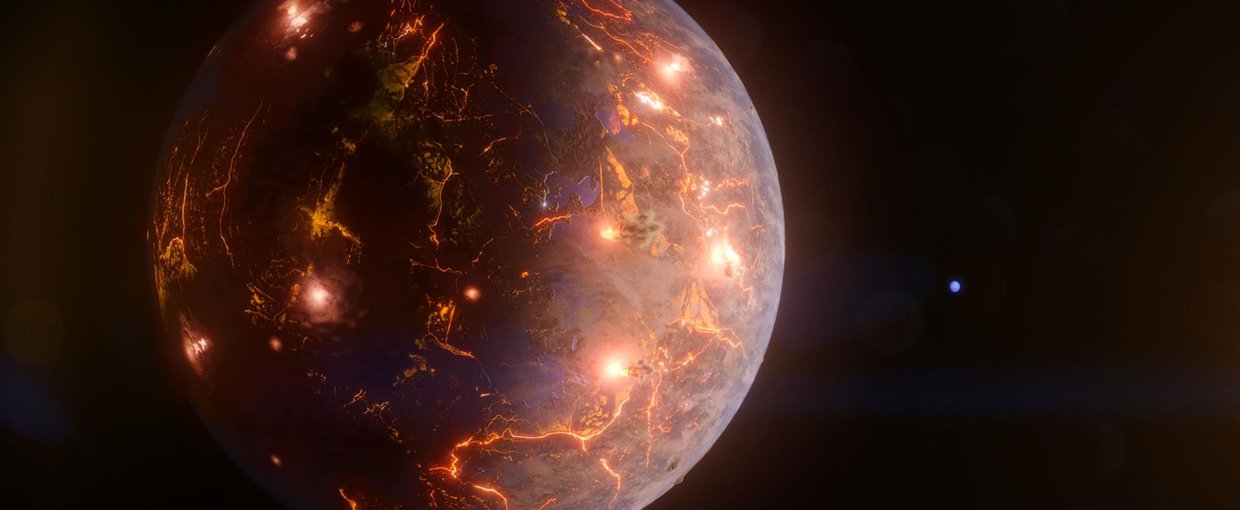
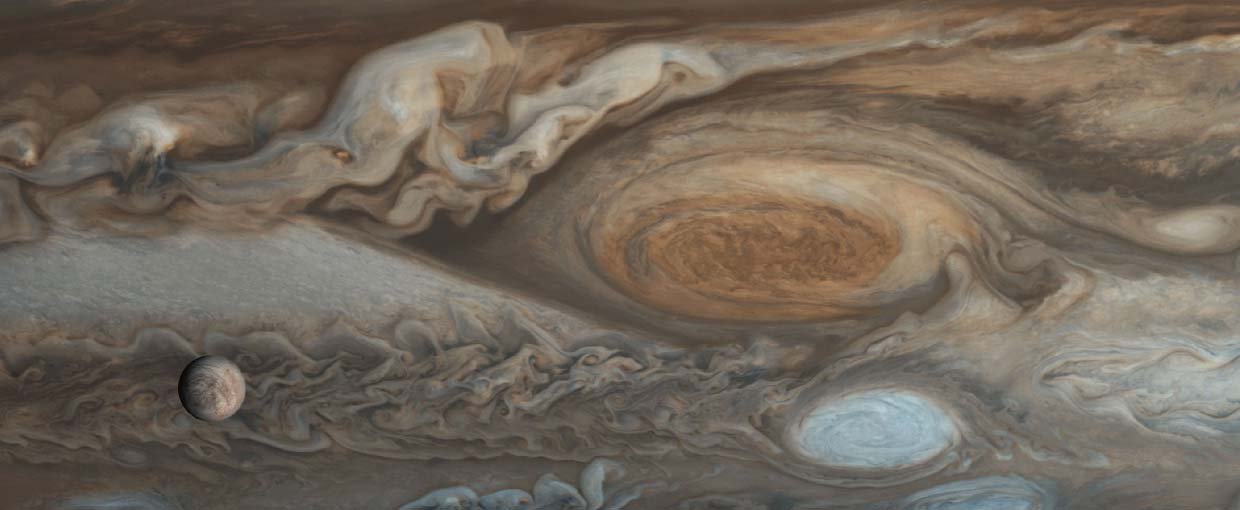
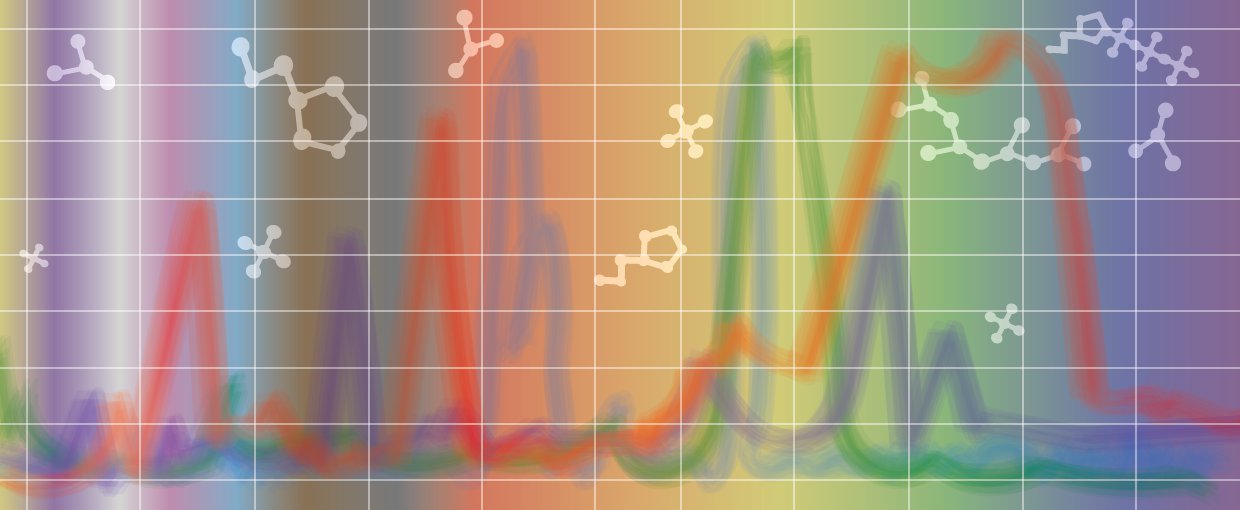
A volcanically active planet is shown in closeup at the left side of the image with glowing eruptions and lines of lava on the surface. To the right and in the distance is a faint blue glowing ball representing the more massive planet in the system.Sixteen frames from Voyager 1's flyby of Jupiter in 1979 were merged to create this image. Jupiter's Great Red Spot is visible in the center. Jupiter's moon Europa can be seen in the foreground at the bottom left of the image.The frame is a horizontal rainbow of color on a grid. Shadows of molecules can be seen through the light as well as the jagged peaks and troughs of spectral lines.
Fizzy Super Earths and Lava Worlds“Fizzy Super-Earths: Impacts of Magma Composition on the Bulk Density and Structure of Lava Worlds.” in The Astrophysical Journal.01/03
Identifying Hydrothermal Activity on Icy Ocean Worlds“Ethene-ethanol ratios as potential indicators of hydrothermal activity at Enceladus, Europa, and other icy ocean worlds.” In Icarus.02/03
NASA Raman Spectroscopic Database"The NASA Raman spectroscopic database: Ramdb version 1.00.” In Icarus.03/03
NextPrevious
Go Explore
February 2012Microbial diversity under extreme euxinia: Mahoney Lake, Canada

Klepac-Ceraj, V., Hayes, C. A., Gilhooly, W. P., Lyons, T. W., Kolter, R., & Pearson, A. (2012). Geobiology, 10(3), 223–235. doi:10.1111/j.1472-4669.2012.00317.x

An icy Kuiper belt around the young solar-type star HD 181327

Lebreton, J., Augereau, J-C., Thi, W-F., Roberge, A., Donaldson, J., Schneider, G., … Maddison, S. T. (2012). A&A, 539(None), A17. doi:10.1051/0004-6361/201117714

FIRST DETECTION OF NEAR-INFRARED LINE EMISSION FROM ORGANICS IN YOUNG CIRCUMSTELLAR DISKS

Mandell, A. M., Bast, J., Van Dishoeck, E. F., Blake, G. A., Salyk, C., Mumma, M. J., & Villanueva, G. (2012). The Astrophysical Journal, 747(2), 92. doi:10.1088/0004-637x/747/2/92

Formation of methanol from methane and water in an electrical discharge

Pearce, M. P., Bussemaker, M. J., Cooper, P. D., Lapere, K. M., Wild, D. A., & McKinley, A. J. (2012). Physical Chemistry Chemical Physics, 14(10), 3444. doi:10.1039/c2cp22135g

THE 15–20 μm EMISSION IN THE REFLECTION NEBULA NGC 2023

Peeters, E., Tielens, A. G. G. M., Allamandola, L. J., & Wolfire, M. G. (2012). The Astrophysical Journal, 747(1), 44. doi:10.1088/0004-637x/747/1/44

V900 MON AND THOMMES’ NEBULA: A NEW FUor IN MONOCEROS

Reipurth, B., Aspin, C., & Herbig, G. H. (2012). The Astrophysical Journal, 748(1), L5. doi:10.1088/2041-8205/748/1/l5

The impact of recent advances in laboratory astrophysics on our understanding of the cosmos

Savin, D. W., Brickhouse, N. S., Cowan, J. J., Drake, R. P., Federman, S. R., Ferland, G. J., … Frank, A. (2012). Reports on Progress in Physics, 75(3), 036901. doi:10.1088/0034-4885/75/3/036901

The ineluctable requirement for the trans-iron elements molybdenum and/or tungsten in the origin of life

Schoepp-Cothenet, B., Van Lis, R., Philippot, P., Magalon, A., Russell, M. J., & Nitschke, W. (2012). Scientific Reports, 2(None), None. doi:10.1038/srep00263

2007 TY430: A COLD CLASSICAL KUIPER BELT TYPE BINARY IN THE PLUTINO POPULATION

Sheppard, S. S., Ragozzine, D., & Trujillo, C. (2012). The Astronomical Journal, 143(3), 58. doi:10.1088/0004-6256/143/3/58

SARIM PLUS—sample return of comet 67P/CG and of interstellar matter

Srama, R., Krüger, H., Yamaguchi, T., Stephan, T., Burchell, M., Kearsley, A. T., … Sterken, V. (2012). Exp Astron, 33(2-3), 723–751. doi:10.1007/s10686-011-9285-7