

This website is currently being migrated. For the most up-to-date astrobiology news, resources, and community announcements, please visit our new home at science.nasa.gov/astrobiology

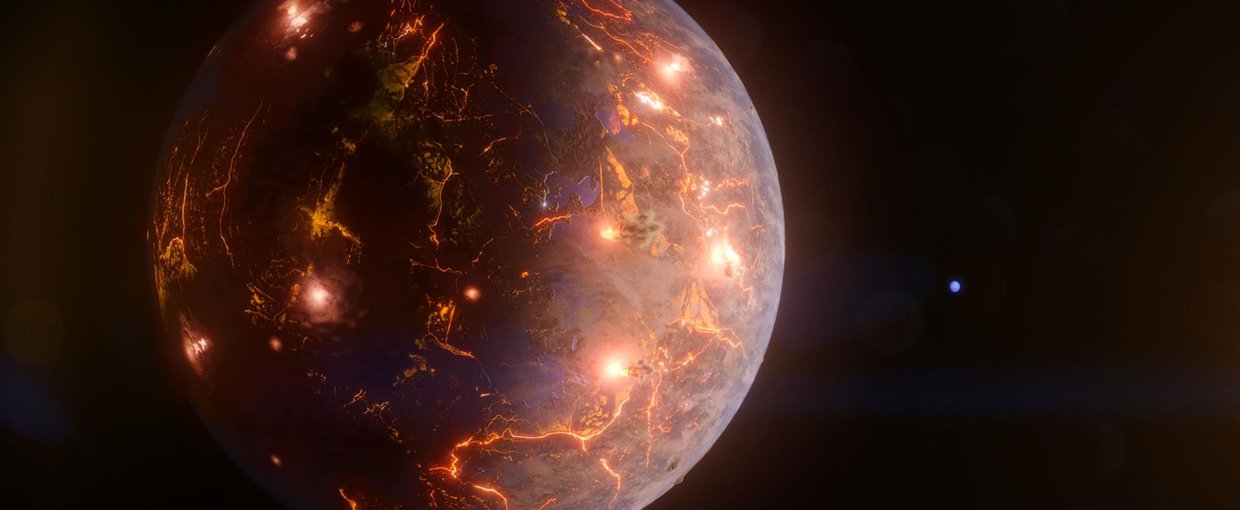
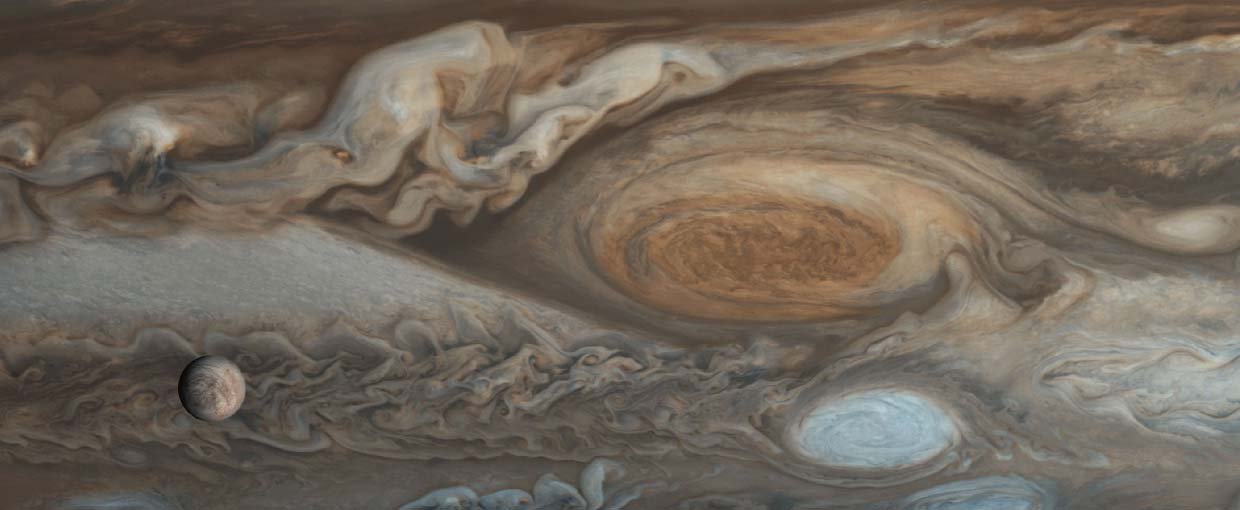
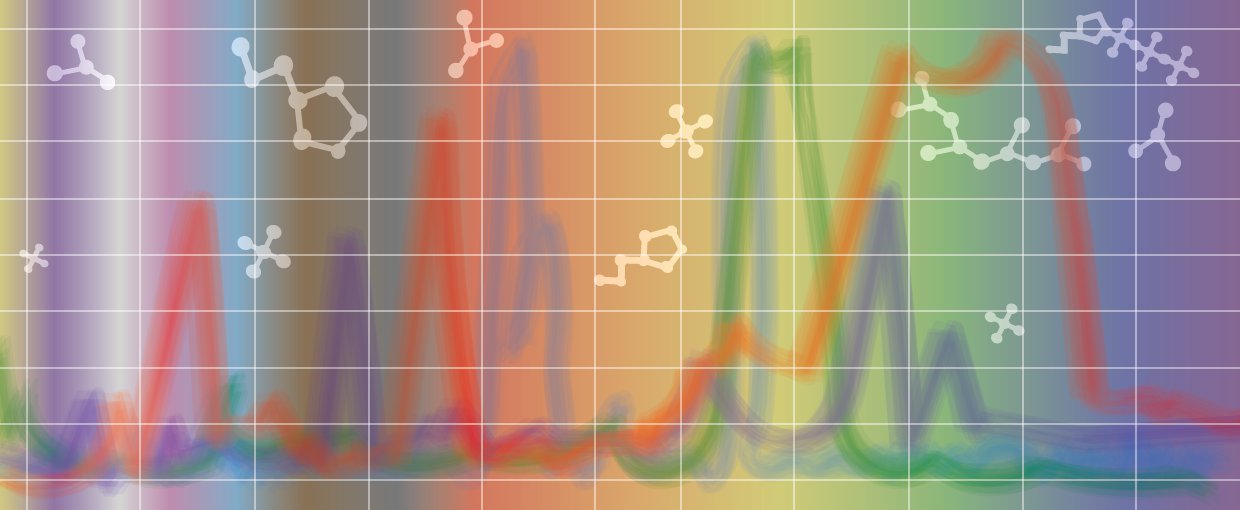
A volcanically active planet is shown in closeup at the left side of the image with glowing eruptions and lines of lava on the surface. To the right and in the distance is a faint blue glowing ball representing the more massive planet in the system.Sixteen frames from Voyager 1's flyby of Jupiter in 1979 were merged to create this image. Jupiter's Great Red Spot is visible in the center. Jupiter's moon Europa can be seen in the foreground at the bottom left of the image.The frame is a horizontal rainbow of color on a grid. Shadows of molecules can be seen through the light as well as the jagged peaks and troughs of spectral lines.
Fizzy Super Earths and Lava Worlds“Fizzy Super-Earths: Impacts of Magma Composition on the Bulk Density and Structure of Lava Worlds.” in The Astrophysical Journal.01/03
Identifying Hydrothermal Activity on Icy Ocean Worlds“Ethene-ethanol ratios as potential indicators of hydrothermal activity at Enceladus, Europa, and other icy ocean worlds.” In Icarus.02/03
NASA Raman Spectroscopic Database"The NASA Raman spectroscopic database: Ramdb version 1.00.” In Icarus.03/03
NextPrevious
Go Explore
March 2012Geobiology of the Proterozoic Eon

Lyons, T. W., Reinhard, C. T., Love, G. D., & Xiao, S. (2012). Geobiology of the Proterozoic Eon. Fundamentals of Geobiology, None, 371–402. doi:10.1002/9781118280874.ch20

Molecular Biology's Contributions to Geobiology

Newman, D. K., Orphan, V. J., & Reysenbach, A-L. (2012). Molecular Biology's Contributions to Geobiology. Fundamentals of Geobiology, None, 228–249. doi:10.1002/9781118280874.ch13

A bistable organic-rich atmosphere on the Neoarchaean Earth

Zerkle, A. L., Claire, M. W., Domagal-Goldman, S. D., Farquhar, J., & Poulton, S. W. (2012). A bistable organic-rich atmosphere on the Neoarchaean Earth. Nature Geoscience, 5(5), 359–363. doi:10.1038/ngeo1425

Hydrothermal Discharge During Submarine Eruptions: The Importance of Detection, Response, and New Technology

Baker, E., Chadwick, W., Cowen, J., Dziak, R., Rubin, K., & Fornari, D. (2012). oceanog, 25(1), 128–141. doi:10.5670/oceanog.2012.11

A propensity for n-ω-amino acids in thermally altered Antarctic meteorites

Burton, A. S., Elsila, J. E., Callahan, M. P., Martin, M. G., Glavin, D. P., Johnson, N. M., & Dworkin, J. P. (2012). Meteoritics & Planetary Science, 47(3), 374–386. doi:10.1111/j.1945-5100.2012.01341.x

Organic Synthesis via Irradiation and Warming of Ice Grains in the Solar Nebula

Ciesla, F. J., & Sandford, S. A. (2012). Science, 336(6080), 452–454. doi:10.1126/science.1217291

Advanced instrument system for real-time and time-series microbial geochemical sampling of the deep (basaltic) crustal biosphere

Cowen, J. P., Copson, D. A., Jolly, J., Hsieh, C-C., Lin, H-T., Glazer, B. T., & Geoffrey Wheat, C. (2012). Deep Sea Research Part I: Oceanographic Research Papers, 61(None), 43–56. doi:10.1016/j.dsr.2011.11.004

Europa's icy bright plains and dark linea: Exogenic and endogenic contributions to composition and surface properties

Dalton, J. B., Shirley, J. H., & Kamp, L. W. (2012). Journal of Geophysical Research: Planets, 117(E3), n/a–n/a. doi:10.1029/2011je003909

Reduced albedo on early Mars does not solve the climate paradox under a faint young Sun

Fairén, A. G., Haqq-Misra, J. D., & McKay, C. P. (2012). A&A, 540(None), A13. doi:10.1051/0004-6361/201118527

THIRD COMPONENT SEARCH AND ABUNDANCES OF THE VERY DUSTY SHORT-PERIOD BINARY BD +20°307

Fekel, F. C., Cordero, M. J., Galicher, R., Zuckerman, B., Melis, C., & Weinberger, A. J. (2012). The Astrophysical Journal, 749(1), 7. doi:10.1088/0004-637x/749/1/7