

This website is currently being migrated. For the most up-to-date astrobiology news, resources, and community announcements, please visit our new home at science.nasa.gov/astrobiology

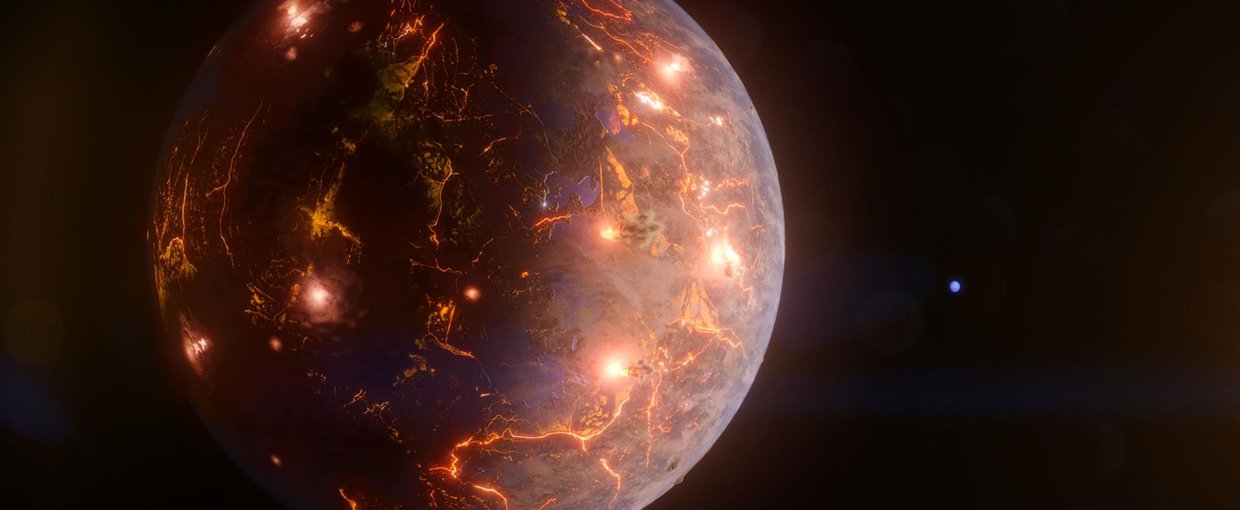
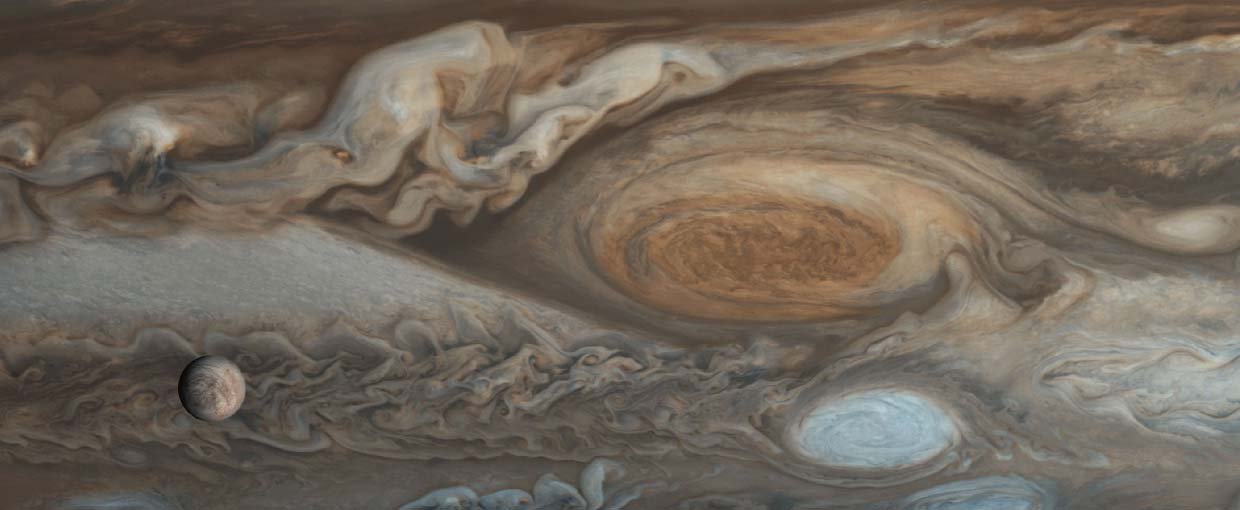
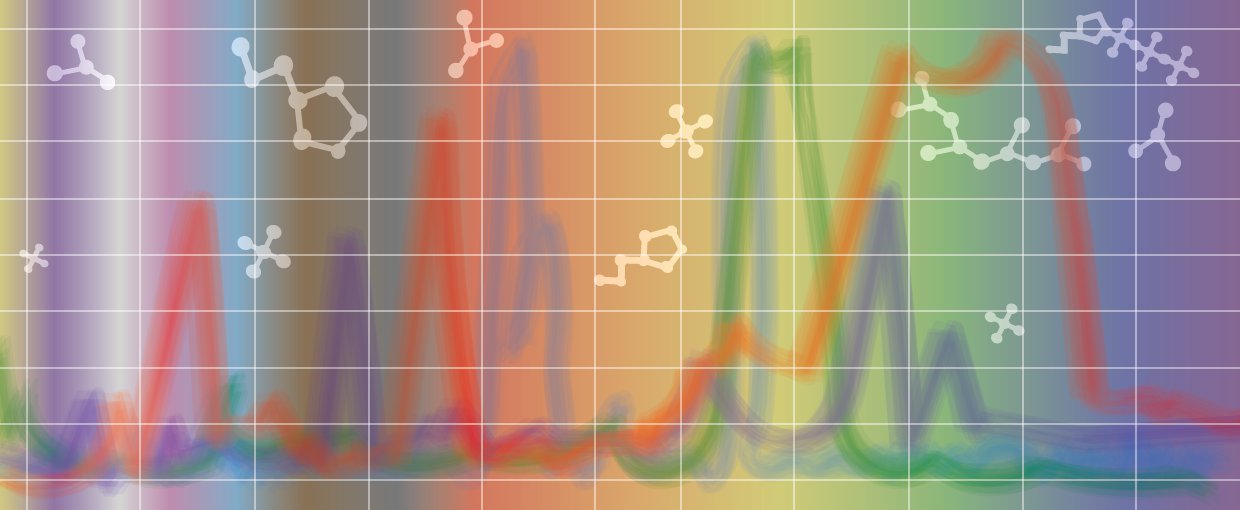
A volcanically active planet is shown in closeup at the left side of the image with glowing eruptions and lines of lava on the surface. To the right and in the distance is a faint blue glowing ball representing the more massive planet in the system.Sixteen frames from Voyager 1's flyby of Jupiter in 1979 were merged to create this image. Jupiter's Great Red Spot is visible in the center. Jupiter's moon Europa can be seen in the foreground at the bottom left of the image.The frame is a horizontal rainbow of color on a grid. Shadows of molecules can be seen through the light as well as the jagged peaks and troughs of spectral lines.
Fizzy Super Earths and Lava Worlds“Fizzy Super-Earths: Impacts of Magma Composition on the Bulk Density and Structure of Lava Worlds.” in The Astrophysical Journal.01/03
Identifying Hydrothermal Activity on Icy Ocean Worlds“Ethene-ethanol ratios as potential indicators of hydrothermal activity at Enceladus, Europa, and other icy ocean worlds.” In Icarus.02/03
NASA Raman Spectroscopic Database"The NASA Raman spectroscopic database: Ramdb version 1.00.” In Icarus.03/03
NextPrevious
Go Explore
August 2012Astrobiology: Frontier or fiction

Lazcano, A., & Hand, K. P. (2012). Nature, 488(7410), 160–161. doi:10.1038/488160a

Melting and dissociation of ammonia at high pressure and high temperature

Ojwang, J. G. O., Stewart McWilliams, R., Ke, X., & Goncharov, A. F. (2012). J. Chem. Phys., 137(6), 064507. doi:10.1063/1.4742340

Kepler-47: A Transiting Circumbinary Multiplanet System

Orosz, J. A., Welsh, W. F., Carter, J. A., Fabrycky, D. C., Cochran, W. D., Endl, M., … Ford, E. B. (2012). Science, 337(6101), 1511–1514. doi:10.1126/science.1228380

Iron isotope and trace metal records of iron cycling in the proto-North Atlantic during the Cenomanian-Turonian oceanic anoxic event (OAE-2)

Owens, J. D., Lyons, T. W., Li, X., Macleod, K. G., Gordon, G., Kuypers, M. M. M., … Anbar, A. (2012). Paleoceanography, 27(3), n/a–n/a. doi:10.1029/2012pa002328

MIXING OF CLUMPY SUPERNOVA EJECTA INTO MOLECULAR CLOUDS

Pan, L., Desch, S. J., Scannapieco, E., & Timmes, F. X. (2012). The Astrophysical Journal, 756(1), 102. doi:10.1088/0004-637x/756/1/102

The Exozodiacal Dust Problem for Direct Observations of Exo-Earths

Roberge, A., Chen, C. H., Millan-Gabet, R., Weinberger, A. J., Hinz, P. M., Stapelfeldt, K. R., … Absil, O. (2012). Publications of the Astronomical Society of the Pacific, 124(918), 799–808. doi:10.1086/667218

MESSENGER detection of electron-induced X-ray fluorescence from Mercury's surface

Starr, R. D., Schriver, D., Nittler, L. R., Weider, S. Z., Byrne, P. K., Ho, G. C., … Rhodes, E. A. (2012). Journal of Geophysical Research: Planets, 117(E12), n/a–n/a. doi:10.1029/2012je004118

Nitrogen isotope ratio of cyanobacterial chlorophyll: Chemostat vs. batch culture

Tsao, L. E., Robinson, R. S., Higgins, M. B., & Pearson, A. (2012). Organic Geochemistry, 49(None), 96–99. doi:10.1016/j.orggeochem.2012.06.001

LIFE: Life Investigation For Enceladus A Sample Return Mission Concept in Search for Evidence of Life

Tsou, P., Brownlee, D. E., McKay, C. P., Anbar, A. D., Yano, H., Altwegg, K., … Beegle, L. W. (2012). Astrobiology, 12(8), 730–742. doi:10.1089/ast.2011.0813

GJ 581 update: Additional evidence for a Super-Earth in the habitable zone

Vogt, S. S., Butler, R. P., & Haghighipour, N. (2012). Astronomische Nachrichten, 333(7), 561–575. doi:10.1002/asna.201211707