

This website is currently being migrated. For the most up-to-date astrobiology news, resources, and community announcements, please visit our new home at science.nasa.gov/astrobiology

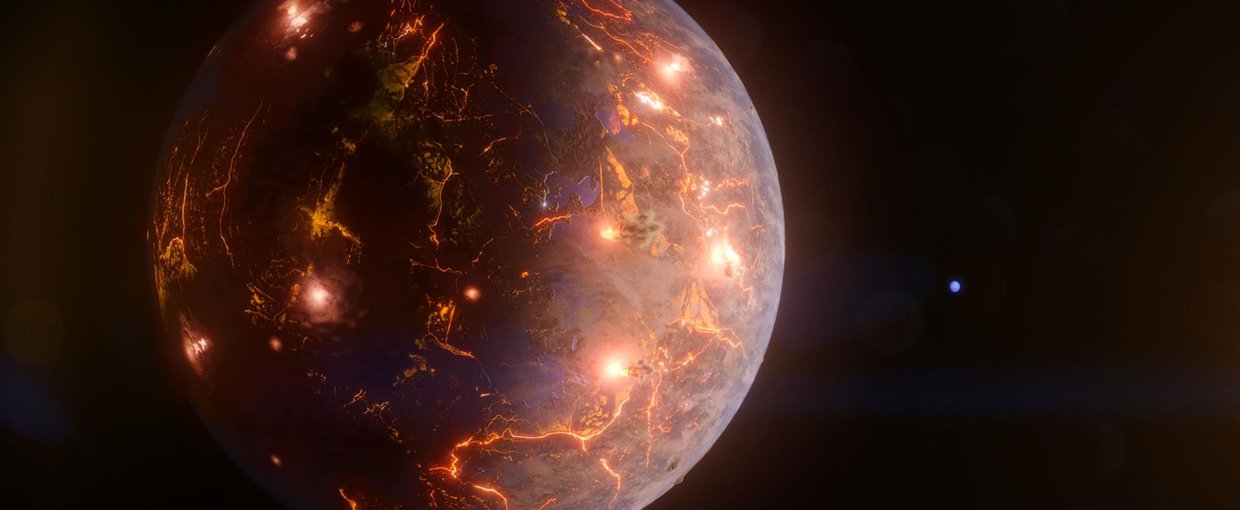
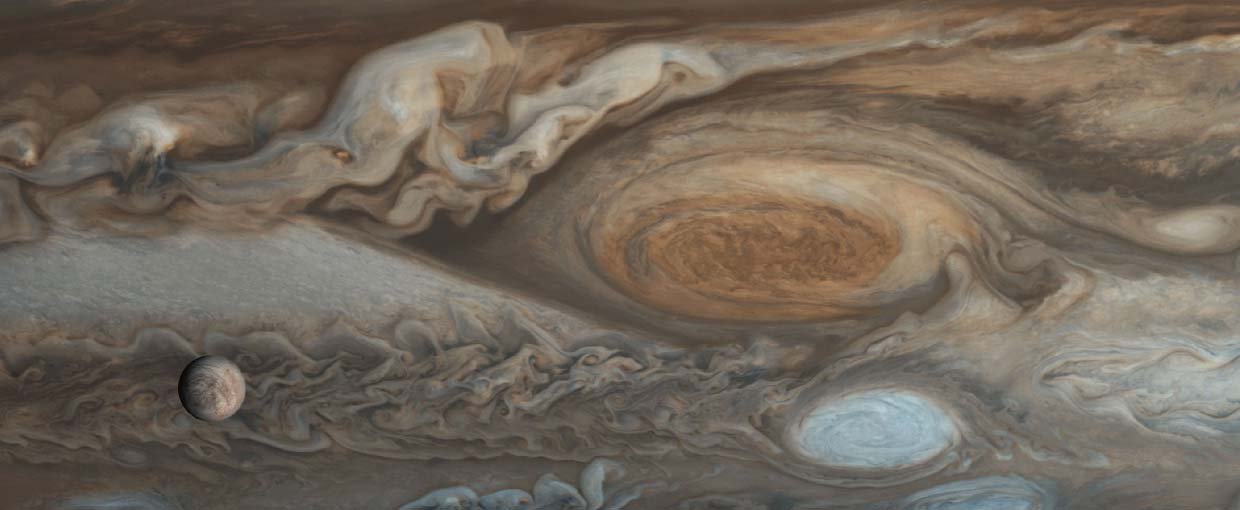
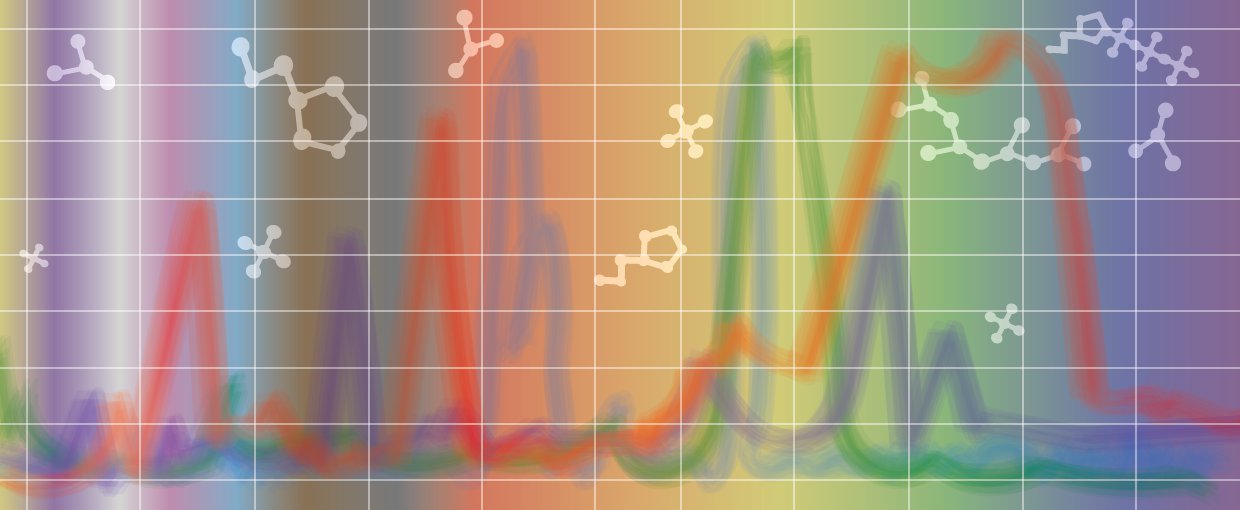
A volcanically active planet is shown in closeup at the left side of the image with glowing eruptions and lines of lava on the surface. To the right and in the distance is a faint blue glowing ball representing the more massive planet in the system.Sixteen frames from Voyager 1's flyby of Jupiter in 1979 were merged to create this image. Jupiter's Great Red Spot is visible in the center. Jupiter's moon Europa can be seen in the foreground at the bottom left of the image.The frame is a horizontal rainbow of color on a grid. Shadows of molecules can be seen through the light as well as the jagged peaks and troughs of spectral lines.
Fizzy Super Earths and Lava Worlds“Fizzy Super-Earths: Impacts of Magma Composition on the Bulk Density and Structure of Lava Worlds.” in The Astrophysical Journal.01/03
Identifying Hydrothermal Activity on Icy Ocean Worlds“Ethene-ethanol ratios as potential indicators of hydrothermal activity at Enceladus, Europa, and other icy ocean worlds.” In Icarus.02/03
NASA Raman Spectroscopic Database"The NASA Raman spectroscopic database: Ramdb version 1.00.” In Icarus.03/03
NextPrevious
Go Explore
September 2012Silicate-COH melt and fluid structure, their physicochemical properties, and partitioning of nominally refractory oxides between melts and fluids

Mysen, B. O. (2012). Lithos, 148(None), 228–246. doi:10.1016/j.lithos.2012.06.005

AN ANALYTIC RADIATIVE-CONVECTIVE MODEL FOR PLANETARY ATMOSPHERES

Robinson, T. D., & Catling, D. C. (2012). The Astrophysical Journal, 757(1), 104. doi:10.1088/0004-637x/757/1/104

Topographic, spectral and thermal inertia analysis of interior layered deposits in Iani Chaos, Mars

Sefton-Nash, E., Catling, D. C., Wood, S. E., Grindrod, P. M., & Teanby, N. A. (2012). Icarus, 221(1), 20–42. doi:10.1016/j.icarus.2012.06.036

IDENTIFYING THE YOUNG LOW-MASS STARS WITHIN 25 pc. II. DISTANCES, KINEMATICS, AND GROUP MEMBERSHIP

Shkolnik, E. L., Anglada-Escudé, G., Liu, M. C., Bowler, B. P., Weinberger, A. J., Boss, A. P., … Neill Reid, I. (2012). The Astrophysical Journal, 758(1), 56. doi:10.1088/0004-637x/758/1/56

Effects of Iron and Nitrogen Limitation on Sulfur Isotope Fractionation during Microbial Sulfate Reduction

Sim, M. S., Ono, S., & Bosak, T. (2012). Applied and Environmental Microbiology, 78(23), 8368–8376. doi:10.1128/aem.01842-12

Contributions to late Archaean sulphur cycling by life on land

Stüeken, E. E., Catling, D. C., & Buick, R. (2012). Nature Geosci, 5(10), 722–725. doi:10.1038/ngeo1585

Titan airglow during eclipse

West, R. A., Ajello, J. M., Stevens, M. H., Strobel, D. F., Gladstone, G. R., Evans, J. S., & Bradley, E. T. (2012). Geophysical Research Letters, 39(18), n/a–n/a. doi:10.1029/2012gl053230

ISOTOPIC ANOMALIES IN PRIMITIVE SOLAR SYSTEM MATTER: SPIN-STATE-DEPENDENT FRACTIONATION OF NITROGEN AND DEUTERIUM IN INTERSTELLAR CLOUDS

Wirström, E. S., Charnley, S. B., Cordiner, M. A., & Milam, S. N. (2012). The Astrophysical Journal, 757(1), L11. doi:10.1088/2041-8205/757/1/l11

August 2012OBLIQUITIES OF HOT JUPITER HOST STARS: EVIDENCE FOR TIDAL INTERACTIONS AND PRIMORDIAL MISALIGNMENTS

Albrecht, S., Winn, J. N., Johnson, J. A., Howard, A. W., Marcy, G. W., Butler, R. P., … Arriagada, P. (2012). The Astrophysical Journal, 757(1), 18. doi:10.1088/0004-637x/757/1/18

Effect of the stellar spin history on the tidal evolution of close-in planets

Bolmont, E., Raymond, S. N., Leconte, J., & Matt, S. P. (2012). A&A, 544(None), A124. doi:10.1051/0004-6361/201219645