

This website is currently being migrated. For the most up-to-date astrobiology news, resources, and community announcements, please visit our new home at science.nasa.gov/astrobiology

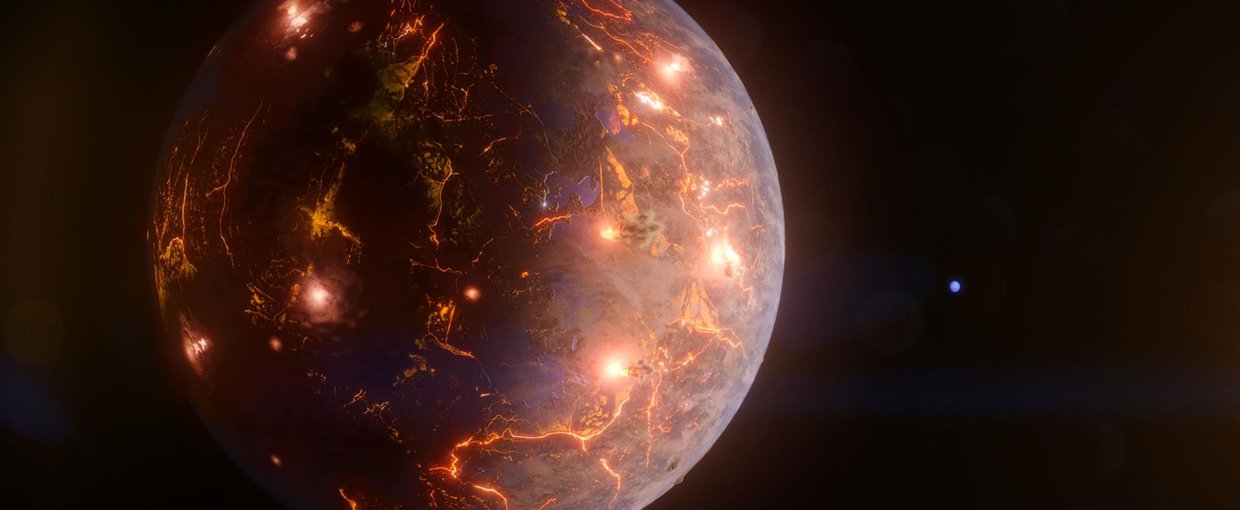
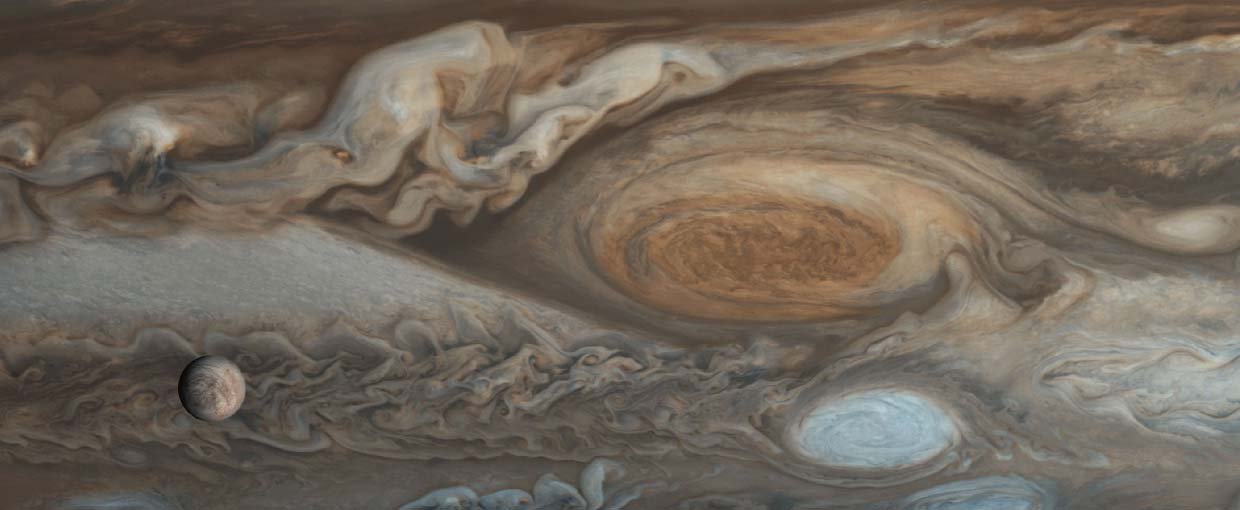
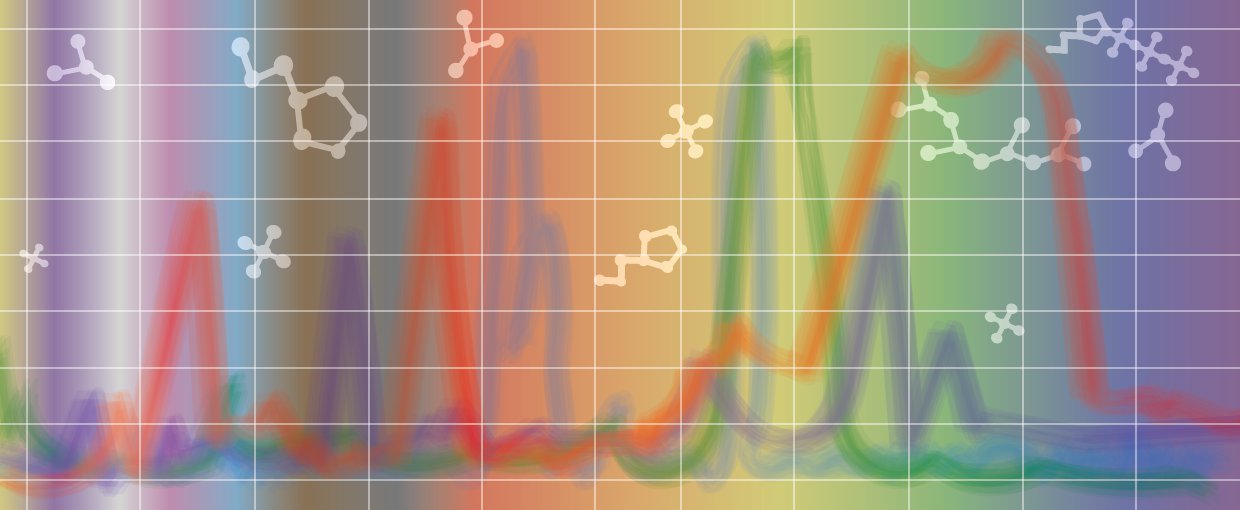
A volcanically active planet is shown in closeup at the left side of the image with glowing eruptions and lines of lava on the surface. To the right and in the distance is a faint blue glowing ball representing the more massive planet in the system.Sixteen frames from Voyager 1's flyby of Jupiter in 1979 were merged to create this image. Jupiter's Great Red Spot is visible in the center. Jupiter's moon Europa can be seen in the foreground at the bottom left of the image.The frame is a horizontal rainbow of color on a grid. Shadows of molecules can be seen through the light as well as the jagged peaks and troughs of spectral lines.
Fizzy Super Earths and Lava Worlds“Fizzy Super-Earths: Impacts of Magma Composition on the Bulk Density and Structure of Lava Worlds.” in The Astrophysical Journal.01/03
Identifying Hydrothermal Activity on Icy Ocean Worlds“Ethene-ethanol ratios as potential indicators of hydrothermal activity at Enceladus, Europa, and other icy ocean worlds.” In Icarus.02/03
NASA Raman Spectroscopic Database"The NASA Raman spectroscopic database: Ramdb version 1.00.” In Icarus.03/03
NextPrevious
Go Explore
October 2012Variations in the abundances of potassium and thorium on the surface of Mercury: Results from the MESSENGER Gamma-Ray Spectrometer

Peplowski, P. N., Lawrence, D. J., Rhodes, E. A., Sprague, A. L., McCoy, T. J., Denevi, B. W., … Evans, L. G. (2012). Journal of Geophysical Research: Planets, 117(E12), n/a–n/a. doi:10.1029/2012je004141

Antagonism influences assembly of a Bacillus guild in a local community and is depicted as a food-chain network

Pérez-Gutiérrez, R-A., López-Ramírez, V., Islas, Á., Alcaraz, L. D., Hernández-González, I., Olivera, B. C. L., … Santillán, M. (2012). ISME J, 7(3), 487–497. doi:10.1038/ismej.2012.119

Sulfur record of rising and falling marine oxygen and sulfate levels during the Lomagundi event

Planavsky, N. J., Bekker, A., Hofmann, A., Owens, J. D., & Lyons, T. W. (2012). Proceedings of the National Academy of Sciences, 109(45), 18300–18305. doi:10.1073/pnas.1120387109

Processes that Drove the Transition from Chemistry to Biology: Concepts and Evidence

Pohorille, A. (2012). Orig Life Evol Biosph, 42(5), 429–432. doi:10.1007/s11084-012-9304-3

Is Water the Universal Solvent for Life?

Pohorille, A., & Pratt, L. R. (2012). Orig Life Evol Biosph, 42(5), 405–409. doi:10.1007/s11084-012-9301-6

HD 172555: detection of 63 μ m [OI] emission in a debris disc

Riviere-Marichalar, P., Barrado, D., Augereau, J-C., Thi, W. F., Roberge, A., Eiroa, C., … Montesinos, B. (2012). A&A, 546(None), L8. doi:10.1051/0004-6361/201219745

Diversity across Seasons of CulturablePseudomonasfrom a Desiccation Lagoon in Cuatro Cienegas, Mexico

Rodríguez-Verdugo, A., Souza, V., Eguiarte, L. E., & Escalante, A. E. (2012). International Journal of Microbiology, 2012(None), 1–10. doi:10.1155/2012/201389

Transit timing observations from Kepler - VII. Confirmation of 27 planets in 13 multiplanet systems via transit timing variations and orbital stability

Steffen, J. H., Fabrycky, D. C., Agol, E., Ford, E. B., Morehead, R. C., Cochran, W. D., … Lissauer, J. J. (2012). Monthly Notices of the Royal Astronomical Society, 428(2), 1077–1087. doi:10.1093/mnras/sts090

Populating the asteroid belt from two parent source regions due to the migration of giant planets-“The Grand Tack”

Walsh, K. J., Morbidelli, A., Raymond, S. N., O’BRIEN, D. P., & Mandell, A. M. (2012). Meteoritics & Planetary Science, 47(12), 1941–1947. doi:10.1111/j.1945-5100.2012.01418.x

Chemical heterogeneity on Mercury's surface revealed by the MESSENGER X-Ray Spectrometer

Weider, S. Z., Nittler, L. R., Starr, R. D., McCoy, T. J., Stockstill-Cahill, K. R., Byrne, P. K., … Denevi, B. W. (2012). Journal of Geophysical Research: Planets, 117(E12), n/a–n/a. doi:10.1029/2012je004153