

This website is currently being migrated. For the most up-to-date astrobiology news, resources, and community announcements, please visit our new home at science.nasa.gov/astrobiology

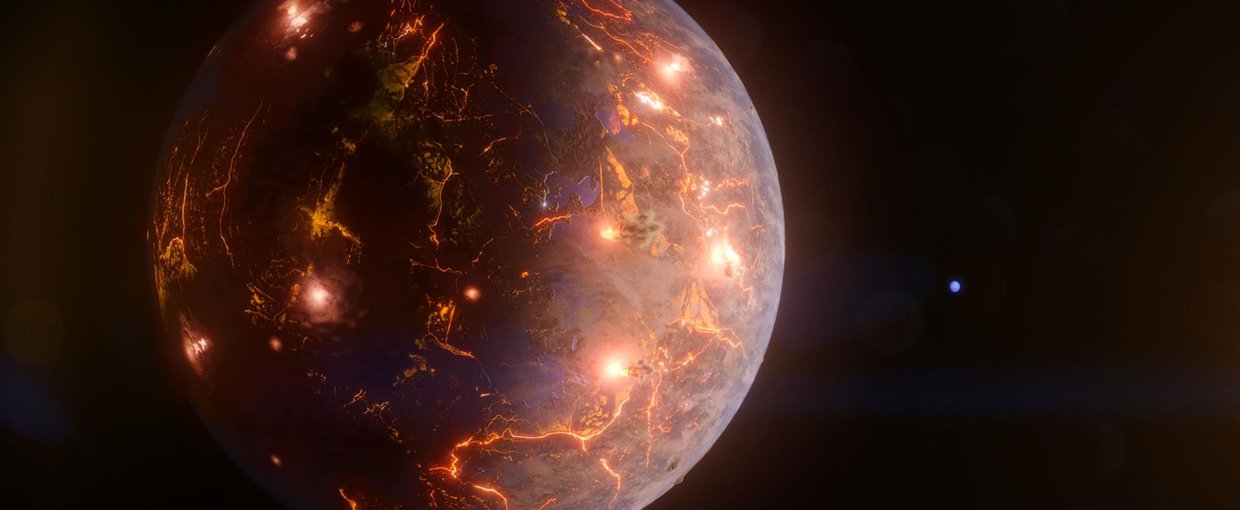
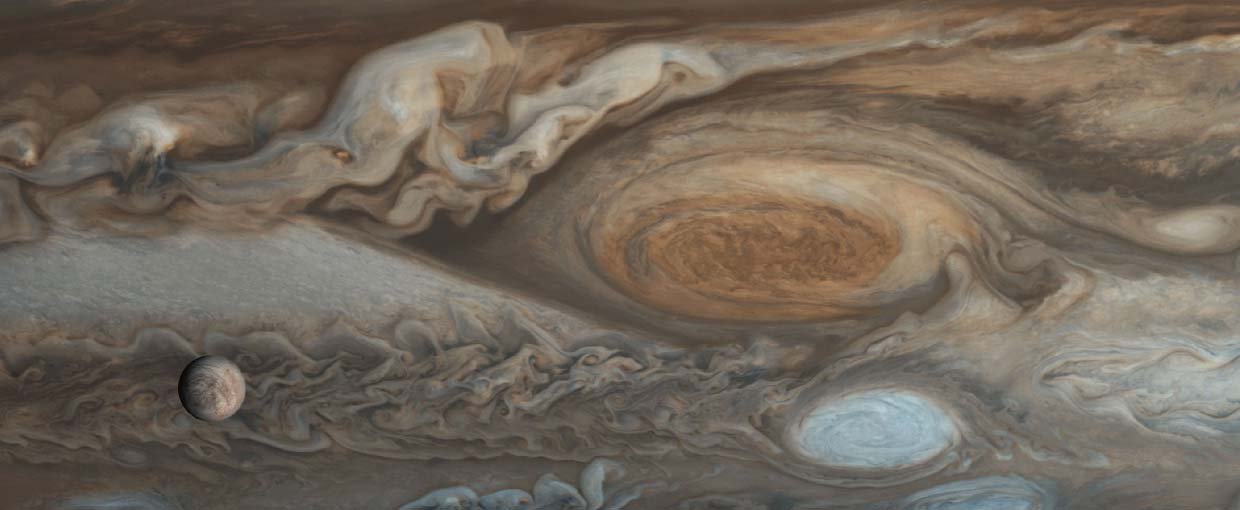
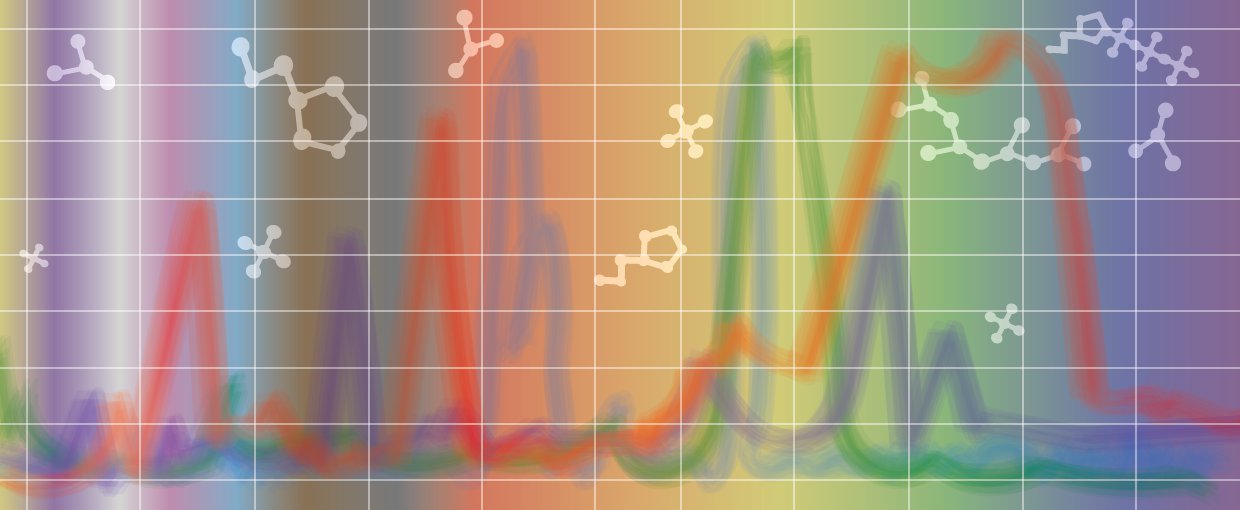
A volcanically active planet is shown in closeup at the left side of the image with glowing eruptions and lines of lava on the surface. To the right and in the distance is a faint blue glowing ball representing the more massive planet in the system.Sixteen frames from Voyager 1's flyby of Jupiter in 1979 were merged to create this image. Jupiter's Great Red Spot is visible in the center. Jupiter's moon Europa can be seen in the foreground at the bottom left of the image.The frame is a horizontal rainbow of color on a grid. Shadows of molecules can be seen through the light as well as the jagged peaks and troughs of spectral lines.
Fizzy Super Earths and Lava Worlds“Fizzy Super-Earths: Impacts of Magma Composition on the Bulk Density and Structure of Lava Worlds.” in The Astrophysical Journal.01/03
Identifying Hydrothermal Activity on Icy Ocean Worlds“Ethene-ethanol ratios as potential indicators of hydrothermal activity at Enceladus, Europa, and other icy ocean worlds.” In Icarus.02/03
NASA Raman Spectroscopic Database"The NASA Raman spectroscopic database: Ramdb version 1.00.” In Icarus.03/03
NextPrevious
Go Explore
October 2012Microbial Nitrogen and Sulfur Cycles at the Gypsum Dunes of White Sands National Monument, New Mexico

Glamoclija, M., Fogel, M. L., Steele, A., & Kish, A. (2012). Geomicrobiology Journal, 29(8), 733–751. doi:10.1080/01490451.2011.608111

A multiple sulfur and organic carbon isotope record from non-conglomeratic sedimentary rocks of the Mesoarchean Witwatersrand Supergroup, South Africa

Guy, B. M., Ono, S., Gutzmer, J., Kaufman, A. J., Lin, Y., Fogel, M. L., & Beukes, N. J. (2012). Precambrian Research, 216-219(None), 208–231. doi:10.1016/j.precamres.2012.06.018

Hydrogen Cyanide Accumulation and Transformations in Non-polluted Salt Marsh Sediments

Kamyshny, A., Oduro, H., Mansaray, Z. F., & Farquhar, J. (2012). Aquat Geochem, 19(2), 97–113. doi:10.1007/s10498-012-9180-5

Faint moving object detection, and the Low Signal-to-Noise recovery of Main Belt comet P/2008 R1 Garradd

Kleyna, J., Meech, K. J., & Hainaut, O. R. (2012). Publications of the Astronomical Society of the Pacific, 124(920), 1083–1089. doi:10.1086/668253

Implantation of multiply charged carbon ions in water ice

Lv, X. Y., De Barros, A. L. F., Boduch, P., Bordalo, V., Da Silveira, E. F., Domaracka, A., … Fulvio, D. (2012). A&A, 546(None), A81. doi:10.1051/0004-6361/201219886

Mercury's moment of inertia from spin and gravity data

Margot, J-L., Peale, S. J., Solomon, S. C., Hauck, S. A., Ghigo, F. D., Jurgens, R. F., … Yseboodt, M. (2012). Journal of Geophysical Research: Planets, 117(E12), n/a–n/a. doi:10.1029/2012je004161

INTERSTELLAR CARBODIIMIDE (HNCNH): A NEW ASTRONOMICAL DETECTION FROM THE GBT PRIMOS SURVEY VIA MASER EMISSION FEATURES

McGuire, B. A., Loomis, R. A., Charness, C. M., Corby, J. F., Blake, G. A., Hollis, J. M., … Lovas, F. J. (2012). The Astrophysical Journal, 758(2), L33. doi:10.1088/2041-8205/758/2/l33

Phylogenetic Estimation of Timescales Using Ancient DNA: The Effects of Temporal Sampling Scheme and Uncertainty in Sample Ages

Molak, M., Lorenzen, E. D., Shapiro, B., & Ho, S. Y. W. (2012). Molecular Biology and Evolution, 30(2), 253–262. doi:10.1093/molbev/mss232

Geochemistry of Carbonates on Mars: Implications for Climate History and Nature of Aqueous Environments

Niles, P. B., Catling, D. C., Berger, G., Chassefière, E., Ehlmann, B. L., Michalski, J. R., … Morris, R. (2012). Space Sci Rev, 174(1-4), 301–328. doi:10.1007/s11214-012-9940-y

THE NEPTUNE-SIZED CIRCUMBINARY PLANET KEPLER-38b

Orosz, J. A., Welsh, W. F., Carter, J. A., Brugamyer, E., Buchhave, L. A., Cochran, W. D., … Endl, M. (2012). The Astrophysical Journal, 758(2), 87. doi:10.1088/0004-637x/758/2/87