

This website is currently being migrated. For the most up-to-date astrobiology news, resources, and community announcements, please visit our new home at science.nasa.gov/astrobiology

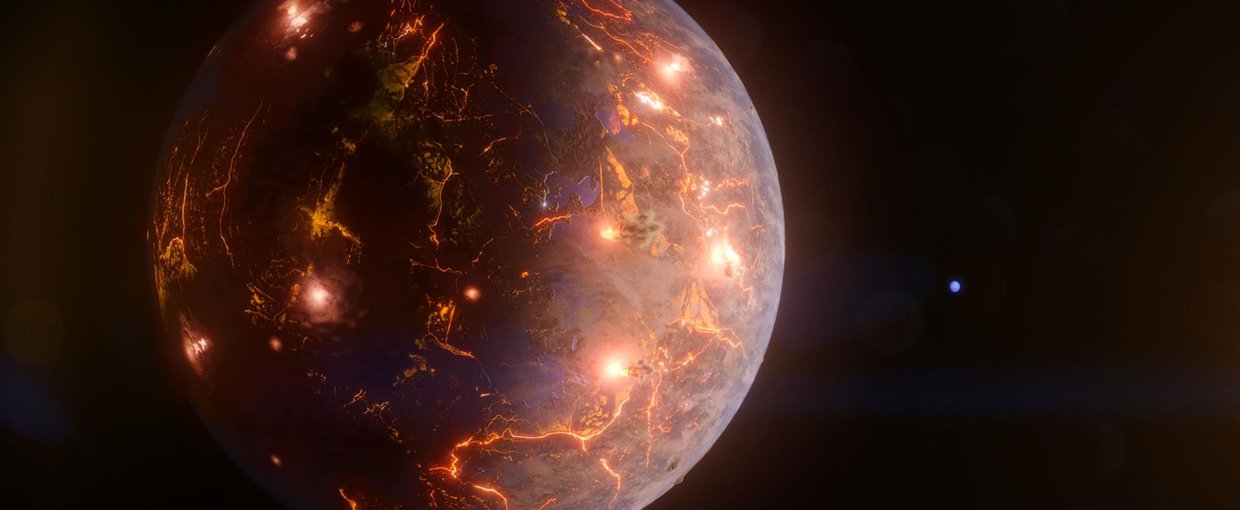
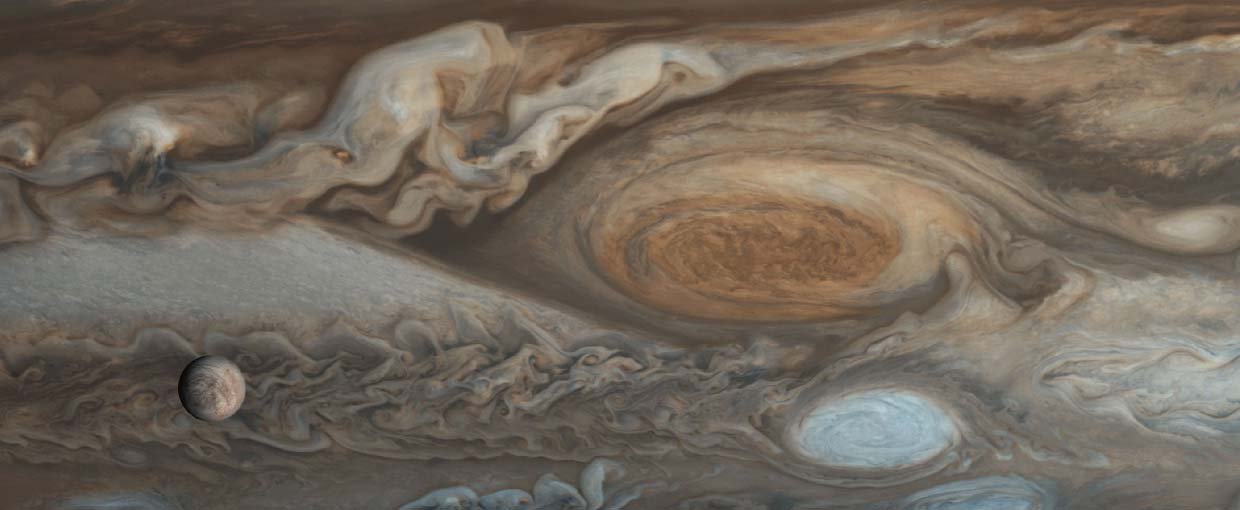
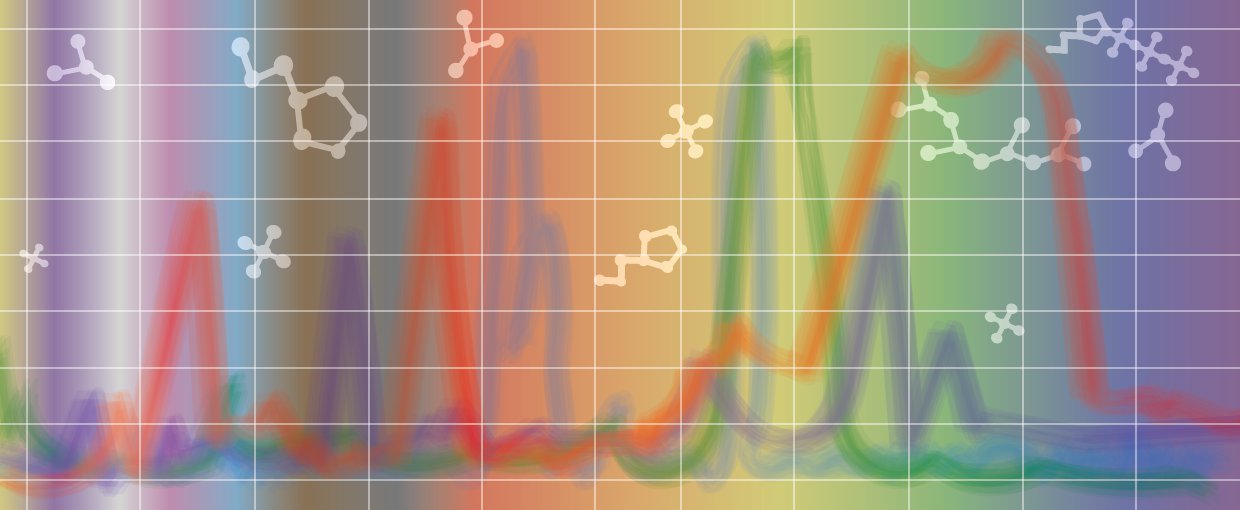
A volcanically active planet is shown in closeup at the left side of the image with glowing eruptions and lines of lava on the surface. To the right and in the distance is a faint blue glowing ball representing the more massive planet in the system.Sixteen frames from Voyager 1's flyby of Jupiter in 1979 were merged to create this image. Jupiter's Great Red Spot is visible in the center. Jupiter's moon Europa can be seen in the foreground at the bottom left of the image.The frame is a horizontal rainbow of color on a grid. Shadows of molecules can be seen through the light as well as the jagged peaks and troughs of spectral lines.
Fizzy Super Earths and Lava Worlds“Fizzy Super-Earths: Impacts of Magma Composition on the Bulk Density and Structure of Lava Worlds.” in The Astrophysical Journal.01/03
Identifying Hydrothermal Activity on Icy Ocean Worlds“Ethene-ethanol ratios as potential indicators of hydrothermal activity at Enceladus, Europa, and other icy ocean worlds.” In Icarus.02/03
NASA Raman Spectroscopic Database"The NASA Raman spectroscopic database: Ramdb version 1.00.” In Icarus.03/03
NextPrevious
Go Explore
December 2012Digital and Analog Chemical Evolution

Goodwin, J. T., Mehta, A. K., & Lynn, D. G. (2012). Digital and Analog Chemical Evolution. Accounts of Chemical Research, 45(12), 2189–2199. doi:10.1021/ar300214w

Role of pKaof Nucleobases in the Origins of Chemical Evolution

Krishnamurthy, R. (2012). Role of pKaof Nucleobases in the Origins of Chemical Evolution. Accounts of Chemical Research, 45(12), 2035–2044. doi:10.1021/ar200262x

Enhanced Nonenzymatic Ligation of Homopurine Miniduplexes: Support for Greater Base Stacking in a Pre-RNA World

Kuruvilla, E., Schuster, G. B., & Hud, N. V. (2012). Enhanced Nonenzymatic Ligation of Homopurine Miniduplexes: Support for Greater Base Stacking in a Pre-RNA World. ChemBioChem, 14(1), 45–48. doi:10.1002/cbic.201200601

A First Analysis of Metallome Biosignatures of Hyperthermophilic Archaea

Cameron, V., House, C. H., & Brantley, S. L. (2012). Archaea, 2012(None), 1–12. doi:10.1155/2012/789278

Structure and dynamics of a primordial catalytic fold generated by in vitro evolution

Chao, F-A., Morelli, A., Iii, J. C. H., Churchfield, L., Hagmann, L. N., Shi, L., … Masterson, L. R. (2012). Nat Chem Biol, 9(2), 81–83. doi:10.1038/nchembio.1138

Supporting Mars exploration: BIOMEX in Low Earth Orbit and further astrobiological studies on the Moon using Raman and PanCam technology

De Vera, J-P., Boettger, U., Noetzel, R. d. l. T., Sánchez, F. J., Grunow, D., Schmitz, N., … Lange, C. (2012). Planetary and Space Science, 74(1), 103–110. doi:10.1016/j.pss.2012.06.010

HIGHLY DEPLETED ETHANE AND MILDLY DEPLETED METHANOL IN COMET 21P/GIACOBINI-ZINNER: APPLICATION OF A NEW EMPIRICAL ν 2 -BAND MODEL FOR CH 3 OH NEAR 50 K

DiSanti, M. A., Bonev, B. P., Villanueva, G. L., & Mumma, M. J. (2012). The Astrophysical Journal, 763(1), 1. doi:10.1088/0004-637x/763/1/1

Magmatic water in the martian meteorite Nakhla

Hallis, L. J., Taylor, G. J., Nagashima, K., & Huss, G. R. (2012). Earth and Planetary Science Letters, 359-360(None), 84–92. doi:10.1016/j.epsl.2012.09.049

Radar-Enabled Recovery of the Sutter's Mill Meteorite, a Carbonaceous Chondrite Regolith Breccia

Jenniskens, P., Fries, M. D., Yin, Q-Z., Zolensky, M., Krot, A. N., Sandford, S. A., … Sears, D. (2012). Science, 338(6114), 1583–1587. doi:10.1126/science.1227163

Heavily metamorphosed clasts from the CV chondrite breccias Mokoia and Yamato-86009

Jogo, K., Nagashima, K., Hutcheon, I. D., Krot, A. N., & Nakamura, T. (2012). Meteoritics & Planetary Science, 47(12), 2251–2268. doi:10.1111/maps.12042