

This website is currently being migrated. For the most up-to-date astrobiology news, resources, and community announcements, please visit our new home at science.nasa.gov/astrobiology

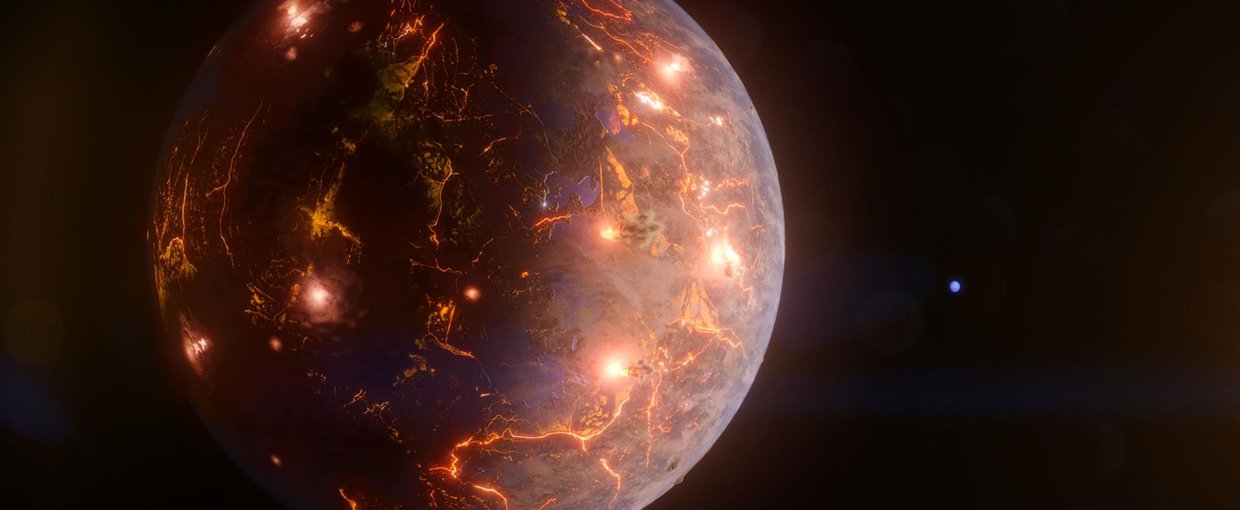
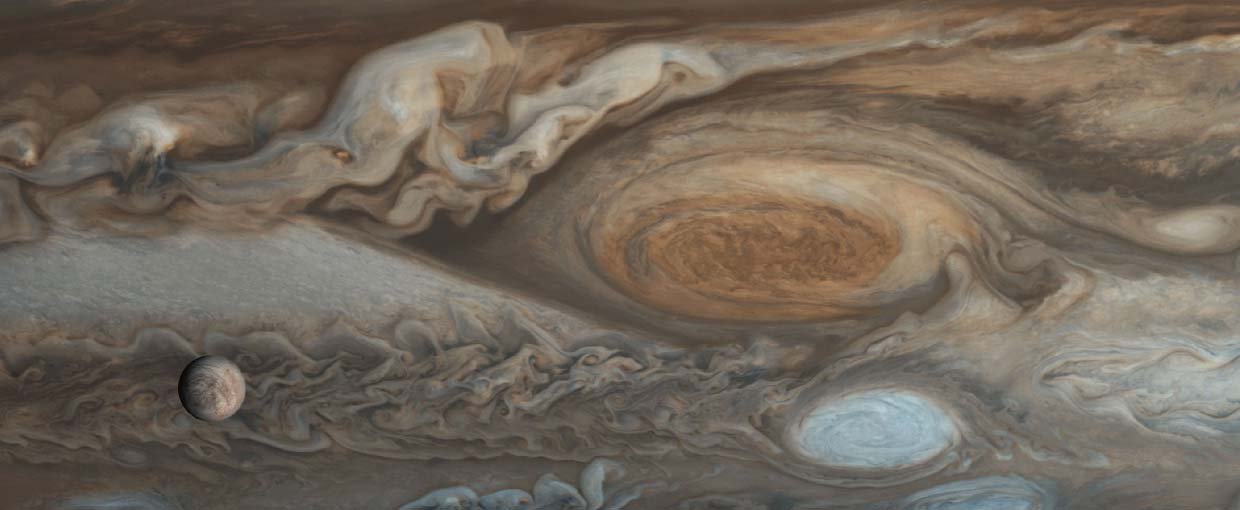
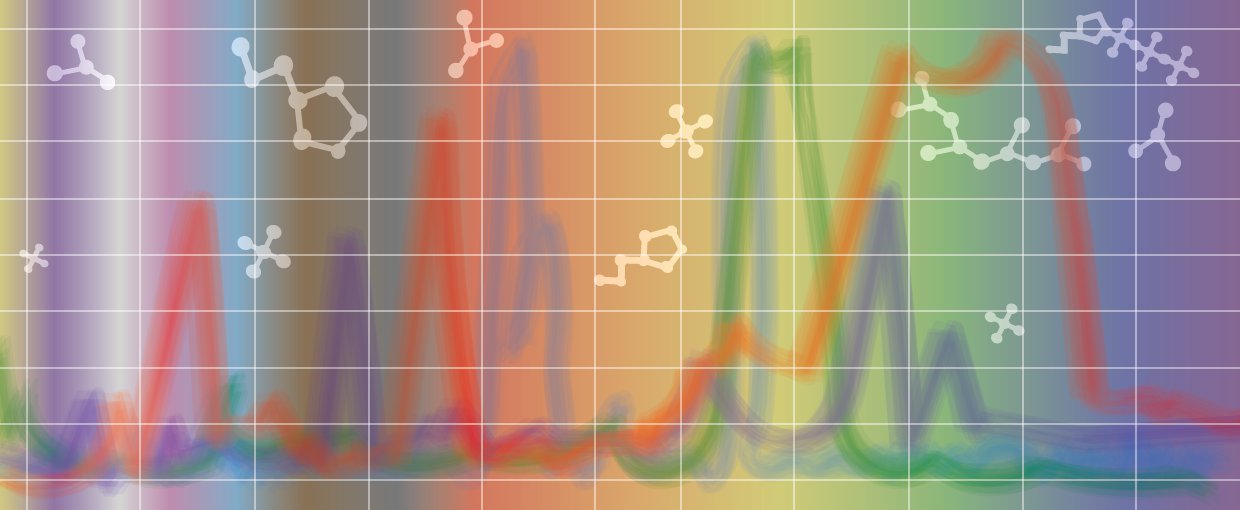
A volcanically active planet is shown in closeup at the left side of the image with glowing eruptions and lines of lava on the surface. To the right and in the distance is a faint blue glowing ball representing the more massive planet in the system.Sixteen frames from Voyager 1's flyby of Jupiter in 1979 were merged to create this image. Jupiter's Great Red Spot is visible in the center. Jupiter's moon Europa can be seen in the foreground at the bottom left of the image.The frame is a horizontal rainbow of color on a grid. Shadows of molecules can be seen through the light as well as the jagged peaks and troughs of spectral lines.
Fizzy Super Earths and Lava Worlds“Fizzy Super-Earths: Impacts of Magma Composition on the Bulk Density and Structure of Lava Worlds.” in The Astrophysical Journal.01/03
Identifying Hydrothermal Activity on Icy Ocean Worlds“Ethene-ethanol ratios as potential indicators of hydrothermal activity at Enceladus, Europa, and other icy ocean worlds.” In Icarus.02/03
NASA Raman Spectroscopic Database"The NASA Raman spectroscopic database: Ramdb version 1.00.” In Icarus.03/03
NextPrevious
Go Explore
January 2013Molecular paleontology: a biochemical model of the ancestral ribosome

Hsiao, C., Lenz, T. K., Peters, J. K., Fang, P-Y., Schneider, D. M., Anderson, E. J., … Preeprem, T. (2013). Nucleic Acids Research, 41(5), 3373–3385. doi:10.1093/nar/gkt023

Planetary system disruption by Galactic perturbations to wide binary stars

Kaib, N. A., Raymond, S. N., & Duncan, M. (2013). Nature, 493(7432), 381–384. doi:10.1038/nature11780

How Was Early Earth Kept Warm?

Kasting, J. F. (2013). Science, 339(6115), 44–45. doi:10.1126/science.1232662

APOSTLE: 11 TRANSIT OBSERVATIONS OF TrES-3b

Kundurthy, P., Becker, A. C., Agol, E., Barnes, R., & Williams, B. (2013). The Astrophysical Journal, 764(1), 8. doi:10.1088/0004-637x/764/1/8

α Centauri A in the far infrared

Liseau, R., Montesinos, B., Olofsson, G., Bryden, G., Marshall, J. P., Ardila, D., … Bayo Aran, A. (2013). A&A, 549(None), L7. doi:10.1051/0004-6361/201220776

Primordial Origins of Earth's Carbon

Marty, B., Alexander, C. M. O., & Raymond, S. N. (2013). Reviews in Mineralogy and Geochemistry, 75(1), 149–181. doi:10.2138/rmg.2013.75.6

The Identification of MicroRNAs in Calcisponges: Independent Evolution of MicroRNAs in Basal Metazoans

Robinson, J. M., Sperling, E. A., Bergum, B., Adamski, M., Nichols, S. A., Adamska, M., & Peterson, K. J. (2013). J. Exp. Zool. (Mol. Dev. Evol.), 320(2), 84–93. doi:10.1002/jez.b.22485

High-precision temporal calibration of Late Permian vertebrate biostratigraphy: U-Pb zircon constraints from the Karoo Supergroup, South Africa

Rubidge, B. S., Erwin, D. H., Ramezani, J., Bowring, S. A., & De Klerk, W. J. (2013). Geology, 41(3), 363–366. doi:10.1130/g33622.1

Serpentinization, Carbon, and Deep Life

Schrenk, M. O., Brazelton, W. J., & Lang, S. Q. (2013). Reviews in Mineralogy and Geochemistry, 75(1), 575–606. doi:10.2138/rmg.2013.75.18

Did life originate from a global chemical reactor?

Stüeken, E. E., Anderson, R. E., Bowman, J. S., Brazelton, W. J., Colangelo-Lillis, J., Goldman, A. D., … Som, S. M. (2013). Geobiology, 11(2), 101–126. doi:10.1111/gbi.12025