

This website is currently being migrated. For the most up-to-date astrobiology news, resources, and community announcements, please visit our new home at science.nasa.gov/astrobiology

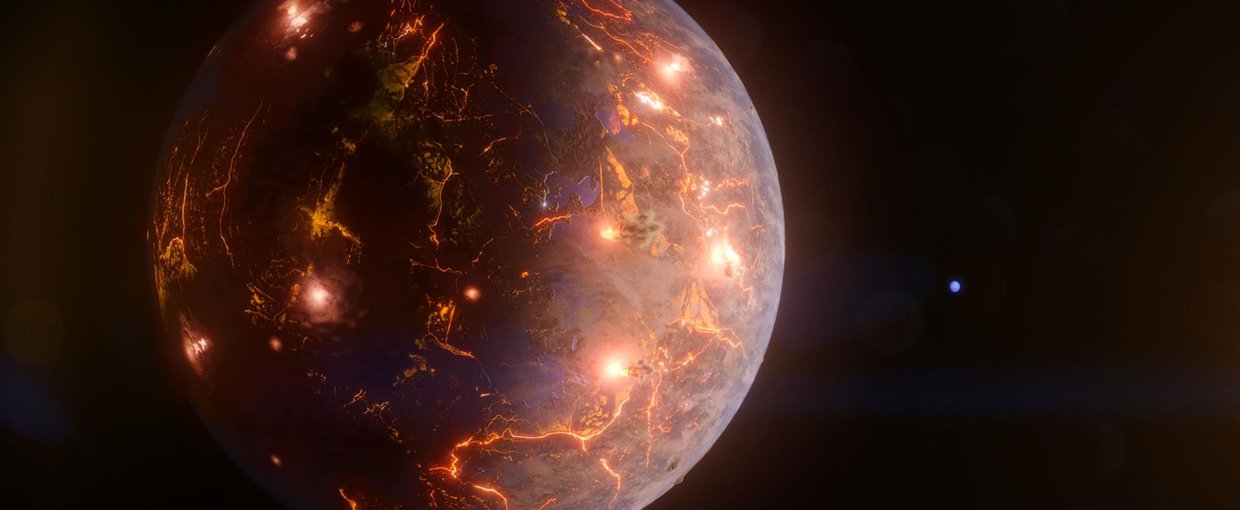
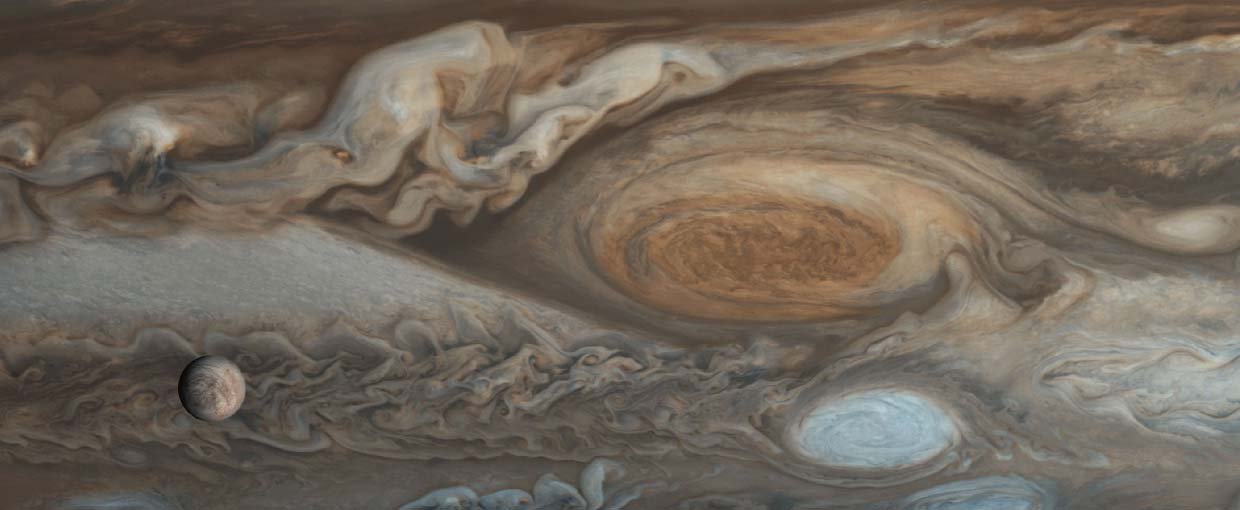
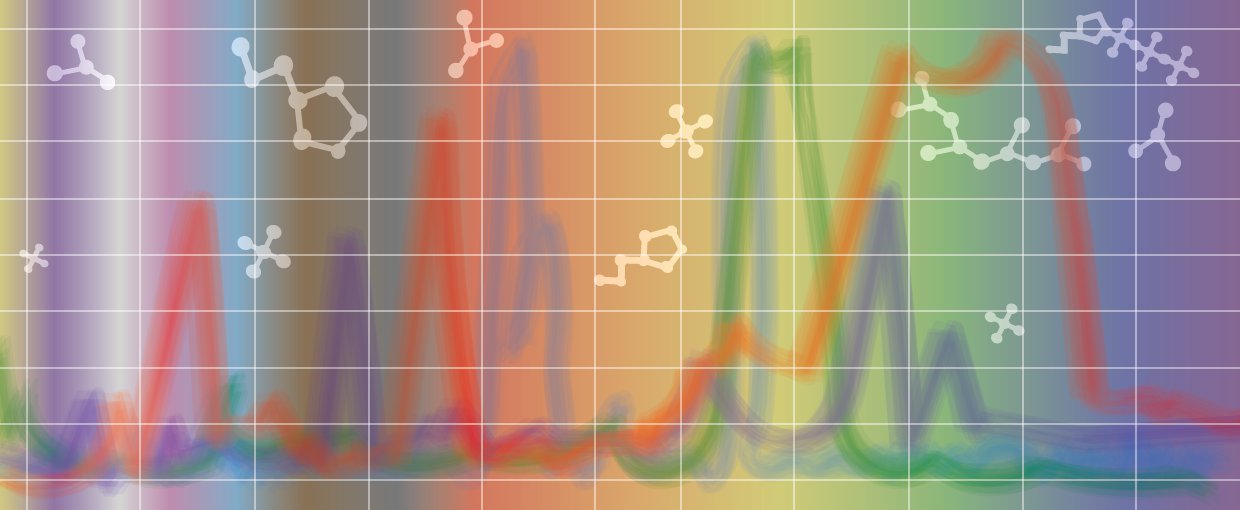
A volcanically active planet is shown in closeup at the left side of the image with glowing eruptions and lines of lava on the surface. To the right and in the distance is a faint blue glowing ball representing the more massive planet in the system.Sixteen frames from Voyager 1's flyby of Jupiter in 1979 were merged to create this image. Jupiter's Great Red Spot is visible in the center. Jupiter's moon Europa can be seen in the foreground at the bottom left of the image.The frame is a horizontal rainbow of color on a grid. Shadows of molecules can be seen through the light as well as the jagged peaks and troughs of spectral lines.
Fizzy Super Earths and Lava Worlds“Fizzy Super-Earths: Impacts of Magma Composition on the Bulk Density and Structure of Lava Worlds.” in The Astrophysical Journal.01/03
Identifying Hydrothermal Activity on Icy Ocean Worlds“Ethene-ethanol ratios as potential indicators of hydrothermal activity at Enceladus, Europa, and other icy ocean worlds.” In Icarus.02/03
NASA Raman Spectroscopic Database"The NASA Raman spectroscopic database: Ramdb version 1.00.” In Icarus.03/03
NextPrevious
Go Explore
March 2013Implications of the spectroscopic abundances in   Centauri A and B

Hinkel, N. R., & Kane, S. R. (2013). Monthly Notices of the Royal Astronomical Society: Letters, 432(1), L36–L40. doi:10.1093/mnrasl/slt032

A COMPOUND MODEL FOR THE ORIGIN OF EARTH'S WATER

Izidoro, A., De Souza Torres, K., Winter, O. C., & Haghighipour, N. (2013). The Astrophysical Journal, 767(1), 54. doi:10.1088/0004-637x/767/1/54

Progress in demonstrating homochiral selection in prebiotic RNA synthesis

Joshi, P. C., Aldersley, M. F., & Ferris, J. P. (2013). Advances in Space Research, 51(5), 772–779. doi:10.1016/j.asr.2012.09.036

A REVISED ESTIMATE OF THE OCCURRENCE RATE OF TERRESTRIAL PLANETS IN THE HABITABLE ZONES AROUND KEPLER M-DWARFS

Kopparapu, R. K. (2013). The Astrophysical Journal, 767(1), L8. doi:10.1088/2041-8205/767/1/l8

Atmospheric sulfur rearrangement 2.7 billion years ago: Evidence for oxygenic photosynthesis

Kurzweil, F., Claire, M., Thomazo, C., Peters, M., Hannington, M., & Strauss, H. (2013). Earth and Planetary Science Letters, 366(None), 17–26. doi:10.1016/j.epsl.2013.01.028

The end of the Ediacara biota: Extinction, biotic replacement, or Cheshire Cat?

Laflamme, M., Darroch, S. A. F., Tweedt, S. M., Peterson, K. J., & Erwin, D. H. (2013). Gondwana Research, 23(2), 558–573. doi:10.1016/j.gr.2012.11.004

Microbial secondary succession in soil microcosms of a desert oasis in the Cuatro Cienegas Basin, Mexico

López-Lozano, N. E., Heidelberg, K. B., Nelson, W. C., GarcíA-Oliva, F., Eguiarte, L. E., & Souza, V. (2013). PeerJ, 1(None), e47. doi:10.7717/peerj.47

Photosystem trap energies and spectrally-dependent energy-storage efficiencies in the Chl d-utilizing cyanobacterium, Acaryochloris marina

Mielke, S. P., Kiang, N. Y., Blankenship, R. E., & Mauzerall, D. (2013). Biochimica et Biophysica Acta (BBA) - Bioenergetics, 1827(3), 255–265. doi:10.1016/j.bbabio.2012.11.002

Niche Construction Theory: A Practical Guide for Ecologists

Odling-Smee, J., Erwin, D. H., Palkovacs, E. P., Feldman, M. W., & Laland, K. N. (2013). The Quarterly Review of Biology, 88(1), 3–28. doi:10.1086/669266

GROUND-BASED INFRARED DETECTIONS OF CO IN THE CENTAUR-COMET 29P/SCHWASSMANN-WACHMANN 1 AT 6.26 AU FROM THE SUN

Paganini, L., Mumma, M. J., Boehnhardt, H., DiSanti, M. A., Villanueva, G. L., Bonev, B. P., … Lippi, M. (2013). The Astrophysical Journal, 766(2), 100. doi:10.1088/0004-637x/766/2/100