

This website is currently being migrated. For the most up-to-date astrobiology news, resources, and community announcements, please visit our new home at science.nasa.gov/astrobiology

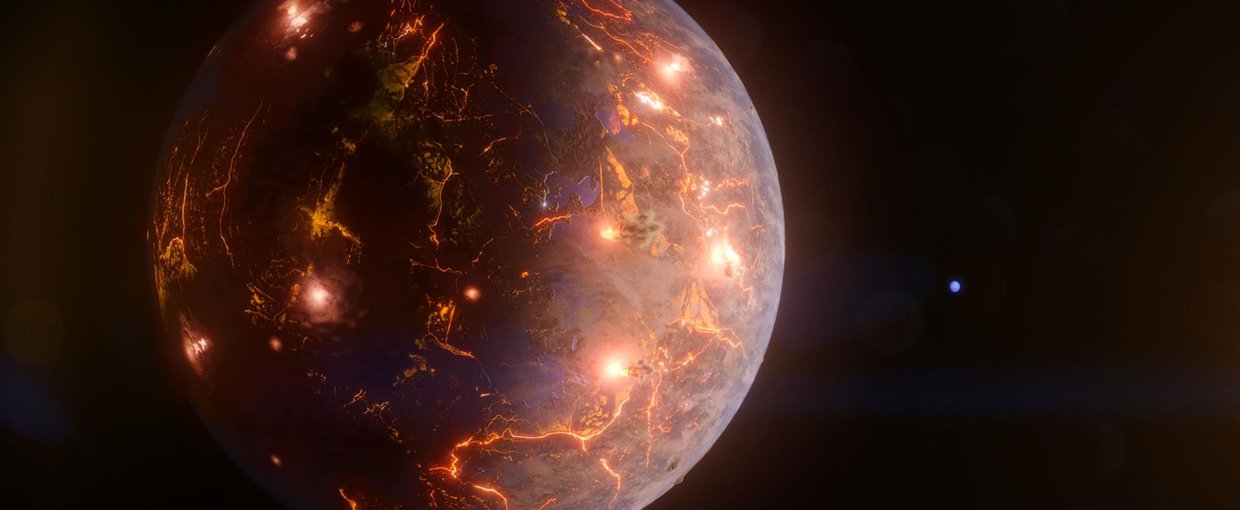
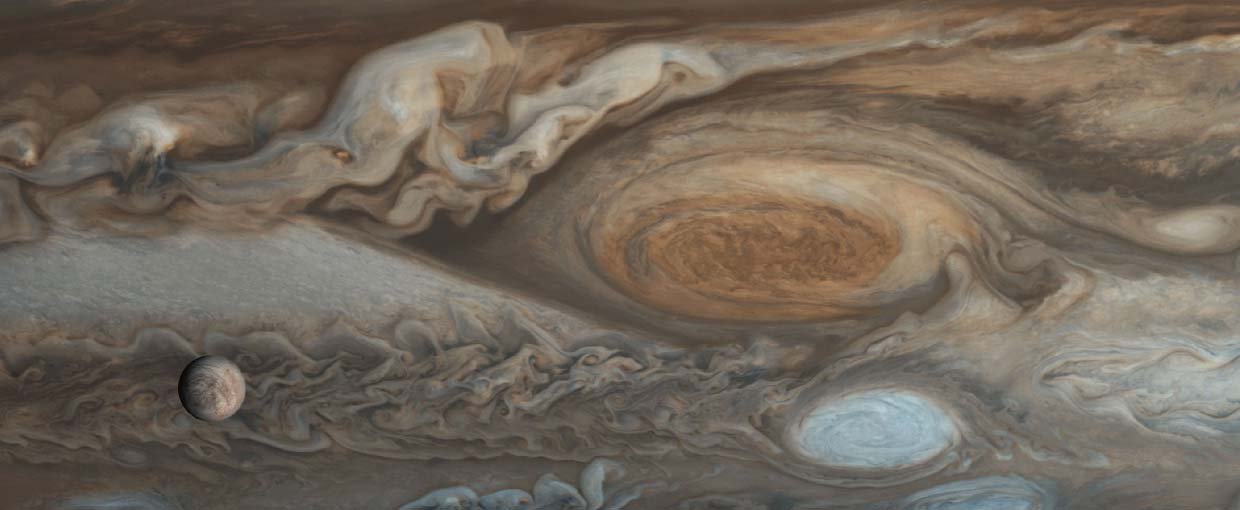
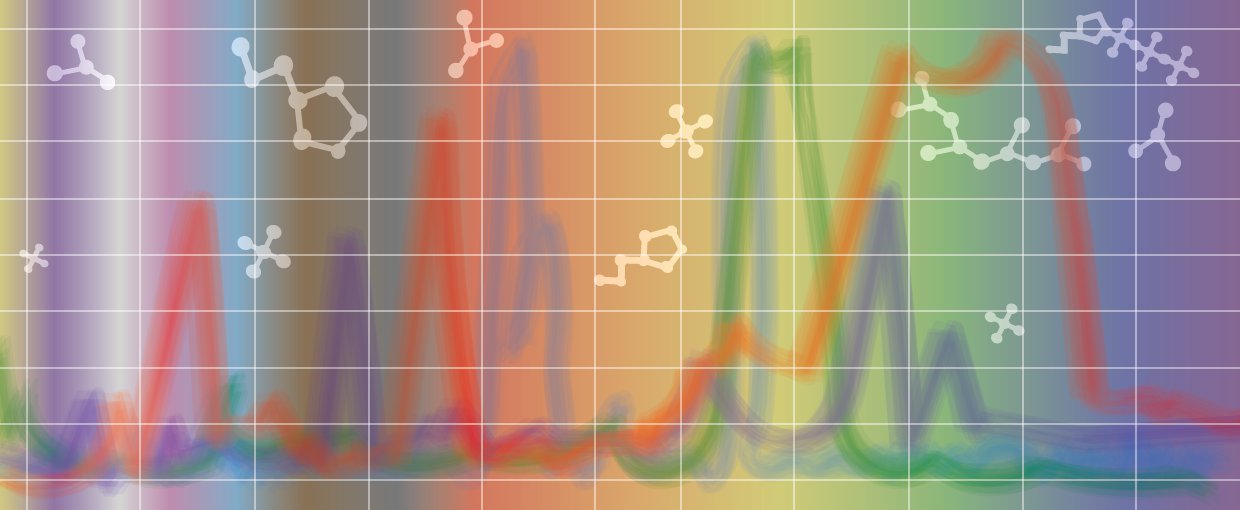
A volcanically active planet is shown in closeup at the left side of the image with glowing eruptions and lines of lava on the surface. To the right and in the distance is a faint blue glowing ball representing the more massive planet in the system.Sixteen frames from Voyager 1's flyby of Jupiter in 1979 were merged to create this image. Jupiter's Great Red Spot is visible in the center. Jupiter's moon Europa can be seen in the foreground at the bottom left of the image.The frame is a horizontal rainbow of color on a grid. Shadows of molecules can be seen through the light as well as the jagged peaks and troughs of spectral lines.
Fizzy Super Earths and Lava Worlds“Fizzy Super-Earths: Impacts of Magma Composition on the Bulk Density and Structure of Lava Worlds.” in The Astrophysical Journal.01/03
Identifying Hydrothermal Activity on Icy Ocean Worlds“Ethene-ethanol ratios as potential indicators of hydrothermal activity at Enceladus, Europa, and other icy ocean worlds.” In Icarus.02/03
NASA Raman Spectroscopic Database"The NASA Raman spectroscopic database: Ramdb version 1.00.” In Icarus.03/03
NextPrevious
Go Explore
May 2013Presentation of the 2012 Paleontological Society Medal to Bill Schopf

Bottjer, D. (2013). Journal of Paleontology, 87(3), 526–529. doi:10.1666/0022-3360-87.3.526

Novel high-temperature and pressure-compatible ultrasonic levitator apparatus coupled to Raman and Fourier transform infrared spectrometers

Brotton, S. J., & Kaiser, R. I. (2013). Review of Scientific Instruments, 84(5), 055114. doi:10.1063/1.4804647

SPECTRO-ASTROMETRY OF WATER IN DR TAURI

Brown, L. R., Troutman, M. R., & Gibb, E. L. (2013). The Astrophysical Journal, 770(1), L14. doi:10.1088/2041-8205/770/1/l14

VERY LOW MASS STELLAR AND SUBSTELLAR COMPANIONS TO SOLAR-LIKE STARS FROM MARVELS. V. A LOW ECCENTRICITY BROWN DWARF FROM THE DRIEST PART OF THE DESERT, MARVELS-6b

De Lee, N., Ge, J., Crepp, J. R., Eastman, J., Esposito, M., FemeníA, B., … Fleming, S. W. (2013). The Astronomical Journal, 145(6), 155. doi:10.1088/0004-6256/145/6/155

GASPS—A Herschel Survey of Gas and Dust in Protoplanetary Disks: Summary and Initial Statistics

Dent, W. R. F., Thi, W. F., Kamp, I., Williams, J. P., Menard, F., Andrews, S., … Ardila, D. (2013). Publications of the Astronomical Society of the Pacific, 125(927), 477–505. doi:10.1086/670826

Paleoredox and pyritization of soft-bodied fossils in the Ordovician Frankfort Shale of New York

Farrell, U. C., Briggs, D. E. G., Hammarlund, E. U., Sperling, E. A., & Gaines, R. R. (2013). American Journal of Science, 313(5), 452–489. doi:10.2475/05.2013.02

H/D methane isotopologues dissolved in magmatic fluids: Stable hydrogen isotope fractionations in the Earth's interior

Foustoukos, D. I., & Mysen, B. O. (2013). American Mineralogist, 98(5-6), 946–954. doi:10.2138/am.2013.4419

Sound velocities in solid hydrogen under pressure

Freiman, Y. A., Grechnev, A., Tretyak, S. M., Goncharov, A. F., & Hemley, R. J. (2013). Low Temp. Phys., 39(5), 423. doi:10.1063/1.4807043

The Formation and Dynamics of Super-Earth Planets

Haghighipour, N. (2013). Annual Review of Earth and Planetary Sciences, 41(1), 469–495. doi:10.1146/annurev-earth-042711-105340

RNA with iron(II) as a cofactor catalyses electron transfer

Hsiao, C., Chou, I-C., Okafor, C. D., Bowman, J. C., O'Neill, E. B., Athavale, S. S., … Petrov, A. S. (2013). Nature Chem, 5(6), 525–528. doi:10.1038/nchem.1649