

This website is currently being migrated. For the most up-to-date astrobiology news, resources, and community announcements, please visit our new home at science.nasa.gov/astrobiology

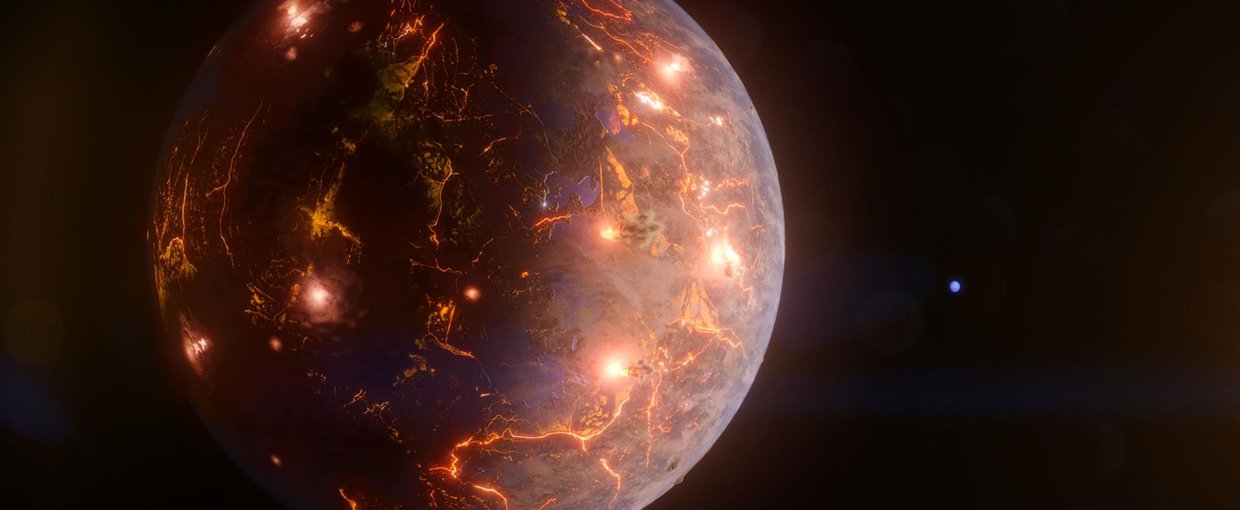
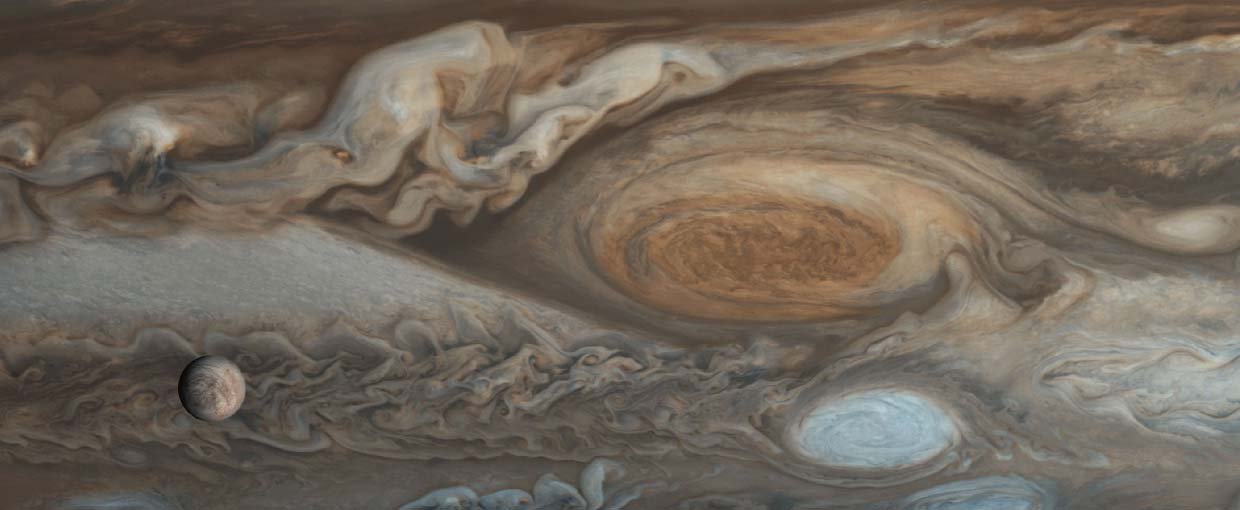
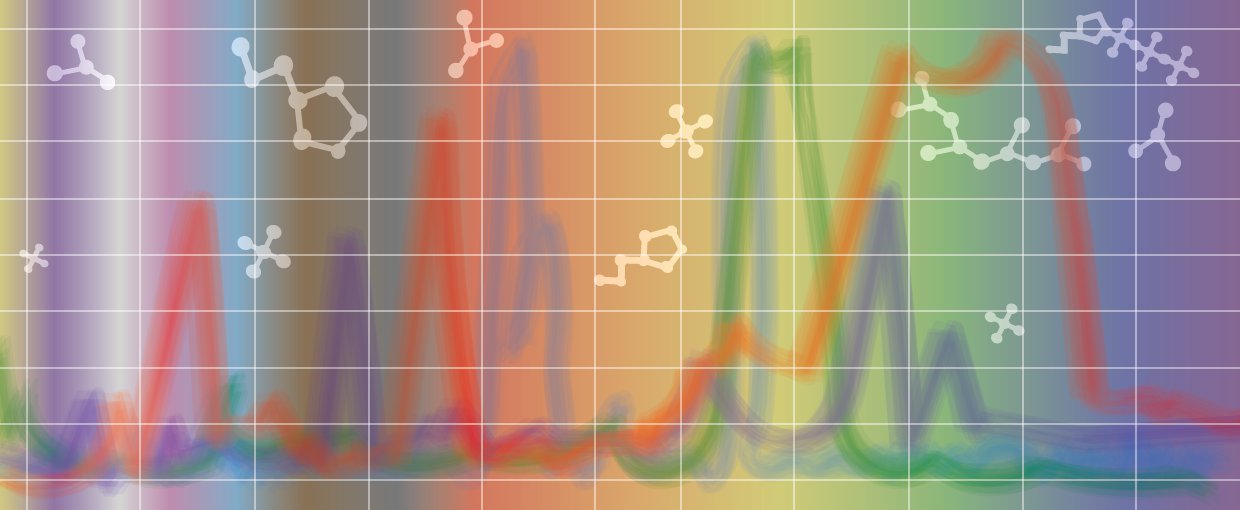
A volcanically active planet is shown in closeup at the left side of the image with glowing eruptions and lines of lava on the surface. To the right and in the distance is a faint blue glowing ball representing the more massive planet in the system.Sixteen frames from Voyager 1's flyby of Jupiter in 1979 were merged to create this image. Jupiter's Great Red Spot is visible in the center. Jupiter's moon Europa can be seen in the foreground at the bottom left of the image.The frame is a horizontal rainbow of color on a grid. Shadows of molecules can be seen through the light as well as the jagged peaks and troughs of spectral lines.
Fizzy Super Earths and Lava Worlds“Fizzy Super-Earths: Impacts of Magma Composition on the Bulk Density and Structure of Lava Worlds.” in The Astrophysical Journal.01/03
Identifying Hydrothermal Activity on Icy Ocean Worlds“Ethene-ethanol ratios as potential indicators of hydrothermal activity at Enceladus, Europa, and other icy ocean worlds.” In Icarus.02/03
NASA Raman Spectroscopic Database"The NASA Raman spectroscopic database: Ramdb version 1.00.” In Icarus.03/03
NextPrevious
Go Explore
July 2013 Precambrian-Cambrian boundary interval occurrence and form of the enigmatic tubular body fossil Shaanxilithes ningqiangensis from the Lesser Himalaya of India

Tarhan, L. G., Hughes, N. C., Myrow, P. M., Bhargava, O. N., Ahluwalia, A. D., & Kudryavtsev, A. B. (2013). Palaeontology, 57(2), 283–298. doi:10.1111/pala.12066

Isotope Ratios of H, C, and O in CO2 and H2O of the Martian Atmosphere

Webster, C. R., Mahaffy, P. R., Flesch, G. J., Niles, P. B., Jones, J. H., Leshin, L. A., … Atreya, S. K. (2013). Science, 341(6143), 260–263. doi:10.1126/science.1237961

Augmenting the Genetic Toolbox for Sulfolobus islandicus with a Stringent Positive Selectable Marker for Agmatine Prototrophy

Zhang, C., Cooper, T. E., Krause, D. J., & Whitaker, R. J. (2013). Applied and Environmental Microbiology, 79(18), 5539–5549. doi:10.1128/aem.01608-13

June 2013Evidence for reactive reduced phosphorus species in the early Archean ocean

Pasek, M. A., Harnmeijer, J. P., Buick, R., Gull, M., & Atlas, Z. (2013). Evidence for reactive reduced phosphorus species in the early Archean ocean. Proceedings of the National Academy of Sciences, 110(25), 10089–10094. doi:10.1073/pnas.1303904110

TWO PLANETARY COMPANIONS AROUND THE K7 DWARF GJ 221: A HOT SUPER-EARTH AND A CANDIDATE IN THE SUB-SATURN DESERT RANGE

Arriagada, P., Anglada-Escudé, G., Butler, R. P., Crane, J. D., Shectman, S. A., Thompson, I., … Wende, S. (2013). The Astrophysical Journal, 771(1), 42. doi:10.1088/0004-637x/771/1/42

High-Sensitivity Raman Spectrometer To Study Pristine and Irradiated Interstellar Ice Analogs

Bennett, C. J., Brotton, S. J., Jones, B. M., Misra, A. K., Sharma, S. K., & Kaiser, R. I. (2013). Anal. Chem., 85(12), 5659–5665. doi:10.1021/ac303259y

Coordinated analyses of Antarctic sediments as Mars analog materials using reflectance spectroscopy and current flight-like instruments for CheMin, SAM and MOMA

Bishop, J. L., Franz, H. B., Goetz, W., Blake, D. F., Freissinet, C., Steininger, H., … Goesmann, F. (2013). Icarus, 224(2), 309–325. doi:10.1016/j.icarus.2012.05.014

Corrigendum to “Turnstiles and bifurcators: The disequilibrium converting engines that put metabolism on the road” [Biochim. Biophys. Acta 1827 (2013) 62–78]

Branscomb, E., & Russell, M. J. (2013). Biochimica et Biophysica Acta (BBA) - Bioenergetics, 1827(6), 806. doi:10.1016/j.bbabio.2013.02.017

Population structure of the oldest known macroscopic communities from Mistaken Point, Newfoundland

Darroch, S. A. F., Laflamme, M., & Clapham, M. E. (2013). Paleobiology, 39(4), 591–608. doi:10.1666/12051

THE 0.5-2.22 μm SCATTERED LIGHT SPECTRUM OF THE DISK AROUND TW Hya: DETECTION OF A PARTIALLY FILLED DISK GAP AT 80 AU

Debes, J. H., Jang-Condell, H., Weinberger, A. J., Roberge, A., & Schneider, G. (2013). The Astrophysical Journal, 771(1), 45. doi:10.1088/0004-637x/771/1/45