

This website is currently being migrated. For the most up-to-date astrobiology news, resources, and community announcements, please visit our new home at science.nasa.gov/astrobiology

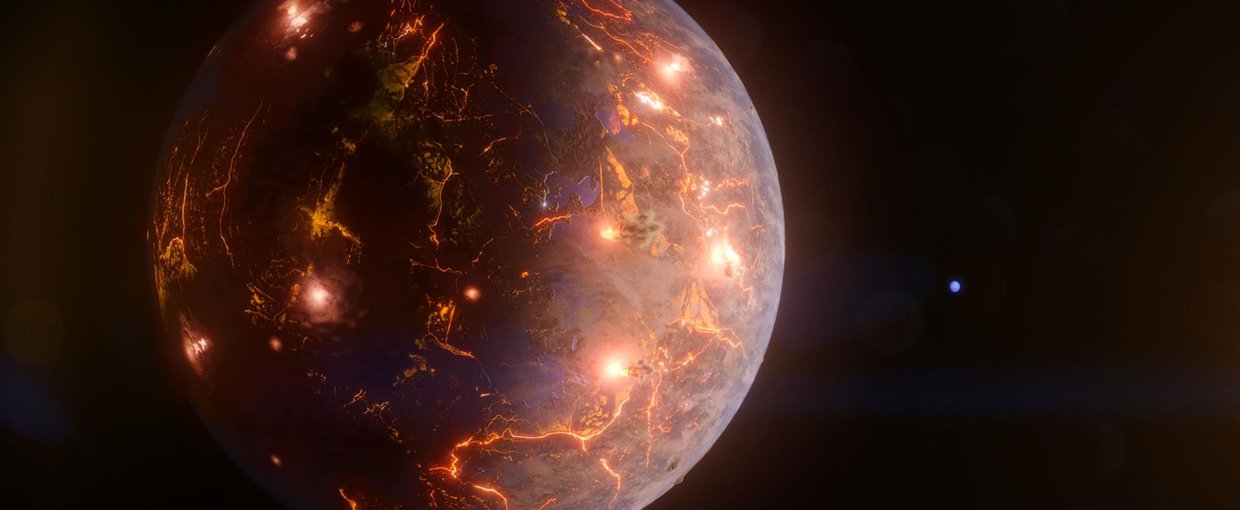
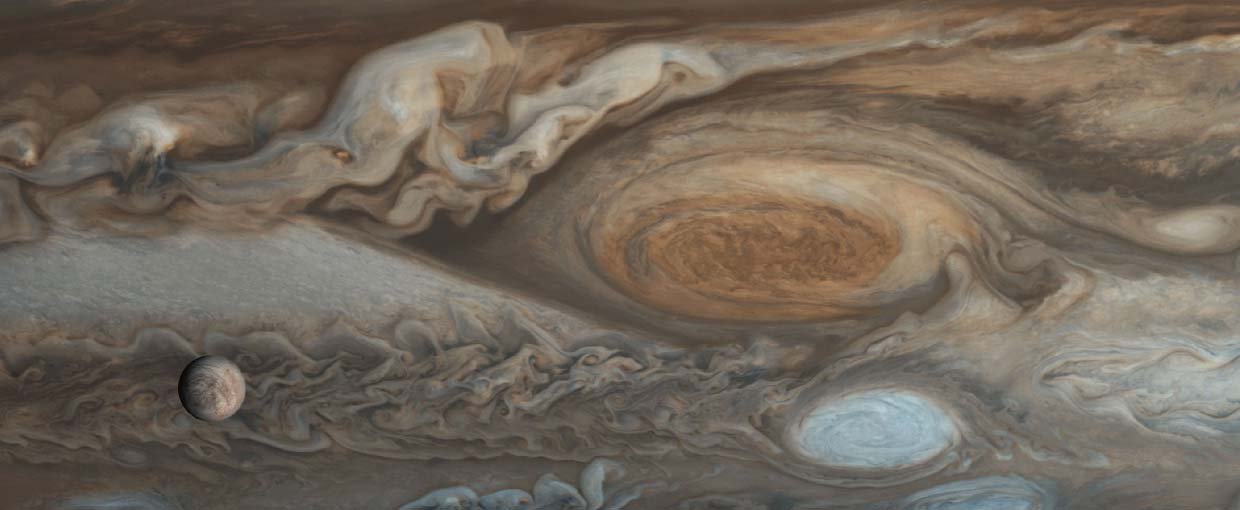
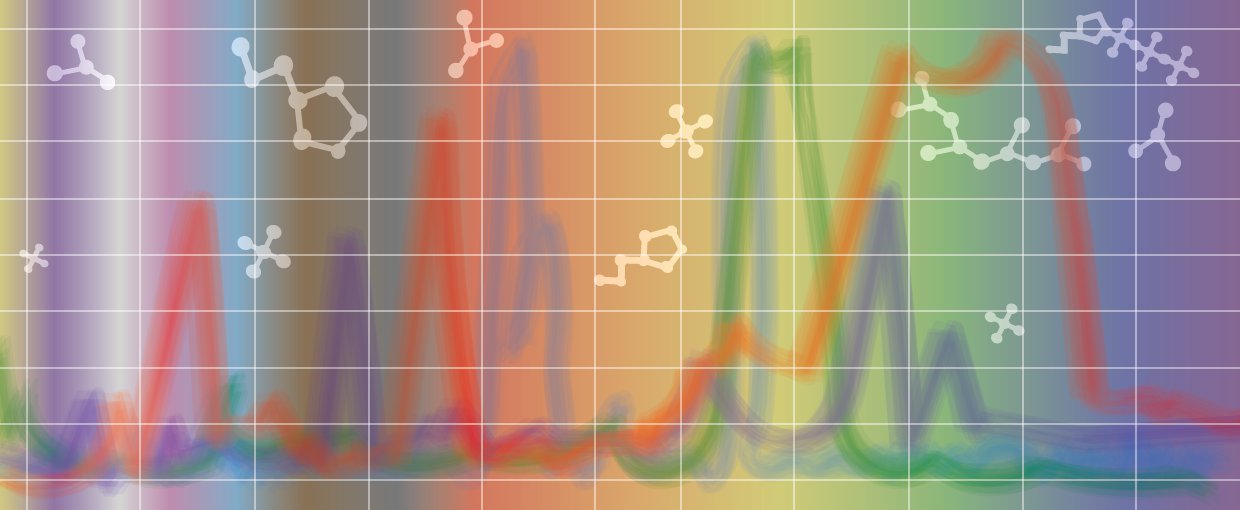
A volcanically active planet is shown in closeup at the left side of the image with glowing eruptions and lines of lava on the surface. To the right and in the distance is a faint blue glowing ball representing the more massive planet in the system.Sixteen frames from Voyager 1's flyby of Jupiter in 1979 were merged to create this image. Jupiter's Great Red Spot is visible in the center. Jupiter's moon Europa can be seen in the foreground at the bottom left of the image.The frame is a horizontal rainbow of color on a grid. Shadows of molecules can be seen through the light as well as the jagged peaks and troughs of spectral lines.
Fizzy Super Earths and Lava Worlds“Fizzy Super-Earths: Impacts of Magma Composition on the Bulk Density and Structure of Lava Worlds.” in The Astrophysical Journal.01/03
Identifying Hydrothermal Activity on Icy Ocean Worlds“Ethene-ethanol ratios as potential indicators of hydrothermal activity at Enceladus, Europa, and other icy ocean worlds.” In Icarus.02/03
NASA Raman Spectroscopic Database"The NASA Raman spectroscopic database: Ramdb version 1.00.” In Icarus.03/03
NextPrevious
Go Explore
July 2013 HERSCHEL 's “COLD DEBRIS DISKS”: BACKGROUND GALAXIES OR QUIESCENT RIMS OF PLANETARY SYSTEMS?

Krivov, A. V., Eiroa, C., Löhne, T., Marshall, J. P., Montesinos, B., Del Burgo, C., … Absil, O. (2013). The Astrophysical Journal, 772(1), 32. doi:10.1088/0004-637x/772/1/32

Texture-specific isotopic compositions in 3.4Gyr old organic matter support selective preservation in cell-like structures

Lepot, K., Williford, K. H., Ushikubo, T., Sugitani, K., Mimura, K., Spicuzza, M. J., & Valley, J. W. (2013). Geochimica et Cosmochimica Acta, 112(None), 66–86. doi:10.1016/j.gca.2013.03.004

Archaeal and bacterial glycerol dialkyl glycerol tetraether lipids in chimneys of the Lost City Hydrothermal Field

Lincoln, S. A., Bradley, A. S., Newman, S. A., & Summons, R. E. (2013). Organic Geochemistry, 60(None), 45–53. doi:10.1016/j.orggeochem.2013.04.010

Formation of sharp eccentric rings in debris disks with gas but without planets

Lyra, W., & Kuchner, M. (2013). Nature, 499(7457), 184–187. doi:10.1038/nature12281

Abundance and Isotopic Composition of Gases in the Martian Atmosphere from the Curiosity Rover

Mahaffy, P. R., Webster, C. R., Atreya, S. K., Franz, H., Wong, M., Conrad, P. G., … Harpold, D. (2013). Science, 341(6143), 263–266. doi:10.1126/science.1237966

CENTAURS AND SCATTERED DISK OBJECTS IN THE THERMAL INFRARED: ANALYSIS OF WISE / NEOWISE OBSERVATIONS

None (2013). The Astrophysical Journal, 773(1), 22. doi:10.1088/0004-637x/773/1/22

Imaging of the CO Snow Line in a Solar Nebula Analog

Qi, C., Oberg, K. I., Wilner, D. J., d'Alessio, P., Bergin, E., Andrews, S. M., … Blake, G. A. (2013). Science, 341(6146), 630–632. doi:10.1126/science.1239560

UNDERSTANDING THE ORIGIN OF THE [O I] LOW-VELOCITY COMPONENT FROM T TAURI STARS

Rigliaco, E., Pascucci, I., Gorti, U., Edwards, S., & Hollenbach, D. (2013). The Astrophysical Journal, 772(1), 60. doi:10.1088/0004-637x/772/1/60

Gas and dust in the TW Hydrae association as seen by the Herschel Space Observatory

Riviere-Marichalar, P., Pinte, C., Barrado, D., Thi, W. F., Eiroa, C., Kamp, I., … Montesinos, B. (2013). A&A, 555(None), A67. doi:10.1051/0004-6361/201321506

Thermal-Stable Proteins of Fruit of Long-Living Sacred Lotus Nelumbo nucifera Gaertn var. China Antique

Shen-Miller, J., Lindner, P., Xie, Y., Villa, S., Wooding, K., Clarke, S. G., … Loo, R. R. O. (2013). Tropical Plant Biology, 6(2-3), 69–84. doi:10.1007/s12042-013-9124-2