

This website is currently being migrated. For the most up-to-date astrobiology news, resources, and community announcements, please visit our new home at science.nasa.gov/astrobiology

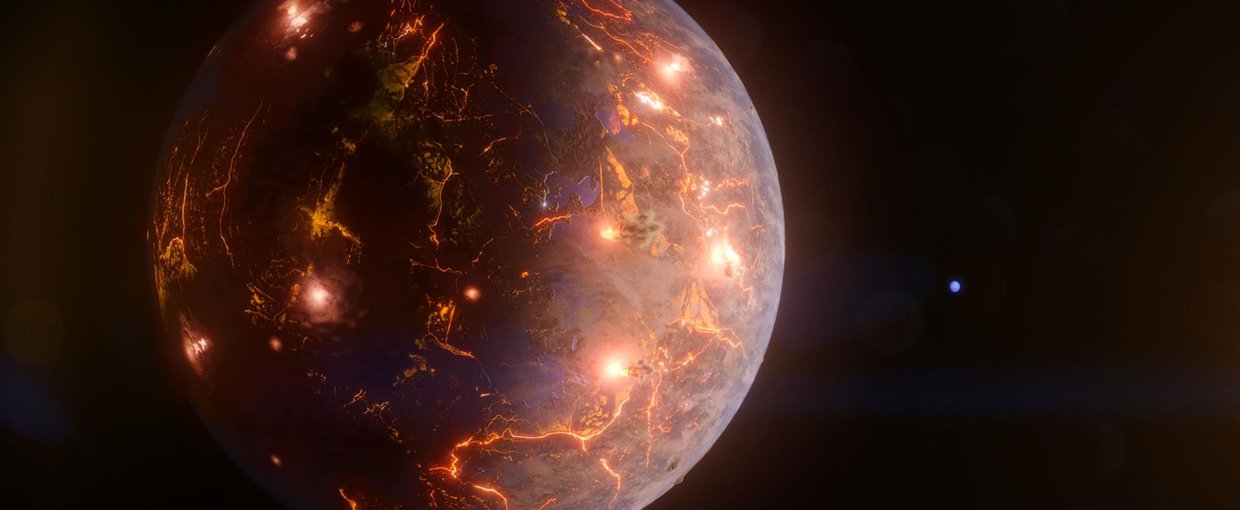
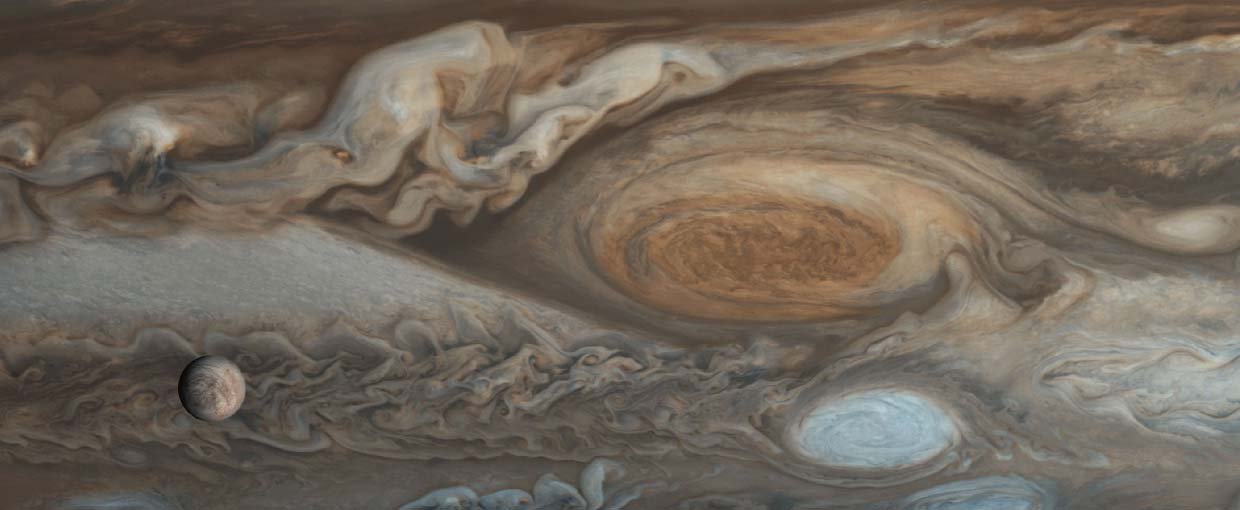
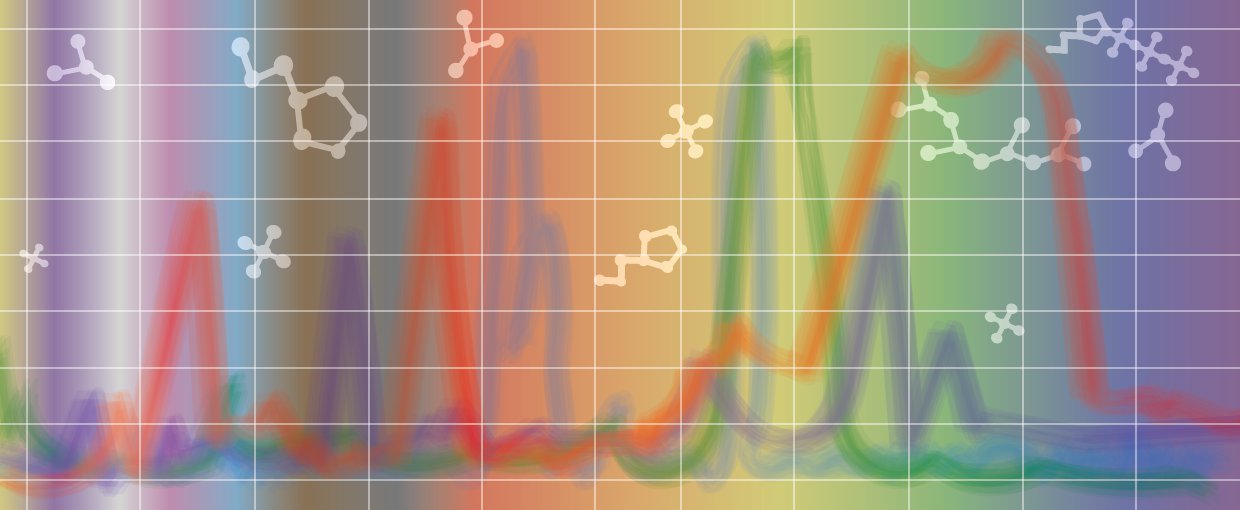
A volcanically active planet is shown in closeup at the left side of the image with glowing eruptions and lines of lava on the surface. To the right and in the distance is a faint blue glowing ball representing the more massive planet in the system.Sixteen frames from Voyager 1's flyby of Jupiter in 1979 were merged to create this image. Jupiter's Great Red Spot is visible in the center. Jupiter's moon Europa can be seen in the foreground at the bottom left of the image.The frame is a horizontal rainbow of color on a grid. Shadows of molecules can be seen through the light as well as the jagged peaks and troughs of spectral lines.
Fizzy Super Earths and Lava Worlds“Fizzy Super-Earths: Impacts of Magma Composition on the Bulk Density and Structure of Lava Worlds.” in The Astrophysical Journal.01/03
Identifying Hydrothermal Activity on Icy Ocean Worlds“Ethene-ethanol ratios as potential indicators of hydrothermal activity at Enceladus, Europa, and other icy ocean worlds.” In Icarus.02/03
NASA Raman Spectroscopic Database"The NASA Raman spectroscopic database: Ramdb version 1.00.” In Icarus.03/03
NextPrevious
Go Explore
August 2013SECULAR BEHAVIOR OF EXOPLANETS: SELF-CONSISTENCY AND COMPARISONS WITH THE PLANET-PLANET SCATTERING HYPOTHESIS

Timpe, M., Barnes, R., Kopparapu, R., Raymond, S. N., Greenberg, R., & Gorelick, N. (2013). The Astronomical Journal, 146(3), 63. doi:10.1088/0004-6256/146/3/63

THE GEMINI PLANET-FINDING CAMPAIGN: THE FREQUENCY OF GIANT PLANETS AROUND DEBRIS DISK STARS

Wahhaj, Z., Liu, M. C., Nielsen, E. L., Biller, B. A., Hayward, T. L., Close, L. M., … Males, J. R. (2013). The Astrophysical Journal, 773(2), 179. doi:10.1088/0004-637x/773/2/179

OPTICAL AND NEAR-INFRARED SHOCKS IN THE L988 CLOUD COMPLEX

Walawender, J., Reipurth, B., & Bally, J. (2013). The Astronomical Journal, 146(3), 66. doi:10.1088/0004-6256/146/3/66

ICE AND DUST IN THE PRESTELLAR DARK CLOUD LYNDS 183: PREPLANETARY MATTER AT THE LOWEST TEMPERATURES

Whittet, D. C. B., Poteet, C. A., Chiar, J. E., Pagani, L., Bajaj, V. M., Horne, D., … Shenoy, S. S. (2013). The Astrophysical Journal, 774(2), 102. doi:10.1088/0004-637x/774/2/102

Crystal structure, Raman and FTIR spectroscopy, and equations of state of OH-bearing MgSiO3 akimotoite

Ye, Y., Smyth, J. R., Jacobsen, S. D., Panero, W. R., Brown, D. A., Katsura, T., … Chang, Y-Y. (2013). Contrib Mineral Petrol, 166(5), 1375–1388. doi:10.1007/s00410-013-0933-y

July 2013A Necessary Condition for Coexistence of Autocatalytic Replicators in a Prebiotic Environment

Hernandez, A., & Grover, M. (2013). A Necessary Condition for Coexistence of Autocatalytic Replicators in a Prebiotic Environment. Life, 3(3), 403–420. doi:10.3390/life3030403

Phylogenetic diversity and functional gene patterns of sulfur-oxidizing subseafloor Epsilonproteobacteria in diffuse hydrothermal vent fluids

Akerman, N. H., Butterfield, D. A., & Huber, J. A. (2013). Phylogenetic diversity and functional gene patterns of sulfur-oxidizing subseafloor Epsilonproteobacteria in diffuse hydrothermal vent fluids. Frontiers in Microbiology, 4, None. doi:10.3389/fmicb.2013.00185

The Mojave Vadose Zone: A Subsurface Biosphere Analogue for Mars

Abbey, W., Salas, E., Bhartia, R., & Beegle, L. W. (2013). Astrobiology, 13(7), 637–646. doi:10.1089/ast.2012.0948

Resolving Prokaryotic Taxonomy without rRNA: Longer Oligonucleotide Word Lengths Improve Genome and Metagenome Taxonomic Classification

Alsop, E. B., & Raymond, J. (2013). PLoS ONE, 8(7), e67337. doi:10.1371/journal.pone.0067337

Properties of martian slope streak populations

Bergonio, J. R., Rottas, K. M., & Schorghofer, N. (2013). Icarus, 225(1), 194–199. doi:10.1016/j.icarus.2013.03.023