

This website is currently being migrated. For the most up-to-date astrobiology news, resources, and community announcements, please visit our new home at science.nasa.gov/astrobiology

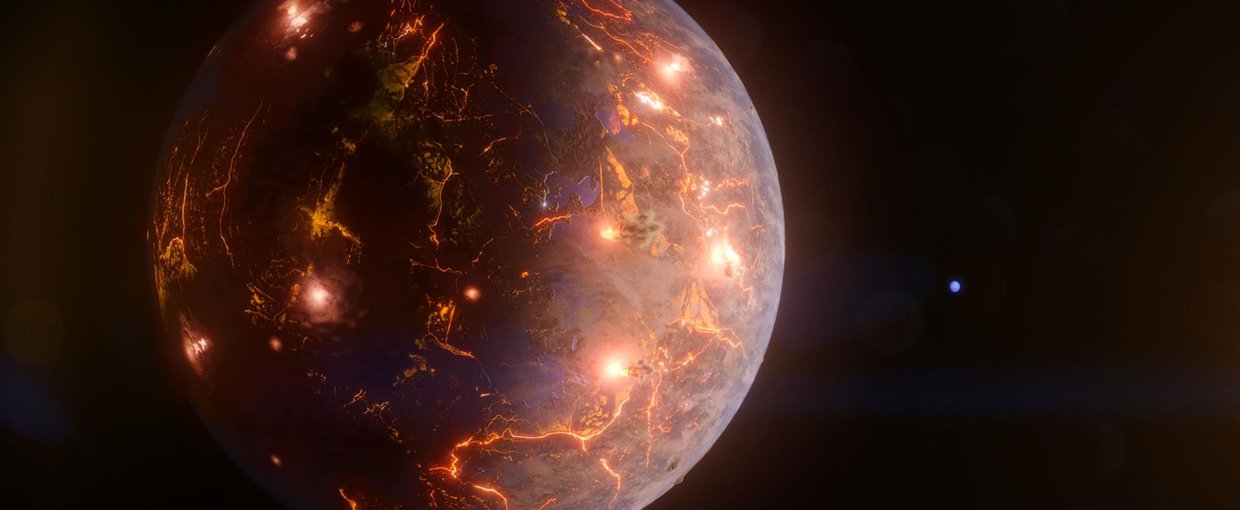
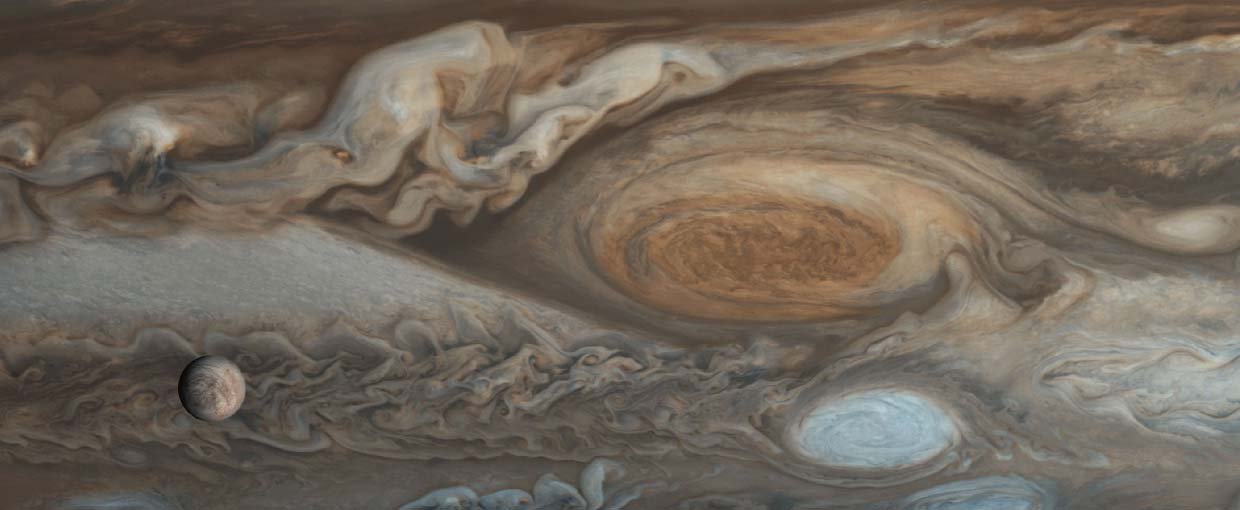
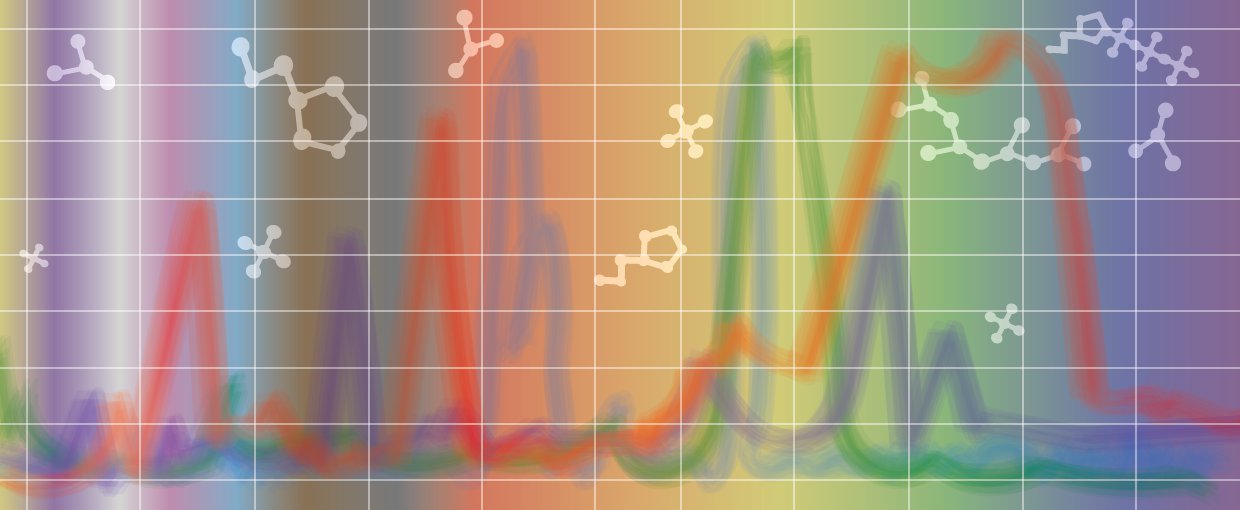
A volcanically active planet is shown in closeup at the left side of the image with glowing eruptions and lines of lava on the surface. To the right and in the distance is a faint blue glowing ball representing the more massive planet in the system.Sixteen frames from Voyager 1's flyby of Jupiter in 1979 were merged to create this image. Jupiter's Great Red Spot is visible in the center. Jupiter's moon Europa can be seen in the foreground at the bottom left of the image.The frame is a horizontal rainbow of color on a grid. Shadows of molecules can be seen through the light as well as the jagged peaks and troughs of spectral lines.
Fizzy Super Earths and Lava Worlds“Fizzy Super-Earths: Impacts of Magma Composition on the Bulk Density and Structure of Lava Worlds.” in The Astrophysical Journal.01/03
Identifying Hydrothermal Activity on Icy Ocean Worlds“Ethene-ethanol ratios as potential indicators of hydrothermal activity at Enceladus, Europa, and other icy ocean worlds.” In Icarus.02/03
NASA Raman Spectroscopic Database"The NASA Raman spectroscopic database: Ramdb version 1.00.” In Icarus.03/03
NextPrevious
Go Explore
October 2013CALCULATING THE HABITABLE ZONE OF BINARY STAR SYSTEMS. II. P-TYPE BINARIES

Haghighipour, N., & Kaltenegger, L. (2013). The Astrophysical Journal, 777(2), 166. doi:10.1088/0004-637x/777/2/166

Three milieux for interstellar chemistry: gas, dust, and ice

Herbst, E. (2014). Phys. Chem. Chem. Phys., 16(8), 3344–3359. doi:10.1039/c3cp54065k

Stress granules form in Brachionus manjavacas (Rotifera) in response to a variety of stressors

Jones, B. L., VanLoozen, J., Kim, M. H., Miles, S. J., Dunham, C. M., Williams, L. D., & Snell, T. W. (2013). Comparative Biochemistry and Physiology Part A: Molecular & Integrative Physiology, 166(2), 375–384. doi:10.1016/j.cbpa.2013.07.009

CALCULATING THE HABITABLE ZONE OF BINARY STAR SYSTEMS. I. S-TYPE BINARIES

Kaltenegger, L., & Haghighipour, N. (2013). The Astrophysical Journal, 777(2), 165. doi:10.1088/0004-637x/777/2/165

SOLAR SYSTEM MOONS AS ANALOGS FOR COMPACT EXOPLANETARY SYSTEMS

Kane, S. R., Hinkel, N. R., & Raymond, S. N. (2013). The Astronomical Journal, 146(5), 122. doi:10.1088/0004-6256/146/5/122

Paschen-Back effect in the CrH molecule and its application for magnetic field measurements on stars, brown dwarfs, and hot exoplanets

Kuzmychov, O., & Berdyugina, S. V. (2013). A&A, 558(None), A120. doi:10.1051/0004-6361/201220041

Thymine and Other Prebiotic Molecules Produced from the Ultraviolet Photo-Irradiation of Pyrimidine in Simple Astrophysical Ice Analogs

Materese, C. K., Nuevo, M., Bera, P. P., Lee, T. J., & Sandford, S. A. (2013). Astrobiology, 13(10), 948–962. doi:10.1089/ast.2013.1044

OUTGASSING BEHAVIOR OF C/2012 S1 (ISON) FROM 2011 SEPTEMBER TO 2013 JUNE

Meech, K. J., Yang, B., Kleyna, J., Ansdell, M., Chiang, H-F., Hainaut, O., … Vincent, J-B. (2013). The Astrophysical Journal, 776(2), L20. doi:10.1088/2041-8205/776/2/l20

REEXAMINATION OF INDUCTION HEATING OF PRIMITIVE BODIES IN PROTOPLANETARY DISKS

Menzel, R. L., & Roberge, W. G. (2013). The Astrophysical Journal, 776(2), 89. doi:10.1088/0004-637x/776/2/89

REEXAMINATION OF INDUCTION HEATING OF PRIMITIVE BODIES IN PROTOPLANETARY DISKS

Menzel, R. L., & Roberge, W. G. (2013). The Astrophysical Journal, 776(2), 89. doi:10.1088/0004-637x/776/2/89