

This website is currently being migrated. For the most up-to-date astrobiology news, resources, and community announcements, please visit our new home at science.nasa.gov/astrobiology

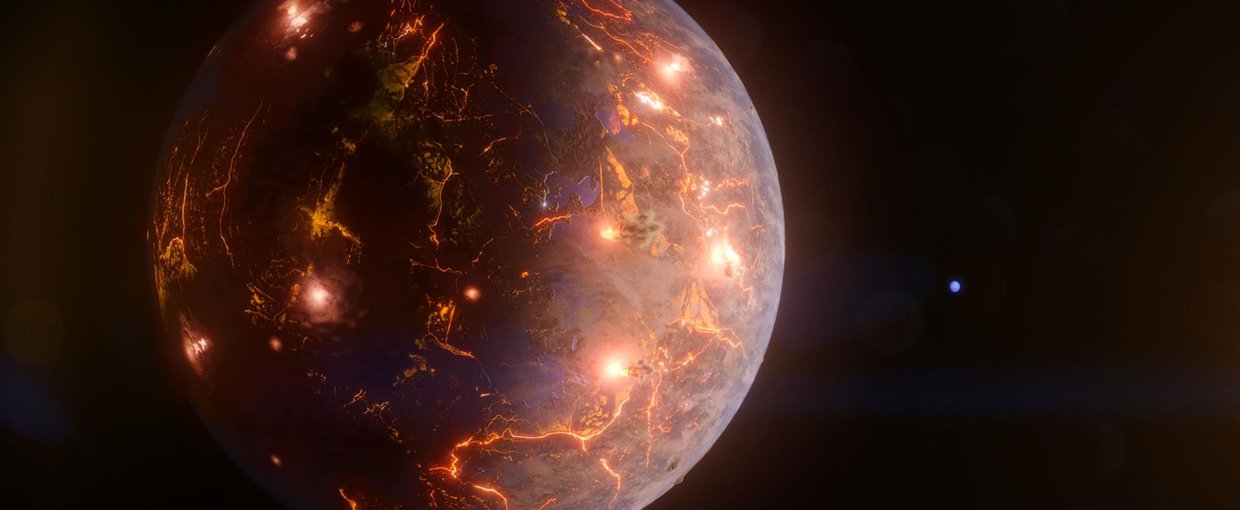
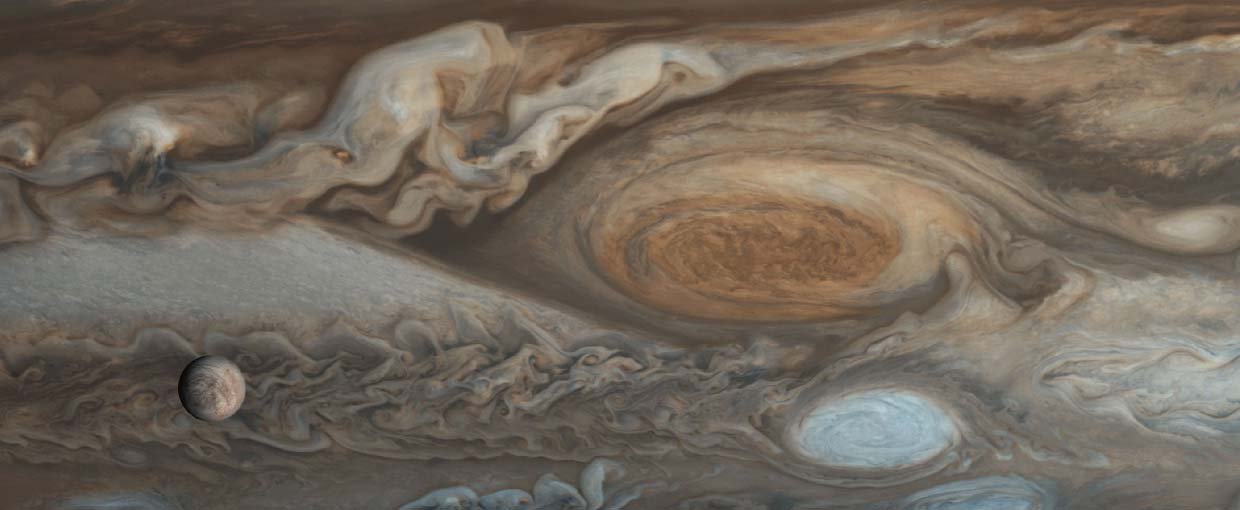
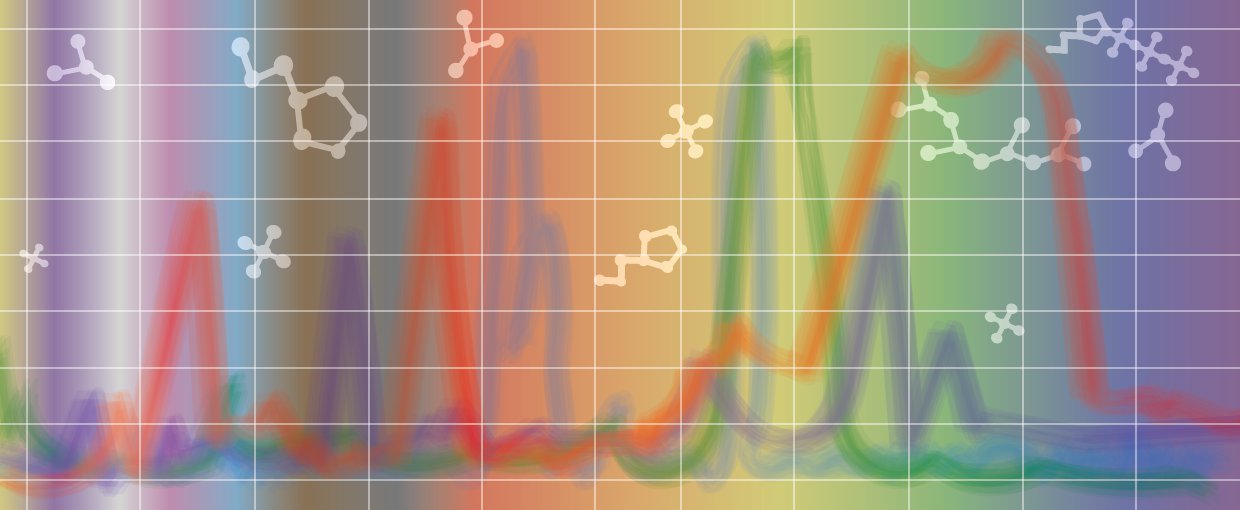
A volcanically active planet is shown in closeup at the left side of the image with glowing eruptions and lines of lava on the surface. To the right and in the distance is a faint blue glowing ball representing the more massive planet in the system.Sixteen frames from Voyager 1's flyby of Jupiter in 1979 were merged to create this image. Jupiter's Great Red Spot is visible in the center. Jupiter's moon Europa can be seen in the foreground at the bottom left of the image.The frame is a horizontal rainbow of color on a grid. Shadows of molecules can be seen through the light as well as the jagged peaks and troughs of spectral lines.
Fizzy Super Earths and Lava Worlds“Fizzy Super-Earths: Impacts of Magma Composition on the Bulk Density and Structure of Lava Worlds.” in The Astrophysical Journal.01/03
Identifying Hydrothermal Activity on Icy Ocean Worlds“Ethene-ethanol ratios as potential indicators of hydrothermal activity at Enceladus, Europa, and other icy ocean worlds.” In Icarus.02/03
NASA Raman Spectroscopic Database"The NASA Raman spectroscopic database: Ramdb version 1.00.” In Icarus.03/03
NextPrevious
Go Explore
November 2013The oxygen isotope equilibrium fractionation between sulfite species and water

Müller, I. A., Brunner, B., Breuer, C., Coleman, M., & Bach, W. (2013). Geochimica et Cosmochimica Acta, 120(None), 562–581. doi:10.1016/j.gca.2013.06.037

Preliminary organic compound analysis of microparticles returned from Asteroid 25143 Itokawa by the Hayabusa mission

Naraoka, H., Mita, H., Hamase, K., Mita, M., Yabuta, H., Saito, K., … Fukushima, K. (2012). GEOCHEMICAL JOURNAL, 46(1), 61–72. doi:10.2343/geochemj.1.0134

Quadruple sulfur isotope constraints on the origin and cycling of volatile organic sulfur compounds in a stratified sulfidic lake

Oduro, H., Kamyshny, A., Zerkle, A. L., Li, Y., & Farquhar, J. (2013). Geochimica et Cosmochimica Acta, 120(None), 251–262. doi:10.1016/j.gca.2013.06.039

MEMS harsh environment sensor array-enabled hot spring mapping

Oiler, J., Shock, E., Hartnett, H., & Yu, H. (2013). 2013 IEEE SENSORS. doi:10.1109/icsens.2013.6688332

Lipidomics for Geochemistry

Pearson, A. (2014). Treatise on Geochemistry, None(None), 291–336. doi:10.1016/b978-0-08-095975-7.01022-6

Biofilm Growth and Fossil Form

Petroff, A. P., Beukes, N. J., Rothman, D. H., & Bosak, T. (2013). Physical Review X, 3(4), None. doi:10.1103/physrevx.3.041012

Warming early Mars with CO2 and H2

Ramirez, R. M., Kopparapu, R., Zugger, M. E., Robinson, T. D., Freedman, R., & Kasting, J. F. (2013). Nature Geosci, 7(1), 59–63. doi:10.1038/ngeo2000

Nitrogen solubility in molten metal and silicate at high pressure and temperature

Roskosz, M., Bouhifd, M. A., Jephcoat, A. P., Marty, B., & Mysen, B. O. (2013). Geochimica et Cosmochimica Acta, 121(None), 15–28. doi:10.1016/j.gca.2013.07.007

The HITRAN2012 molecular spectroscopic database

Rothman, L. S., Gordon, I. E., Babikov, Y., Barbe, A., Chris Benner, D., Bernath, P. F., … Birk, M. (2013). Journal of Quantitative Spectroscopy and Radiative Transfer, 130(None), 4–50. doi:10.1016/j.jqsrt.2013.07.002

Modeling of nitrogen compounds in cometary atmospheres: Fluorescence models of ammonia (NH3), hydrogen cyanide (HCN), hydrogen isocyanide (HNC) and cyanoacetylene (HC3N)

Villanueva, G. L., Magee-Sauer, K., & Mumma, M. J. (2013). Journal of Quantitative Spectroscopy and Radiative Transfer, 129(None), 158–168. doi:10.1016/j.jqsrt.2013.06.010