

This website is currently being migrated. For the most up-to-date astrobiology news, resources, and community announcements, please visit our new home at science.nasa.gov/astrobiology

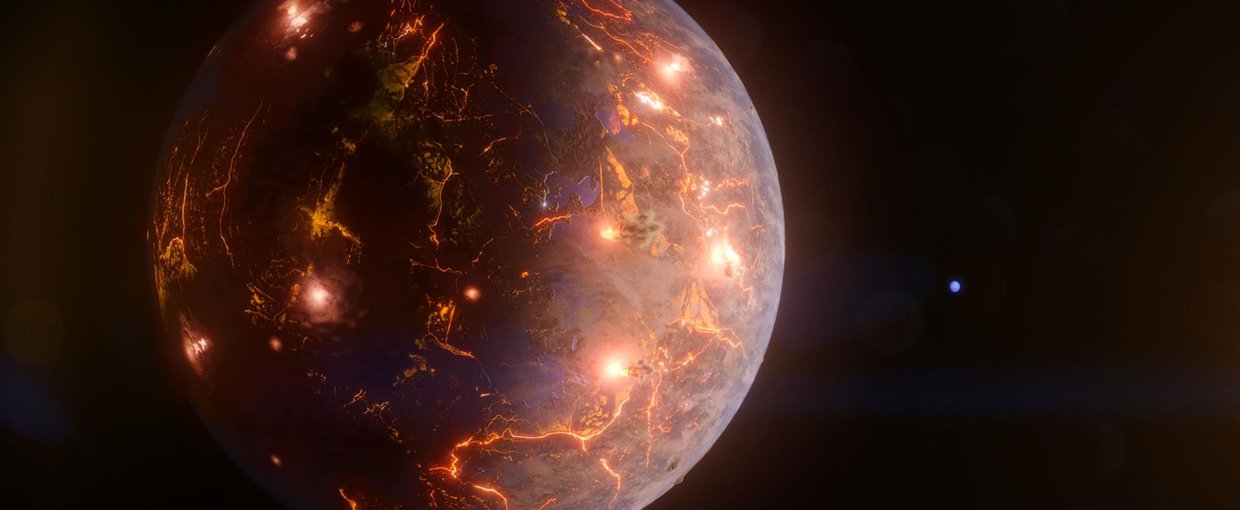
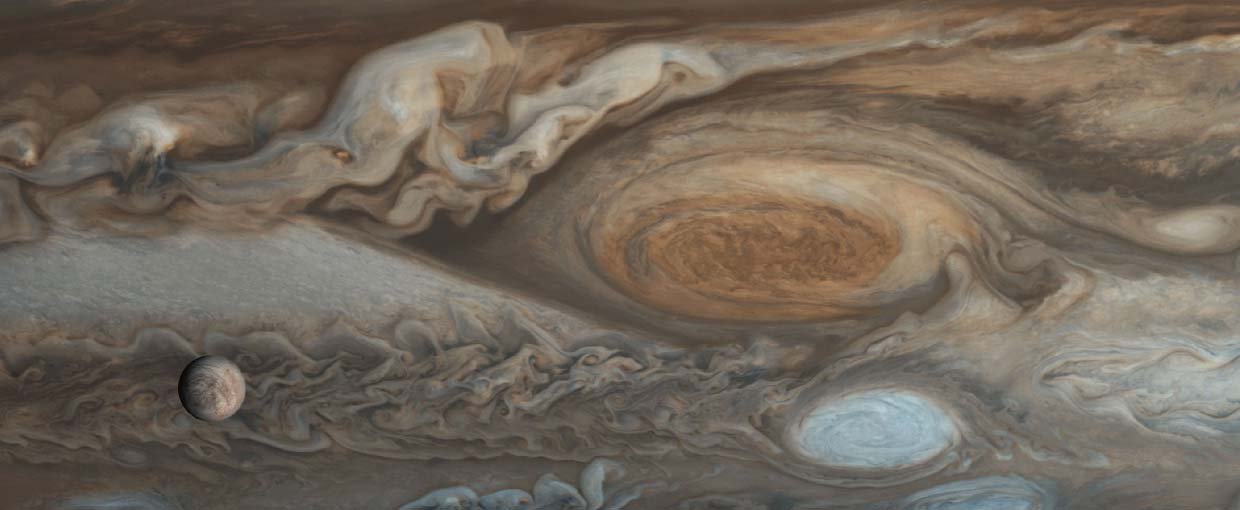
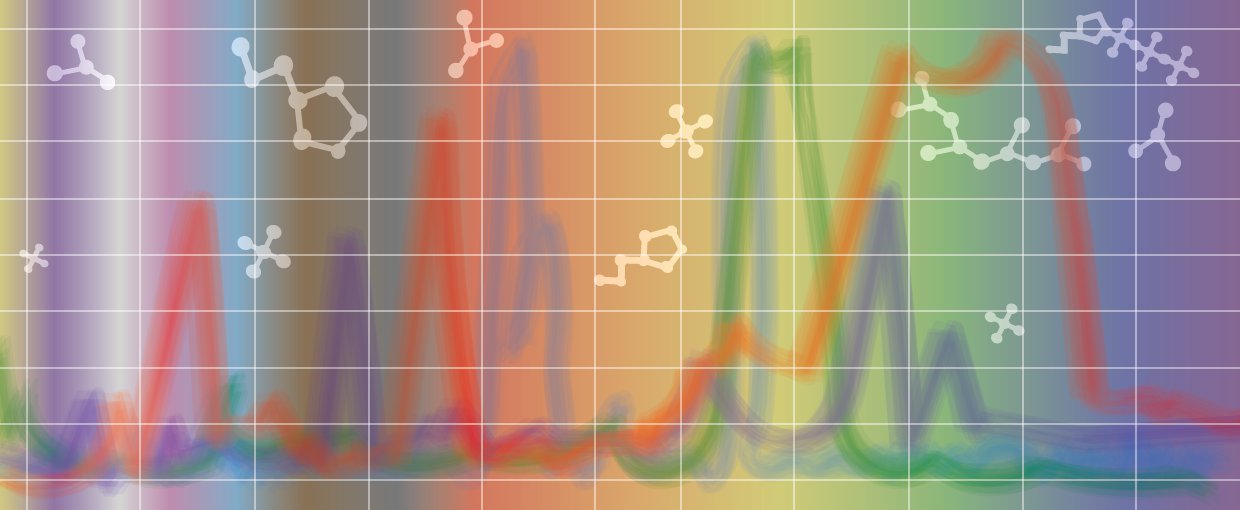
A volcanically active planet is shown in closeup at the left side of the image with glowing eruptions and lines of lava on the surface. To the right and in the distance is a faint blue glowing ball representing the more massive planet in the system.Sixteen frames from Voyager 1's flyby of Jupiter in 1979 were merged to create this image. Jupiter's Great Red Spot is visible in the center. Jupiter's moon Europa can be seen in the foreground at the bottom left of the image.The frame is a horizontal rainbow of color on a grid. Shadows of molecules can be seen through the light as well as the jagged peaks and troughs of spectral lines.
Fizzy Super Earths and Lava Worlds“Fizzy Super-Earths: Impacts of Magma Composition on the Bulk Density and Structure of Lava Worlds.” in The Astrophysical Journal.01/03
Identifying Hydrothermal Activity on Icy Ocean Worlds“Ethene-ethanol ratios as potential indicators of hydrothermal activity at Enceladus, Europa, and other icy ocean worlds.” In Icarus.02/03
NASA Raman Spectroscopic Database"The NASA Raman spectroscopic database: Ramdb version 1.00.” In Icarus.03/03
NextPrevious
Go Explore
November 2013Establishment of the Coast Range ophiolite microbial observatory (CROMO): drilling objectives and preliminary outcomes

Cardace, D., Hoehler, T., McCollom, T., Schrenk, M., Carnevale, D., Kubo, M., & Twing, K. (2013). Sci. Dril., 16(None), 45–55. doi:10.5194/sd-16-45-2013

A survey of volatile species in Oort cloud comets C/2001 Q4 (NEAT) and C/2002 T7 (LINEAR) at millimeter wavelengths

De Val-Borro, M., Küppers, M., Hartogh, P., Rezac, L., Biver, N., Bockelée-Morvan, D., … Crovisier, J. (2013). A&A, 559(None), A48. doi:10.1051/0004-6361/201322284

Geochemical, metagenomic and metaproteomic insights into trace metal utilization by methane-oxidizing microbial consortia in sulphidic marine sediments

Glass, J. B., Yu, H., Steele, J. A., Dawson, K. S., Sun, S., Chourey, K., … Pan, C. (2013). Environmental Microbiology, 16(6), 1592–1611. doi:10.1111/1462-2920.12314

Impact of diagenesis and maturation on the survival of eumelanin in the fossil record

Glass, K., Ito, S., Wilby, P. R., Sota, T., Nakamura, A., Russell Bowers, C., … Miller, K. E. (2013). Organic Geochemistry, 64(None), 29–37. doi:10.1016/j.orggeochem.2013.09.002

Developmental Plasticity, Straight from the Worm’s Mouth

Hartenstein, V., & Jacobs, D. (2013). Cell, 155(4), 742–743. doi:10.1016/j.cell.2013.10.038

Modeling the Archean Atmosphere and Climate

Kasting, J. F. (2014). Treatise on Geochemistry, None(None), 157–175. doi:10.1016/b978-0-08-095975-7.01306-1

Remote life-detection criteria, habitable zone boundaries, and the frequency of Earth-like planets around M and late K stars

Kasting, J. F., Kopparapu, R., Ramirez, R. M., & Harman, C. E. (2013). Proceedings of the National Academy of Sciences, 111(35), 12641–12646. doi:10.1073/pnas.1309107110

A SYSTEMATIC RETRIEVAL ANALYSIS OF SECONDARY ECLIPSE SPECTRA. III. DIAGNOSING CHEMICAL DISEQUILIBRIUM IN PLANETARY ATMOSPHERES

Line, M. R., & Yung, Y. L. (2013). The Astrophysical Journal, 779(1), 3. doi:10.1088/0004-637x/779/1/3

An anoxic, Fe(II)-rich, U-poor ocean 3.46 billion years ago

Li, W., Czaja, A. D., Van Kranendonk, M. J., Beard, B. L., Roden, E. E., & Johnson, C. M. (2013). Geochimica et Cosmochimica Acta, 120(None), 65–79. doi:10.1016/j.gca.2013.06.033