

This website is currently being migrated. For the most up-to-date astrobiology news, resources, and community announcements, please visit our new home at science.nasa.gov/astrobiology

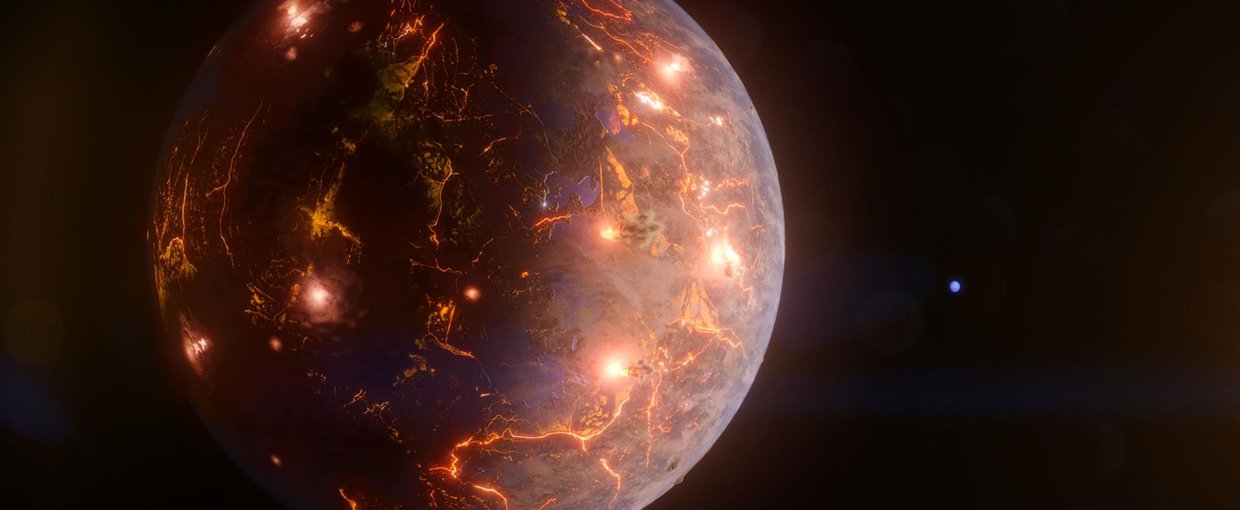
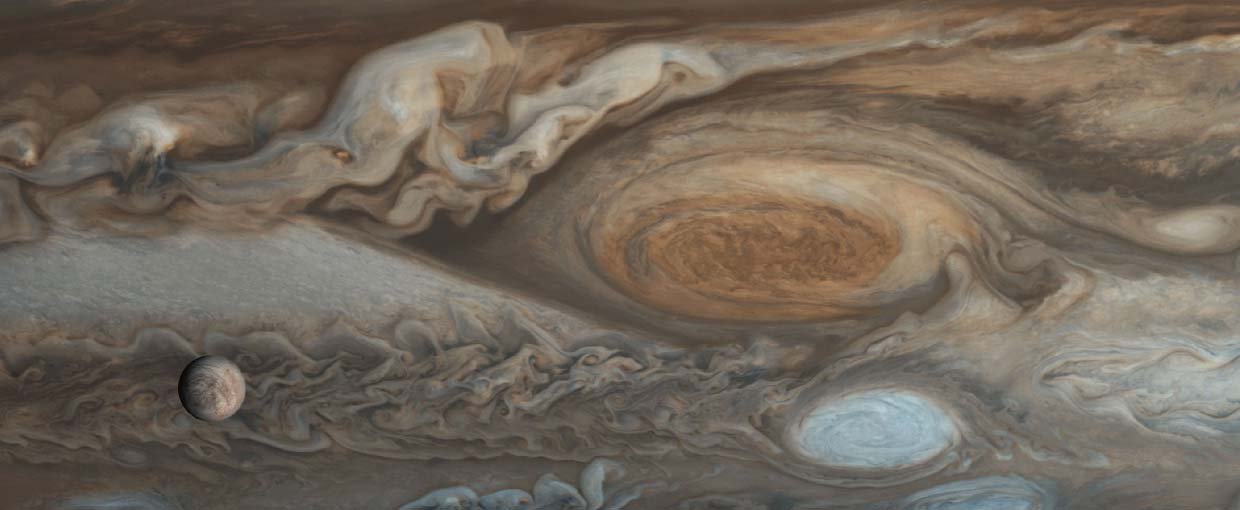
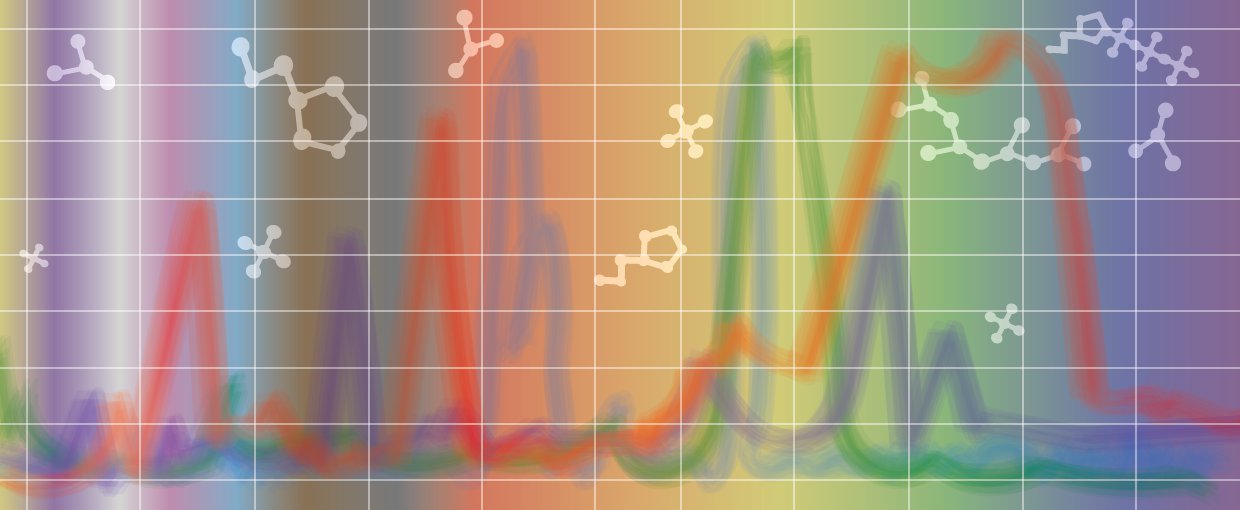
A volcanically active planet is shown in closeup at the left side of the image with glowing eruptions and lines of lava on the surface. To the right and in the distance is a faint blue glowing ball representing the more massive planet in the system.Sixteen frames from Voyager 1's flyby of Jupiter in 1979 were merged to create this image. Jupiter's Great Red Spot is visible in the center. Jupiter's moon Europa can be seen in the foreground at the bottom left of the image.The frame is a horizontal rainbow of color on a grid. Shadows of molecules can be seen through the light as well as the jagged peaks and troughs of spectral lines.
Fizzy Super Earths and Lava Worlds“Fizzy Super-Earths: Impacts of Magma Composition on the Bulk Density and Structure of Lava Worlds.” in The Astrophysical Journal.01/03
Identifying Hydrothermal Activity on Icy Ocean Worlds“Ethene-ethanol ratios as potential indicators of hydrothermal activity at Enceladus, Europa, and other icy ocean worlds.” In Icarus.02/03
NASA Raman Spectroscopic Database"The NASA Raman spectroscopic database: Ramdb version 1.00.” In Icarus.03/03
NextPrevious
Go Explore
January 2014Modeling microbial reaction rates in a submarine hydrothermal vent chimney wall

LaRowe, D. E., Dale, A. W., Aguilera, D. R., L’Heureux, I., Amend, J. P., & Regnier, P. (2014). Geochimica et Cosmochimica Acta, 124(None), 72–97. doi:10.1016/j.gca.2013.09.005

MarcoPolo-R: Near-Earth Asteroid sample return mission selected for the assessment study phase of the ESA program cosmic vision

Michel, P., Barucci, M. A., Cheng, A. F., Böhnhardt, H., Brucato, J. R., Dotto, E., … Ehrenfreund, P. (2014). Acta Astronautica, 93(None), 530–538. doi:10.1016/j.actaastro.2012.05.030

CALCULATING THE HABITABLE ZONES OF MULTIPLE STAR SYSTEMS WITH A NEW INTERACTIVE WEB SITE

Müller, T. W. A., & Haghighipour, N. (2014). The Astrophysical Journal, 782(1), 26. doi:10.1088/0004-637x/782/1/26

Simple X-Ray Diffraction Techniques To Identify MG Calcite, Dolomite, and Magnesite In Tropical Coralline Algae and Assess Peak Asymmetry

Nash, M. C., Opdyke, B. N., Wu, Z., Xu, H., & Trafford, J. M. (2014). Journal of Sedimentary Research, 83(12), 1084–1098. doi:10.2110/jsr.2013.67

A Paleogenomic Perspective on Evolution and Gene Function: New Insights from Ancient DNA

Shapiro, B., & Hofreiter, M. (2014). Science, 343(6169), 1236573–1236573. doi:10.1126/science.1236573

Volumetric estimates of ancient water on Mount Sharp based on boxwork deposits, Gale Crater, Mars

Siebach, K. L., & Grotzinger, J. P. (2014). Journal of Geophysical Research: Planets, 119(1), 189–198. doi:10.1002/2013je004508

Quantifying the process and abruptness of the end-Permian mass extinction

Wang, Y., Sadler, P. M., Shen, S-Z., Erwin, D. H., Zhang, Y-C., Wang, X-D., … Wang, W. (2014). Paleobiology, 40(1), 113–129. doi:10.1666/13022

Determination and application of the equilibrium oxygen isotope effect between water and sulfite

Wankel, S. D., Bradley, A. S., Eldridge, D. L., & Johnston, D. T. (2014). Geochimica et Cosmochimica Acta, 125(None), 694–711. doi:10.1016/j.gca.2013.08.039

Characterization of the terahertz frequency optical constants of montmorillonite

Wilke, I., Ramanathan, V., LaChance, J., Tamalonis, A., Aldersley, M., Joshi, P. C., & Ferris, J. (2014). Applied Clay Science, 87(None), 61–65. doi:10.1016/j.clay.2013.11.006

Formation of brucite and cronstedtite-bearing mineral assemblages on Ceres

Zolotov, M. Y. (2014). Icarus, 228(None), 13–26. doi:10.1016/j.icarus.2013.09.020