

This website is currently being migrated. For the most up-to-date astrobiology news, resources, and community announcements, please visit our new home at science.nasa.gov/astrobiology

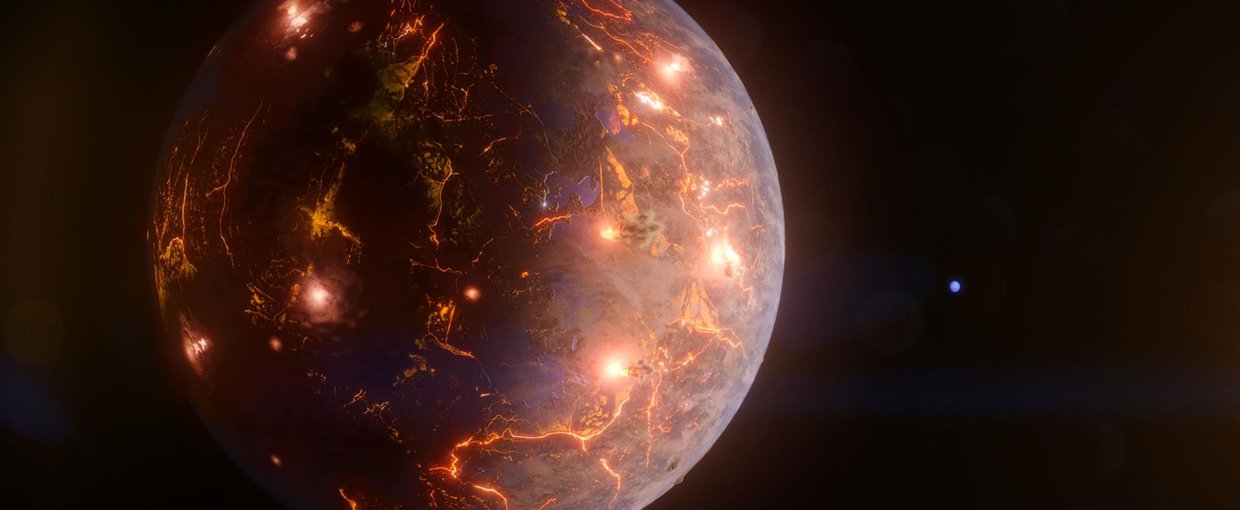
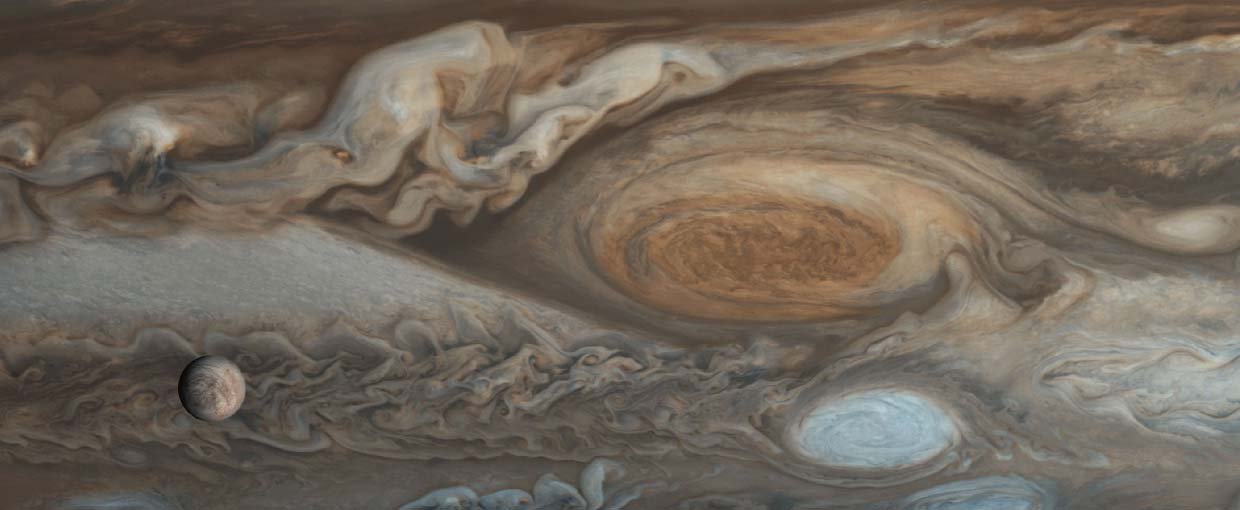
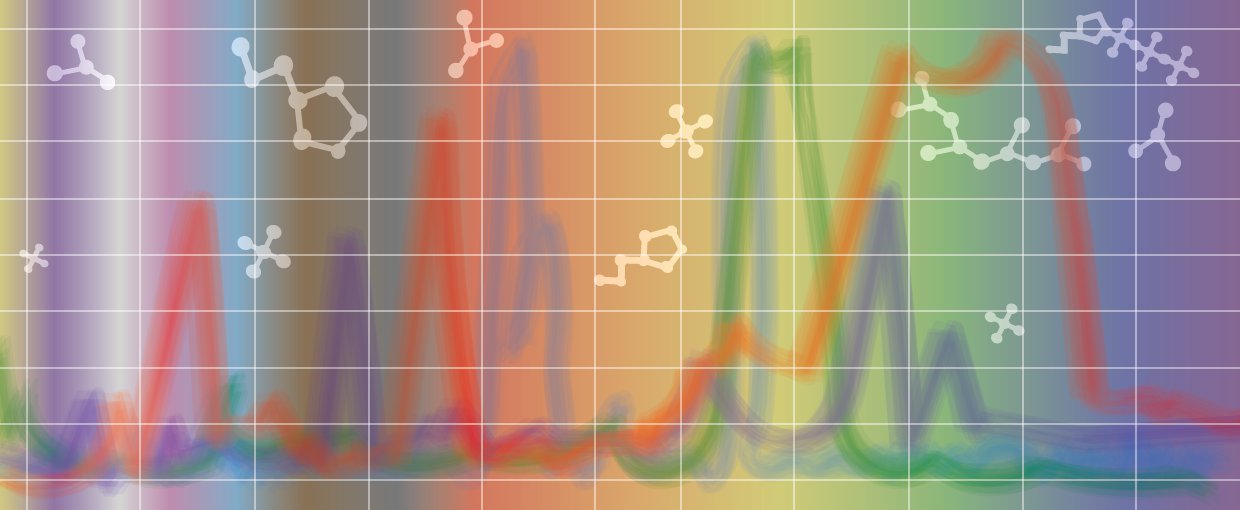
A volcanically active planet is shown in closeup at the left side of the image with glowing eruptions and lines of lava on the surface. To the right and in the distance is a faint blue glowing ball representing the more massive planet in the system.Sixteen frames from Voyager 1's flyby of Jupiter in 1979 were merged to create this image. Jupiter's Great Red Spot is visible in the center. Jupiter's moon Europa can be seen in the foreground at the bottom left of the image.The frame is a horizontal rainbow of color on a grid. Shadows of molecules can be seen through the light as well as the jagged peaks and troughs of spectral lines.
Fizzy Super Earths and Lava Worlds“Fizzy Super-Earths: Impacts of Magma Composition on the Bulk Density and Structure of Lava Worlds.” in The Astrophysical Journal.01/03
Identifying Hydrothermal Activity on Icy Ocean Worlds“Ethene-ethanol ratios as potential indicators of hydrothermal activity at Enceladus, Europa, and other icy ocean worlds.” In Icarus.02/03
NASA Raman Spectroscopic Database"The NASA Raman spectroscopic database: Ramdb version 1.00.” In Icarus.03/03
NextPrevious
Go Explore
February 2014Hadean age for a post-magma-ocean zircon confirmed by atom-probe tomography

Valley, J. W., Cavosie, A. J., Ushikubo, T., Reinhard, D. A., Lawrence, D. F., Larson, D. J., … Clifton, P. H. (2014). Nature Geosci, 7(3), 219–223. doi:10.1038/ngeo2075

January 2014Conducting Miller-Urey Experiments

Parker, E. T., Cleaves, J. H., Burton, A. S., Glavin, D. P., Dworkin, J. P., Zhou, M., … Fernández, F. M. (2014). Conducting Miller-Urey Experiments. Journal of Visualized Experiments, None(83), None. doi:10.3791/51039

Runaway greenhouse effect on exomoons due to irradiation from hot, young giant planets

Heller, R., & Barnes, R. (2014). International Journal of Astrobiology, 14(02), 335–343. doi:10.1017/s1473550413000463

Abundances and implications of volatile-bearing species from evolved gas analysis of the Rocknest aeolian deposit, Gale Crater, Mars

Archer, P. D., Franz, H. B., Sutter, B., Arevalo, R. D., Coll, P., Eigenbrode, J. L., … Glavin, D. P. (2014). Journal of Geophysical Research: Planets, 119(1), 237–254. doi:10.1002/2013je004493

Ancient Aqueous Environments at Endeavour Crater, Mars

Arvidson, R. E., Squyres, S. W., Bell, J. F., Catalano, J. G., Clark, B. C., Crumpler, L. S., … De Souza, P. A. (2014). Science, 343(6169), 1248097–1248097. doi:10.1126/science.1248097

EXPERIMENTAL STUDIES ON THE FORMATION OF D 2 O AND D 2 O 2 BY IMPLANTATION OF ENERGETIC D + IONS INTO OXYGEN ICES

Bennett, C. J., Ennis, C. P., & Kaiser, R. I. (2014). The Astrophysical Journal, 782(2), 63. doi:10.1088/0004-637x/782/2/63

Bacterial Vesicles in Marine Ecosystems

Biller, S. J., Schubotz, F., Roggensack, S. E., Thompson, A. W., Summons, R. E., & Chisholm, S. W. (2014). Science, 343(6167), 183–186. doi:10.1126/science.1243457

SEVO ON THE GROUND: DESIGN OF A LABORATORY SOLAR SIMULATION IN SUPPORT OF THE O/OREOS MISSION

Cook, A. M., Mattioda, A. L., Quinn, R. C., Ricco, A. J., Ehrenfreund, P., Bramall, N. E., … Minelli, G. (2014). The Astrophysical Journal Supplement Series, 210(2), 15. doi:10.1088/0067-0049/210/2/15

UTILITARIAN OPACITY MODEL FOR AGGREGATE PARTICLES IN PROTOPLANETARY NEBULAE AND EXOPLANET ATMOSPHERES

Cuzzi, J. N., Estrada, P. R., & Davis, S. S. (2014). The Astrophysical Journal Supplement Series, 210(2), 21. doi:10.1088/0067-0049/210/2/21

Systematic evaluation of bias in microbial community profiles induced by whole genome amplification

Direito, S. O. L., Zaura, E., Little, M., Ehrenfreund, P., & Röling, W. F. M. (2014). Environmental Microbiology, 16(3), 643–657. doi:10.1111/1462-2920.12365