

This website is currently being migrated. For the most up-to-date astrobiology news, resources, and community announcements, please visit our new home at science.nasa.gov/astrobiology

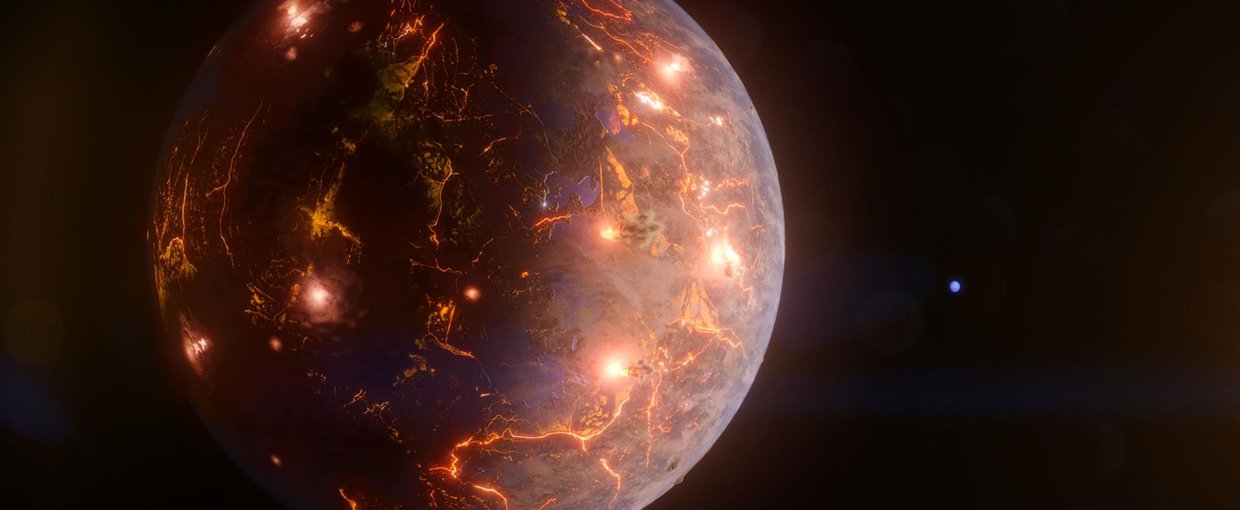
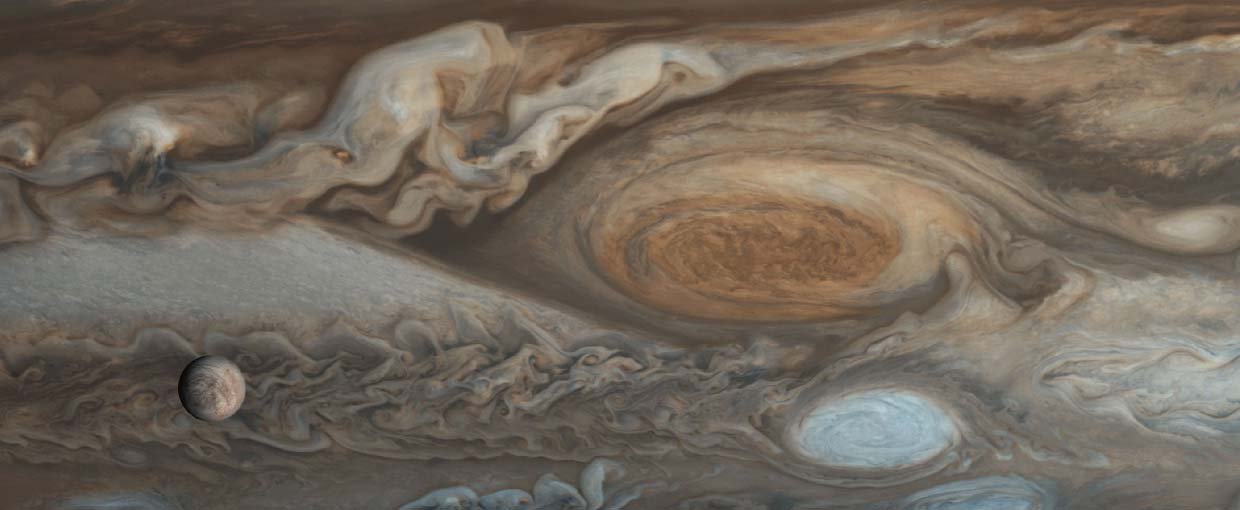
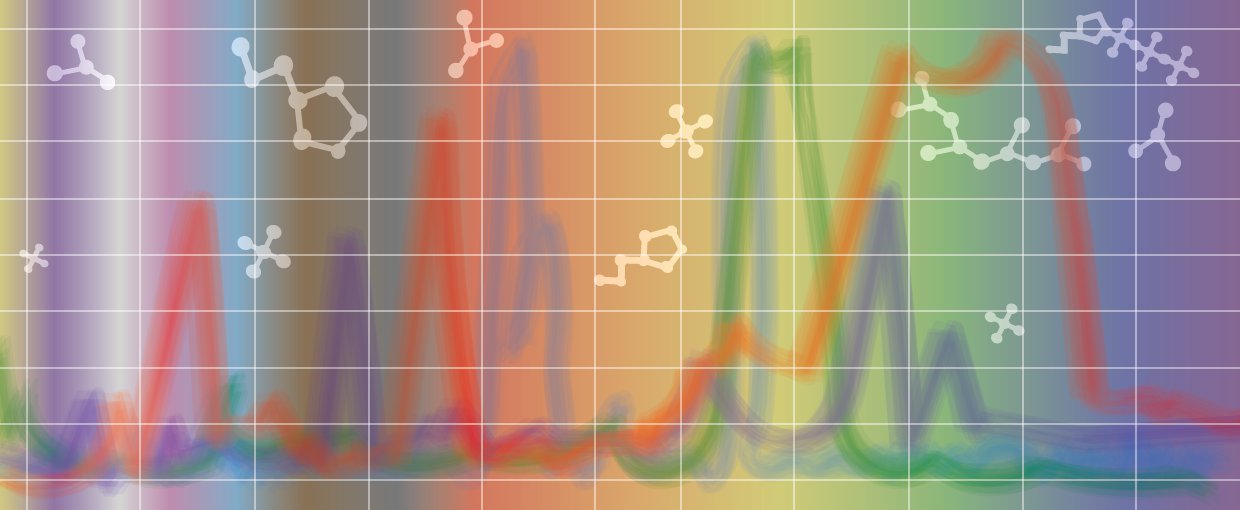
A volcanically active planet is shown in closeup at the left side of the image with glowing eruptions and lines of lava on the surface. To the right and in the distance is a faint blue glowing ball representing the more massive planet in the system.Sixteen frames from Voyager 1's flyby of Jupiter in 1979 were merged to create this image. Jupiter's Great Red Spot is visible in the center. Jupiter's moon Europa can be seen in the foreground at the bottom left of the image.The frame is a horizontal rainbow of color on a grid. Shadows of molecules can be seen through the light as well as the jagged peaks and troughs of spectral lines.
Fizzy Super Earths and Lava Worlds“Fizzy Super-Earths: Impacts of Magma Composition on the Bulk Density and Structure of Lava Worlds.” in The Astrophysical Journal.01/03
Identifying Hydrothermal Activity on Icy Ocean Worlds“Ethene-ethanol ratios as potential indicators of hydrothermal activity at Enceladus, Europa, and other icy ocean worlds.” In Icarus.02/03
NASA Raman Spectroscopic Database"The NASA Raman spectroscopic database: Ramdb version 1.00.” In Icarus.03/03
NextPrevious
Go Explore
April 2014Phototrophic biofilm assembly in microbial-mat-derived unicyanobacterial consortia: model systems for the study of autotroph-heterotroph interactions

Cole, J. K., Hutchison, J. R., Renslow, R. S., Kim, Y-M., Chrisler, W. B., Engelmann, H. E., … Lindemann, S. R. (2014). Phototrophic biofilm assembly in microbial-mat-derived unicyanobacterial consortia: model systems for the study of autotroph-heterotroph interactions. Frontiers in Microbiology, 5, None. doi:10.3389/fmicb.2014.00109

March 2014RNA as an Emergent Entity: An Understanding Gained Through Studying its Nonfunctional Alternatives

Krishnamurthy, R. (2014). RNA as an Emergent Entity: An Understanding Gained Through Studying its Nonfunctional Alternatives. Synlett, 25(11), 1511–1517. doi:10.1055/s-0033-1340183

The amino acid composition of the Sutter's Mill CM2 carbonaceous chondrite

Burton, A. S., Glavin, D. P., Elsila, J. E., Dworkin, J. P., Jenniskens, P., & Yin, Q-Z. (2014). Meteoritics & Planetary Science, 49(11), 2074–2086. doi:10.1111/maps.12281

Pyrophosphate synthesis in iron mineral films and membranes simulating prebiotic submarine hydrothermal precipitates

Barge, L. M., Doloboff, I. J., Russell, M. J., VanderVelde, D., White, L. M., Stucky, G. D., … Baum, M. M. (2014). Geochimica et Cosmochimica Acta, 128(None), 1–12. doi:10.1016/j.gca.2013.12.006

The Fuel Cell Model of Abiogenesis: A New Approach to Origin-of-Life Simulations

Barge, L. M., Kee, T. P., Doloboff, I. J., Hampton, J. M. P., Ismail, M., Pourkashanian, M., … Zeytounian, J. (2014). Astrobiology, 14(3), 254–270. doi:10.1089/ast.2014.1140

A method to identify the boundary between rocky and gaseous exoplanets from tidal theory and transit durations

Barnes, R. (2014). International Journal of Astrobiology, 14(02), 321–333. doi:10.1017/s1473550413000499

Ancient biomolecules: Their origins, fossilization, and role in revealing the history of life

Briggs, D. E. G., & Summons, R. E. (2014). BioEssays, 36(5), 482–490. doi:10.1002/bies.201400010

The amino acid composition of the Sutter's Mill CM2 carbonaceous chondrite

Burton, A. S., Glavin, D. P., Elsila, J. E., Dworkin, J. P., Jenniskens, P., & Yin, Q-Z. (2014). Meteoritics & Planetary Science, 49(11), 2074–2086. doi:10.1111/maps.12281

Amino acid analysis in micrograms of meteorite sample by nanoliquid chromatography–high-resolution mass spectrometry

Callahan, M. P., Martin, M. G., Burton, A. S., Glavin, D. P., & Dworkin, J. P. (2014). Journal of Chromatography A, 1332(None), 30–34. doi:10.1016/j.chroma.2014.01.032

THE SPITZER INFRARED SPECTROGRAPH DEBRIS DISK CATALOG. I. CONTINUUM ANALYSIS OF UNRESOLVED TARGETS

Chen, C. H., Mittal, T., Kuchner, M., Forrest, W. J., Lisse, C. M., Manoj, P., … Sargent, B. A. (2014). The Astrophysical Journal Supplement Series, 211(2), 25. doi:10.1088/0067-0049/211/2/25