

This website is currently being migrated. For the most up-to-date astrobiology news, resources, and community announcements, please visit our new home at science.nasa.gov/astrobiology

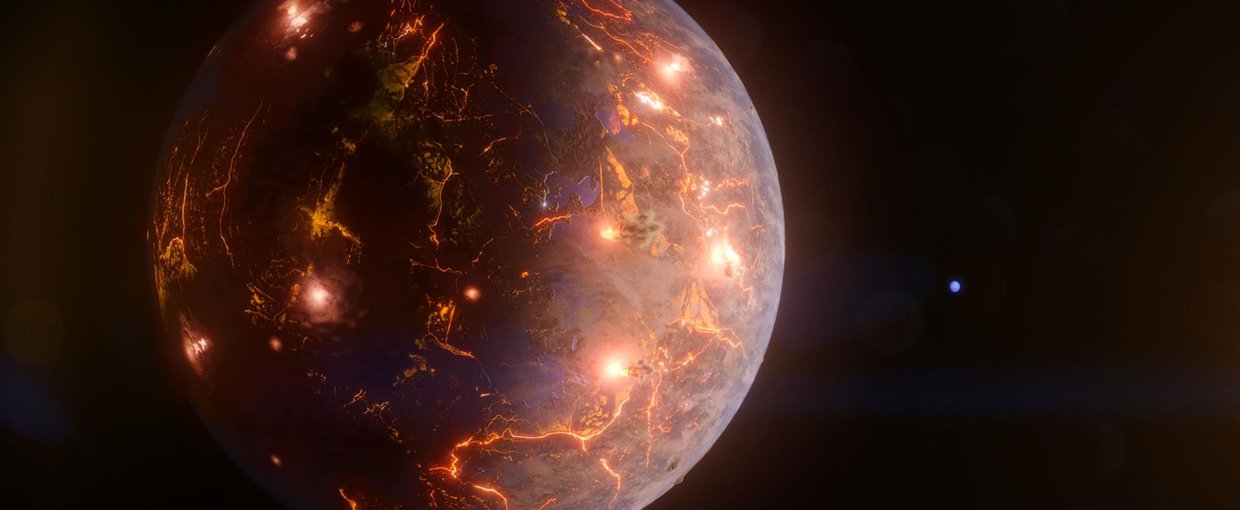
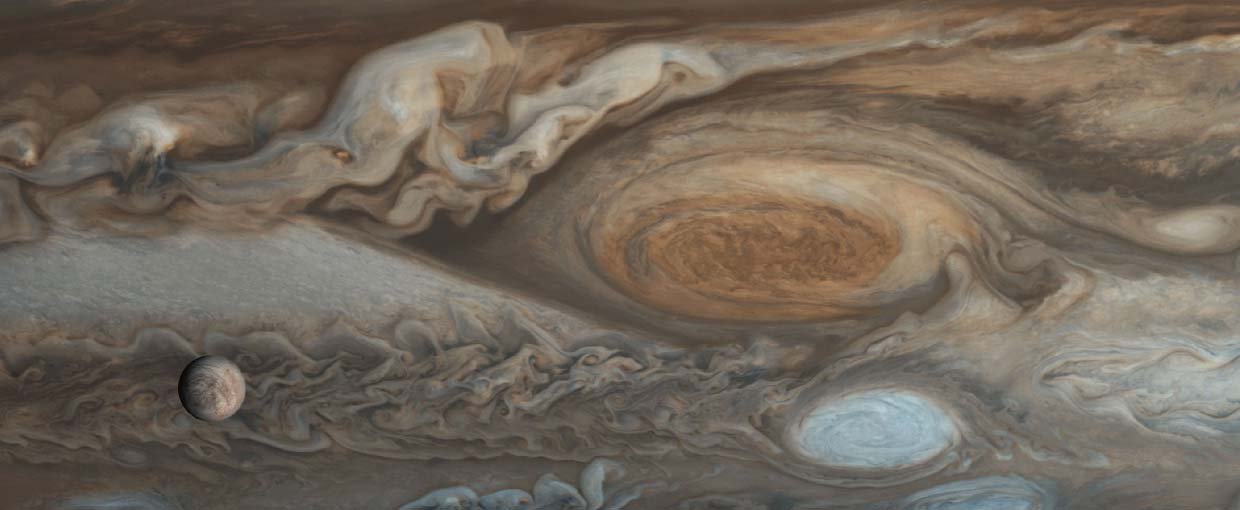
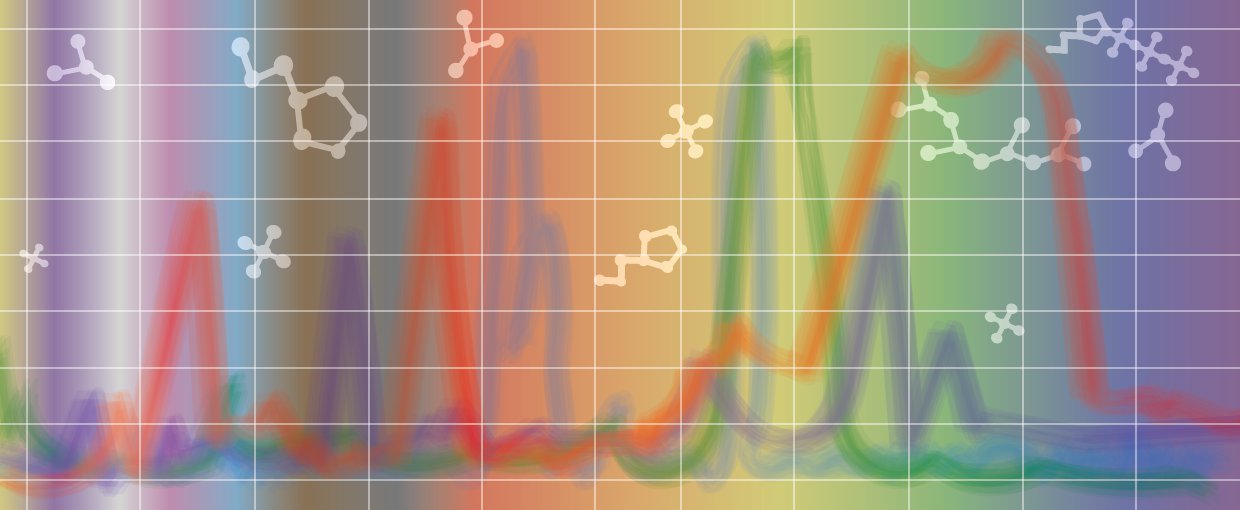
A volcanically active planet is shown in closeup at the left side of the image with glowing eruptions and lines of lava on the surface. To the right and in the distance is a faint blue glowing ball representing the more massive planet in the system.Sixteen frames from Voyager 1's flyby of Jupiter in 1979 were merged to create this image. Jupiter's Great Red Spot is visible in the center. Jupiter's moon Europa can be seen in the foreground at the bottom left of the image.The frame is a horizontal rainbow of color on a grid. Shadows of molecules can be seen through the light as well as the jagged peaks and troughs of spectral lines.
Fizzy Super Earths and Lava Worlds“Fizzy Super-Earths: Impacts of Magma Composition on the Bulk Density and Structure of Lava Worlds.” in The Astrophysical Journal.01/03
Identifying Hydrothermal Activity on Icy Ocean Worlds“Ethene-ethanol ratios as potential indicators of hydrothermal activity at Enceladus, Europa, and other icy ocean worlds.” In Icarus.02/03
NASA Raman Spectroscopic Database"The NASA Raman spectroscopic database: Ramdb version 1.00.” In Icarus.03/03
NextPrevious
Go Explore
June 2014 Elucidation of the B urkholderia cenocepacia hopanoid biosynthesis pathway uncovers functions for conserved proteins in hopanoid-producing bacteria

Schmerk, C. L., Welander, P. V., Hamad, M. A., Bain, K. L., Bernards, M. A., Summons, R. E., & Valvano, M. A. (2014). Environmental Microbiology, 17(3), 735–750. doi:10.1111/1462-2920.12509

THE LUNAR THERMAL ICE PUMP

Schorghofer, N., & Aharonson, O. (2014). The Astrophysical Journal, 788(2), 169. doi:10.1088/0004-637x/788/2/169

The Neanderthal Meal: A New Perspective Using Faecal Biomarkers

Sistiaga, A., Mallol, C., Galván, B., & Summons, R. E. (2014). PLoS ONE, 9(6), e101045. doi:10.1371/journal.pone.0101045

REVEALING ASYMMETRIES IN THE HD 181327 DEBRIS DISK: A RECENT MASSIVE COLLISION OR INTERSTELLAR MEDIUM WARPING

Stark, C. C., Schneider, G., Weinberger, A. J., Debes, J. H., Grady, C. A., Jang-Condell, H., & Kuchner, M. J. (2014). The Astrophysical Journal, 789(1), 58. doi:10.1088/0004-637x/789/1/58

740 Ma vase-shaped microfossils from Yukon, Canada: Implications for Neoproterozoic chronology and biostratigraphy

Strauss, J. V., Rooney, A. D., Macdonald, F. A., Brandon, A. D., & Knoll, A. H. (2014). Geology, 42(8), 659–662. doi:10.1130/g35736.1

Ganymede׳s internal structure including thermodynamics of magnesium sulfate oceans in contact with ice

Vance, S., Bouffard, M., Choukroun, M., & Sotin, C. (2014). Planetary and Space Science, 96(None), 62–70. doi:10.1016/j.pss.2014.03.011

Formation of a New Benzene–Ethane Co-Crystalline Structure Under Cryogenic Conditions

Vu, T. H., Cable, M. L., Choukroun, M., Hodyss, R., & Beauchamp, P. (2014). The Journal of Physical Chemistry A, 118(23), 4087–4094. doi:10.1021/jp501698j

May 2014Redox heterogeneity of subsurface waters in the Mesoproterozoic ocean

Sperling, E. A., Rooney, A. D., Hays, L., Sergeev, V. N., Vorob'eva, N. G., Sergeeva, N. D., … Selby, D. (2014). Geobiology, 12(5), 373–386. doi:10.1111/gbi.12091

The formation of supercooled brines, viscous liquids, and low-temperature perchlorate glasses in aqueous solutions relevant to Mars

Toner, J. D., Catling, D. C., & Light, B. (2014). The formation of supercooled brines, viscous liquids, and low-temperature perchlorate glasses in aqueous solutions relevant to Mars. Icarus, 233, 36–47. doi:10.1016/j.icarus.2014.01.018

Merging metagenomics and geochemistry reveals environmental controls on biological diversity and evolution

Alsop, E. B., Boyd, E. S., & Raymond, J. (2014). BMC Ecology, 14(1), 16. doi:10.1186/1472-6785-14-16