

This website is currently being migrated. For the most up-to-date astrobiology news, resources, and community announcements, please visit our new home at science.nasa.gov/astrobiology

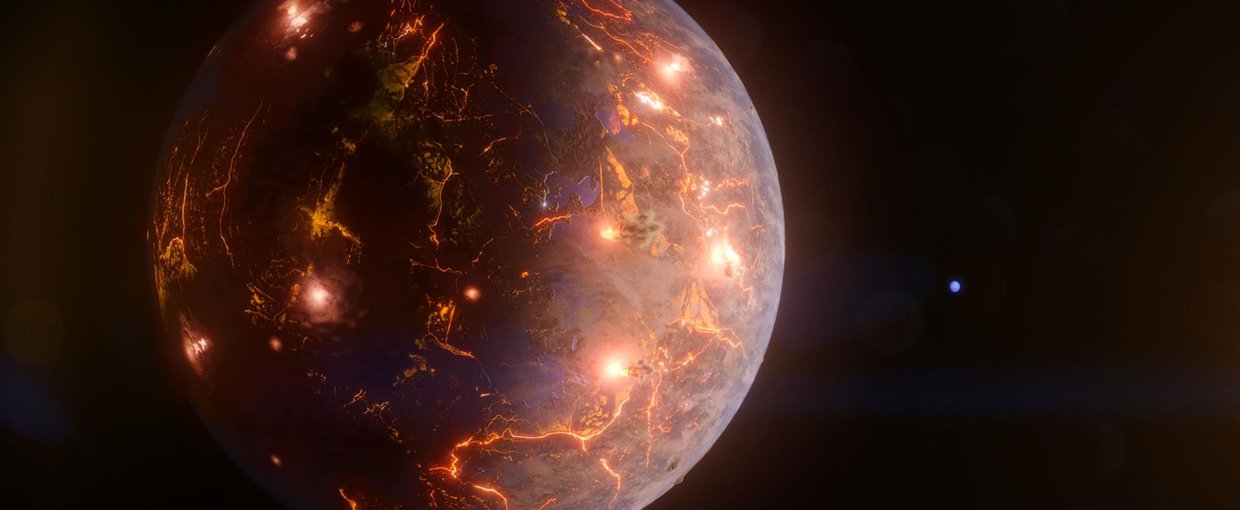
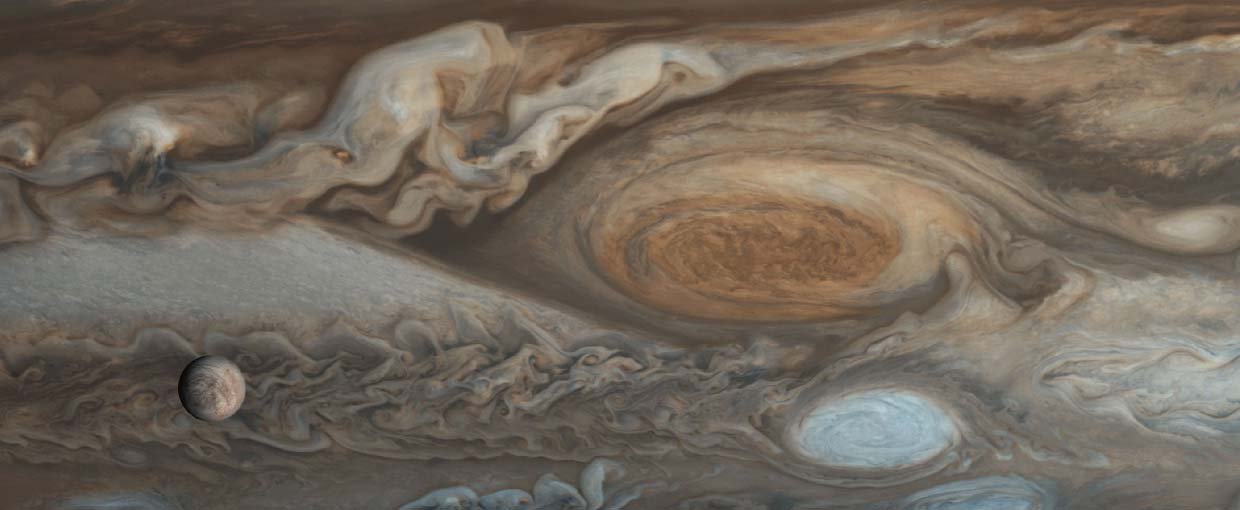
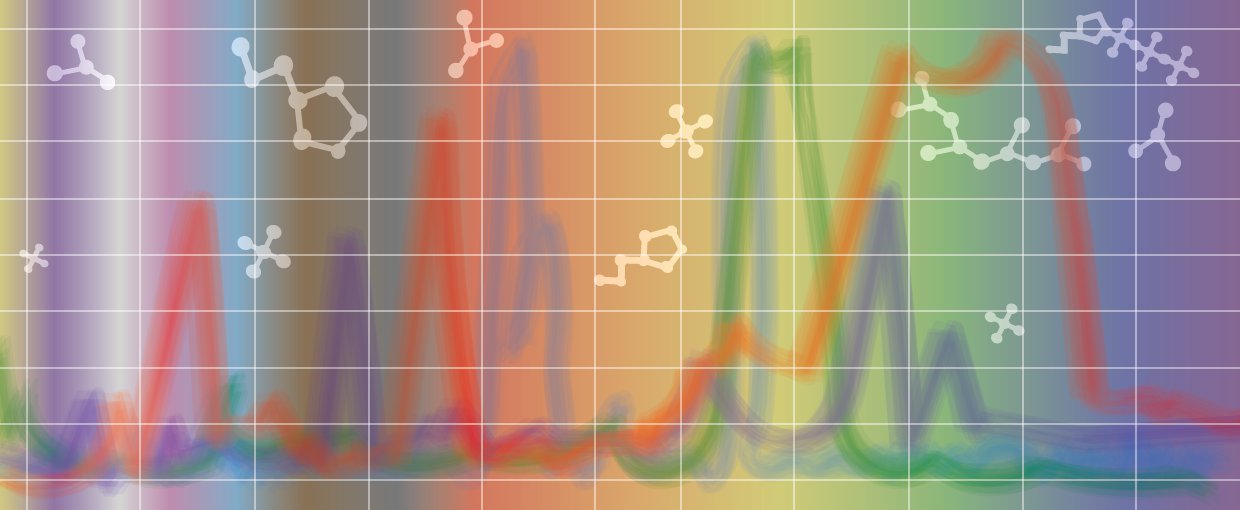
A volcanically active planet is shown in closeup at the left side of the image with glowing eruptions and lines of lava on the surface. To the right and in the distance is a faint blue glowing ball representing the more massive planet in the system.Sixteen frames from Voyager 1's flyby of Jupiter in 1979 were merged to create this image. Jupiter's Great Red Spot is visible in the center. Jupiter's moon Europa can be seen in the foreground at the bottom left of the image.The frame is a horizontal rainbow of color on a grid. Shadows of molecules can be seen through the light as well as the jagged peaks and troughs of spectral lines.
Fizzy Super Earths and Lava Worlds“Fizzy Super-Earths: Impacts of Magma Composition on the Bulk Density and Structure of Lava Worlds.” in The Astrophysical Journal.01/03
Identifying Hydrothermal Activity on Icy Ocean Worlds“Ethene-ethanol ratios as potential indicators of hydrothermal activity at Enceladus, Europa, and other icy ocean worlds.” In Icarus.02/03
NASA Raman Spectroscopic Database"The NASA Raman spectroscopic database: Ramdb version 1.00.” In Icarus.03/03
NextPrevious
Go Explore
December 2014Life in the Ocean Crust

Orcutt, B. N., & Edwards, K. J. (2014). Developments in Marine Geology, None(None), 175–196. doi:10.1016/b978-0-444-62617-2.00007-4

Planning Considerations Related to the Organic Contamination of Martian Samples and Implications for the Mars 2020 Rover

Summons, R. E., Sessions, A. L., Allwood, A. C., Barton, H. A., Beaty, D. W., Blakkolb, B., … Canham, J. (2014). Astrobiology, 14(12), 969–1027. doi:10.1089/ast.2014.1244

Life at Subseafloor Extremes

Takai, K., Nakamura, K., LaRowe, D., & Amend, J. P. (2014). Developments in Marine Geology, None(None), 149–174. doi:10.1016/b978-0-444-62617-2.00006-2

Mars methane detection and variability at Gale crater

Webster, C. R., Mahaffy, P. R., Atreya, S. K., Flesch, G. J., Mischna, M. A., Meslin, P-Y., … Farley, K. A. (2014). Science, 347(6220), 415–417. doi:10.1126/science.1261713

Combining molecular dynamics and an electrodiffusion model to calculate ion channel conductance

Wilson, M. A., Nguyen, T. H., & Pohorille, A. (2014). J. Chem. Phys., 141(22), 22D519. doi:10.1063/1.4900879

X-ray absorption near edge structure spectroscopic study of Hayabusa category 3 carbonaceous particles

Yabuta, H., Uesugi, M., Naraoka, H., Ito, M., Kilcoyne, A. L. D., Sandford, S. A., … Kitajima, F. (2014). Earth Planet Sp, 66(1), None. doi:10.1186/s40623-014-0156-0

November 2014Si-magnetite nano-precipitates in silician magnetite from banded iron formation: Z-contrast imaging and ab initio study

Xu, H., Shen, Z., & Konishi, H. (2014). Si-magnetite nano-precipitates in silician magnetite from banded iron formation: Z-contrast imaging and ab initio study. American Mineralogist, 99(11-12), 2196–2202. doi:10.2138/am-2014-4964

First results of the ORGANIC experiment on EXPOSE-R on the ISS

Bryson, K. L., Salama, F., Elsaesser, A., Peeters, Z., Ricco, A. J., Foing, B. H., & Goreva, Y. (2014). International Journal of Astrobiology, 14(01), 55–66. doi:10.1017/s1473550414000597

Insights into environmental controls on microbial communities in a continental serpentinite aquifer using a microcosm-based approach

Crespo-Medina, M., Twing, K. I., Kubo, M. D. Y., Hoehler, T. M., Cardace, D., McCollom, T., & Schrenk, M. O. (2014). Frontiers in Microbiology, 5(None), None. doi:10.3389/fmicb.2014.00604

COSAC prepares for sampling and in situ analysis of cometary matter from comet 67P/Churyumov–Gerasimenko

Goesmann, F., Raulin, F., Bredehöft, J. H., Cabane, M., Ehrenfreund, P., MacDermott, A. J., … McKenna-Lawlor, S. (2014). Planetary and Space Science, 103(None), 318–330. doi:10.1016/j.pss.2014.08.006