

This website is currently being migrated. For the most up-to-date astrobiology news, resources, and community announcements, please visit our new home at science.nasa.gov/astrobiology

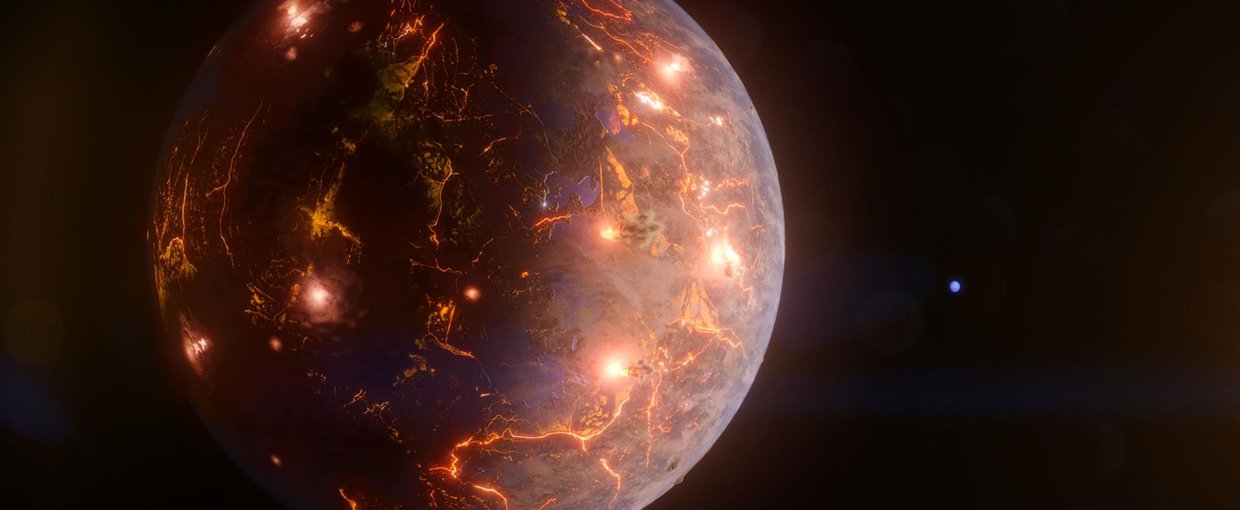
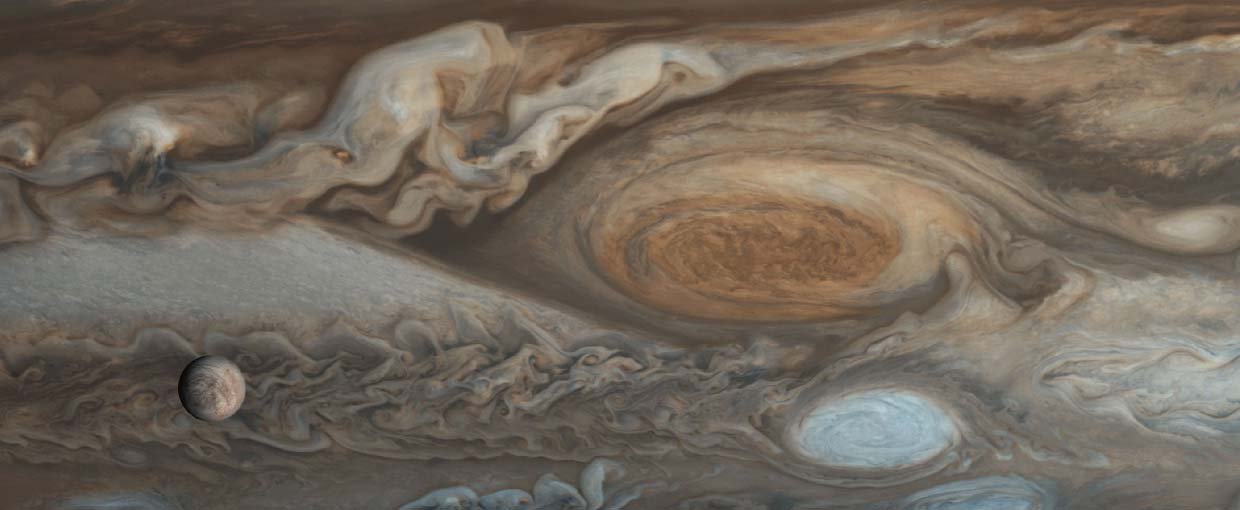
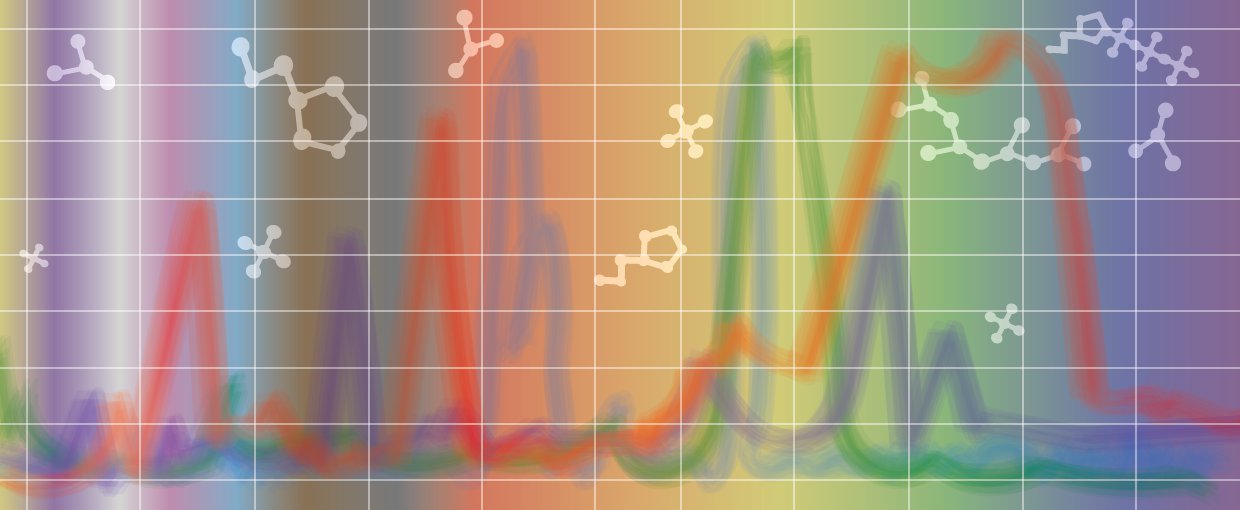
A volcanically active planet is shown in closeup at the left side of the image with glowing eruptions and lines of lava on the surface. To the right and in the distance is a faint blue glowing ball representing the more massive planet in the system.Sixteen frames from Voyager 1's flyby of Jupiter in 1979 were merged to create this image. Jupiter's Great Red Spot is visible in the center. Jupiter's moon Europa can be seen in the foreground at the bottom left of the image.The frame is a horizontal rainbow of color on a grid. Shadows of molecules can be seen through the light as well as the jagged peaks and troughs of spectral lines.
Fizzy Super Earths and Lava Worlds“Fizzy Super-Earths: Impacts of Magma Composition on the Bulk Density and Structure of Lava Worlds.” in The Astrophysical Journal.01/03
Identifying Hydrothermal Activity on Icy Ocean Worlds“Ethene-ethanol ratios as potential indicators of hydrothermal activity at Enceladus, Europa, and other icy ocean worlds.” In Icarus.02/03
NASA Raman Spectroscopic Database"The NASA Raman spectroscopic database: Ramdb version 1.00.” In Icarus.03/03
NextPrevious
Go Explore
December 2014Diversity of Methane-Cycling Archaea in Hydrothermal Sediment Investigated by General and Group-Specific PCR Primers

Lever, M. A., & Teske, A. P. (2014). Appl. Environ. Microbiol., 81(4), 1426–1441. doi:10.1128/aem.03588-14

EXTERNAL PHOTOEVAPORATION OF THE SOLAR NEBULA: JUPITER's NOBLE GAS ENRICHMENTS

Monga, N., & Desch, S. (2014). The Astrophysical Journal, 798(1), 9. doi:10.1088/0004-637x/798/1/9

GAP CLEARING BY PLANETS IN A COLLISIONAL DEBRIS DISK

Nesvold, E. R., & Kuchner, M. J. (2014). The Astrophysical Journal, 798(2), 83. doi:10.1088/0004-637x/798/2/83

ON THE MORPHOLOGY AND CHEMICAL COMPOSITION OF THE HR 4796A DEBRIS DISK

Rodigas, T. J., Stark, C. C., Weinberger, A., Debes, J. H., Hinz, P. M., Close, L., … Chen, C. (2014). The Astrophysical Journal, 798(2), 96. doi:10.1088/0004-637x/798/2/96

A unifying model for Neoproterozoic–Palaeozoic exceptional fossil preservation through pyritization and carbonaceous compression

Schiffbauer, J. D., Xiao, S., Cai, Y., Wallace, A. F., Hua, H., Hunter, J., … Xu, H. (2014). Nat Comms, 5(None), 5754. doi:10.1038/ncomms6754

Towards Co-Evolution of Membrane Proteins and Metabolism

A. Wilson, M., Wei, C., & Pohorille, A. (2014). Orig Life Evol Biosph, 44(4), 357–361. doi:10.1007/s11084-014-9393-2

Scratching the surface of martian habitability

Conrad, P. G. (2014). Science, 346(6215), 1288–1289. doi:10.1126/science.1259943

Parallel evolution of small colony variants in Burkholderia cenocepacia biofilms

Cooper, V. S., Staples, R. K., Traverse, C. C., & Ellis, C. N. (2014). Genomics, 104(6), 447–452. doi:10.1016/j.ygeno.2014.09.007

KEPLER FLARES. II. THE TEMPORAL MORPHOLOGY OF WHITE-LIGHT FLARES ON GJ 1243

Davenport, J. R. A., Hawley, S. L., Hebb, L., Wisniewski, J. P., Kowalski, A. F., Johnson, E. C., … Malatesta, M. (2014). The Astrophysical Journal, 797(2), 122. doi:10.1088/0004-637x/797/2/122

THE THREE-DIMENSIONAL ARCHITECTURE OF THE υ ANDROMEDAE PLANETARY SYSTEM

Deitrick, R., Barnes, R., McArthur, B., Quinn, T. R., Luger, R., Antonsen, A., & Fritz Benedict, G. (2014). The Astrophysical Journal, 798(1), 46. doi:10.1088/0004-637x/798/1/46