

This website is currently being migrated. For the most up-to-date astrobiology news, resources, and community announcements, please visit our new home at science.nasa.gov/astrobiology

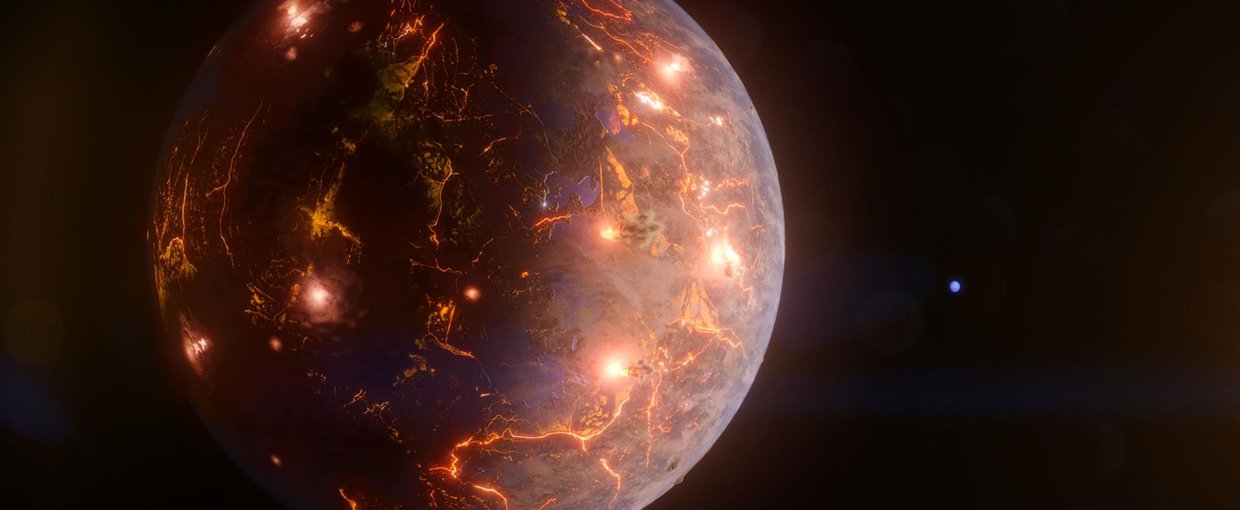
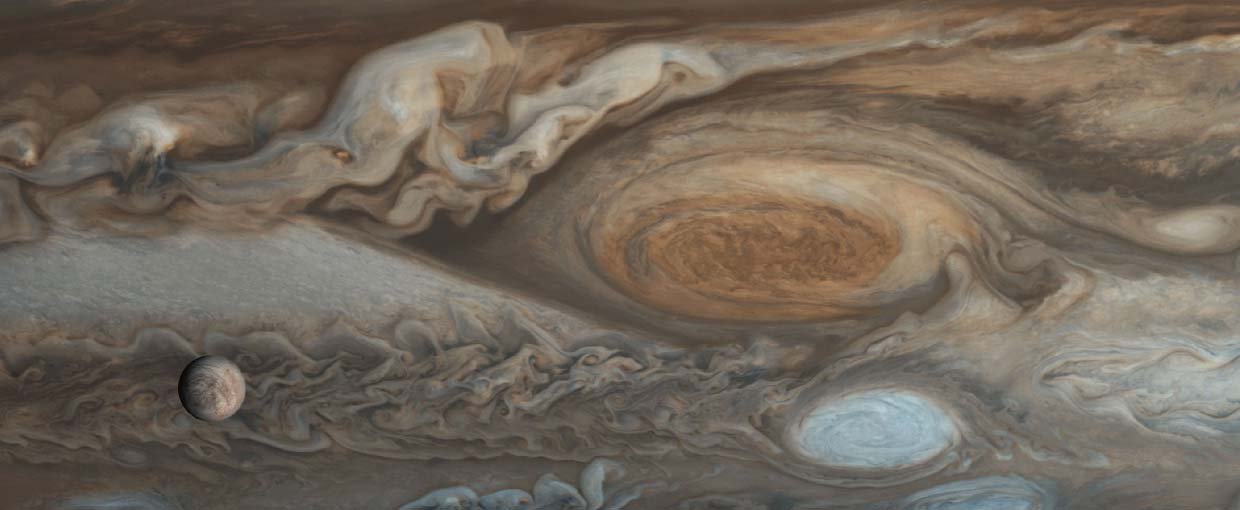
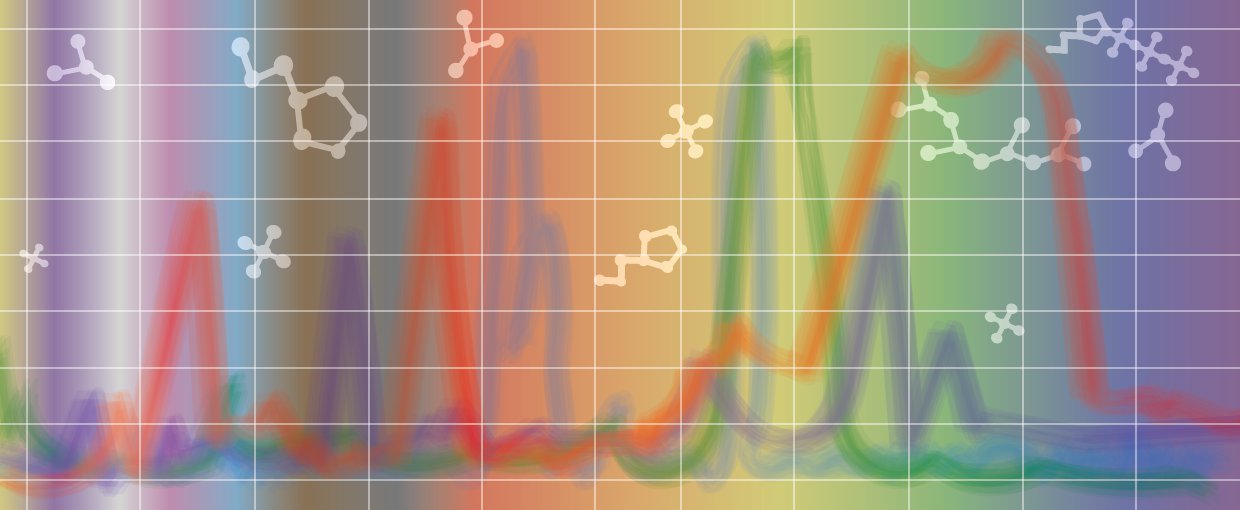
A volcanically active planet is shown in closeup at the left side of the image with glowing eruptions and lines of lava on the surface. To the right and in the distance is a faint blue glowing ball representing the more massive planet in the system.Sixteen frames from Voyager 1's flyby of Jupiter in 1979 were merged to create this image. Jupiter's Great Red Spot is visible in the center. Jupiter's moon Europa can be seen in the foreground at the bottom left of the image.The frame is a horizontal rainbow of color on a grid. Shadows of molecules can be seen through the light as well as the jagged peaks and troughs of spectral lines.
Fizzy Super Earths and Lava Worlds“Fizzy Super-Earths: Impacts of Magma Composition on the Bulk Density and Structure of Lava Worlds.” in The Astrophysical Journal.01/03
Identifying Hydrothermal Activity on Icy Ocean Worlds“Ethene-ethanol ratios as potential indicators of hydrothermal activity at Enceladus, Europa, and other icy ocean worlds.” In Icarus.02/03
NASA Raman Spectroscopic Database"The NASA Raman spectroscopic database: Ramdb version 1.00.” In Icarus.03/03
NextPrevious
Go Explore
January 2015Habitable Evaporated Cores: Transforming Mini-Neptunes into Super-Earths in the Habitable Zones of M Dwarfs

Luger, R., Barnes, R., Lopez, E., Fortney, J., Jackson, B., & Meadows, V. (2015). Astrobiology, 15(1), 57–88. doi:10.1089/ast.2014.1215

Spectroscopy and Viability of Bacillus subtilis Spores after Ultraviolet Irradiation: Implications for the Detection of Potential Bacterial Life on Europa

Noell, A. C., Ely, T., Bolser, D. K., Darrach, H., Hodyss, R., Johnson, P. V., … Hein, J. D. (2015). Astrobiology, 15(1), 20–31. doi:10.1089/ast.2014.1169

Marine sediments microbes capable of electrode oxidation as a surrogate for lithotrophic insoluble substrate metabolism

Rowe, A. R., Chellamuthu, P., Lam, B., Okamoto, A., & Nealson, K. H. (2015). Frontiers in Microbiology, 5(None), None. doi:10.3389/fmicb.2014.00784

December 2014Modeling the impediment of methane ebullition bubbles by seasonal lake ice

Greene, S., Walter Anthony, K. M., Archer, D., Sepulveda-Jauregui, A., & Martinez-Cruz, K. (2014). Biogeosciences, 11(23), 6791–6811. doi:10.5194/bg-11-6791-2014

Molecular Crowding and Early Evolution

Saha, R., Pohorille, A., & Chen, I. A. (2014). Molecular Crowding and Early Evolution. Origins of Life and Evolution of Biospheres, 44(4), 319–324. doi:10.1007/s11084-014-9392-3

A large volume particulate and water multi-sampler with in situ preservation for microbial and biogeochemical studies

Breier, J. A., Sheik, C. S., Gomez-Ibanez, D., Sayre-McCord, R. T., Sanger, R., Rauch, C., … Dick, G. J. (2014). A large volume particulate and water multi-sampler with in situ preservation for microbial and biogeochemical studies. Deep Sea Research Part I: Oceanographic Research Papers, 94, 195–206. doi:10.1016/j.dsr.2014.08.008

Graphitic Carbons and Biosignatures

Bernard, S., & Papineau, D. (2014). Elements, 10(6), 435–440. doi:10.2113/gselements.10.6.435

Community Structure and Biogeochemical Impacts of Microbial Life on Floating Pumice

Elser, J. J., Bastidas Navarro, M., Corman, J. R., Emick, H., Kellom, M., Laspoumaderes, C., … Lee, Z. M. (2014). Appl. Environ. Microbiol., 81(5), 1542–1549. doi:10.1128/aem.03160-14

The structure of water-saturated carbonate melts

Foustoukos, D. I., & Mysen, B. O. (2014). American Mineralogist, 100(1), 35–46. doi:10.2138/am-2015-4856

Modeling the Raman Spectrum of Graphitic Material in Rock Samples with Fluorescence Backgrounds: Accuracy of Fitting and Uncertainty Estimation

Gasda, P. J., & Ogliore, R. C. (2014). appl spectrosc, 68(12), 1393–1406. doi:10.1366/13-07318