

This website is currently being migrated. For the most up-to-date astrobiology news, resources, and community announcements, please visit our new home at science.nasa.gov/astrobiology

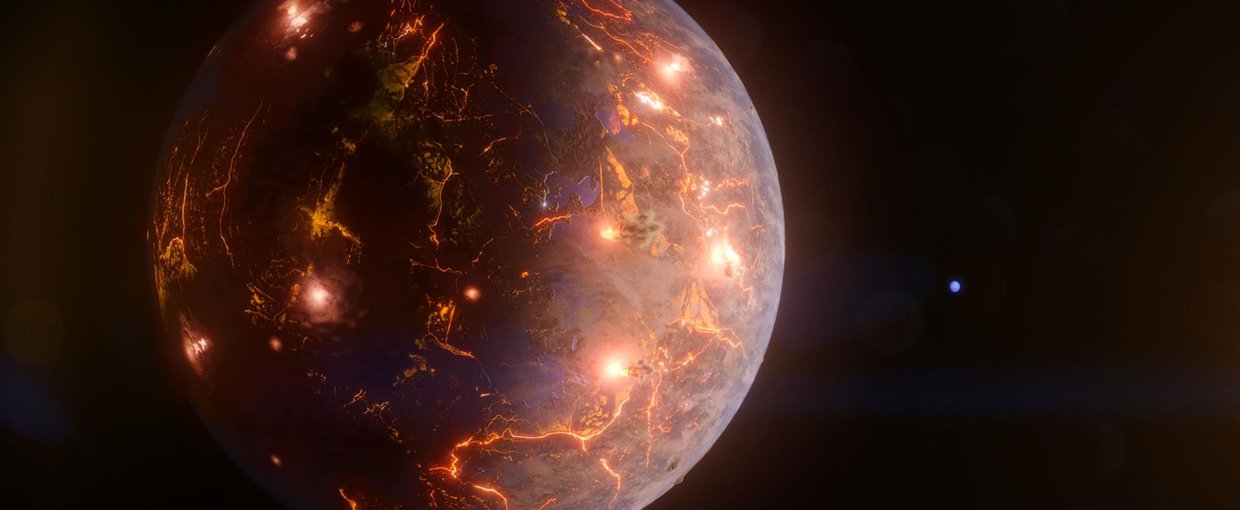
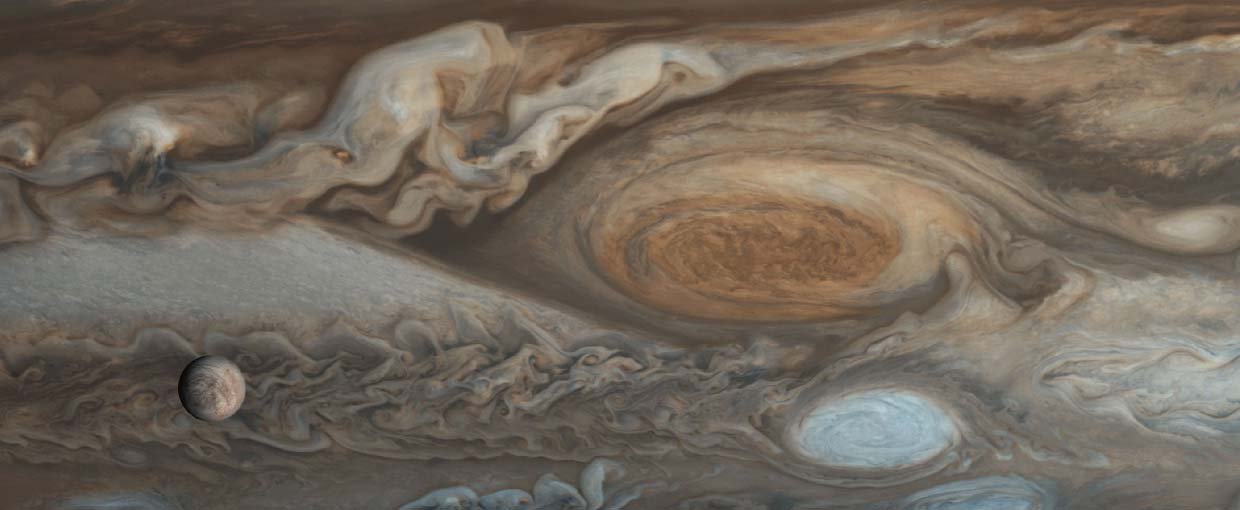
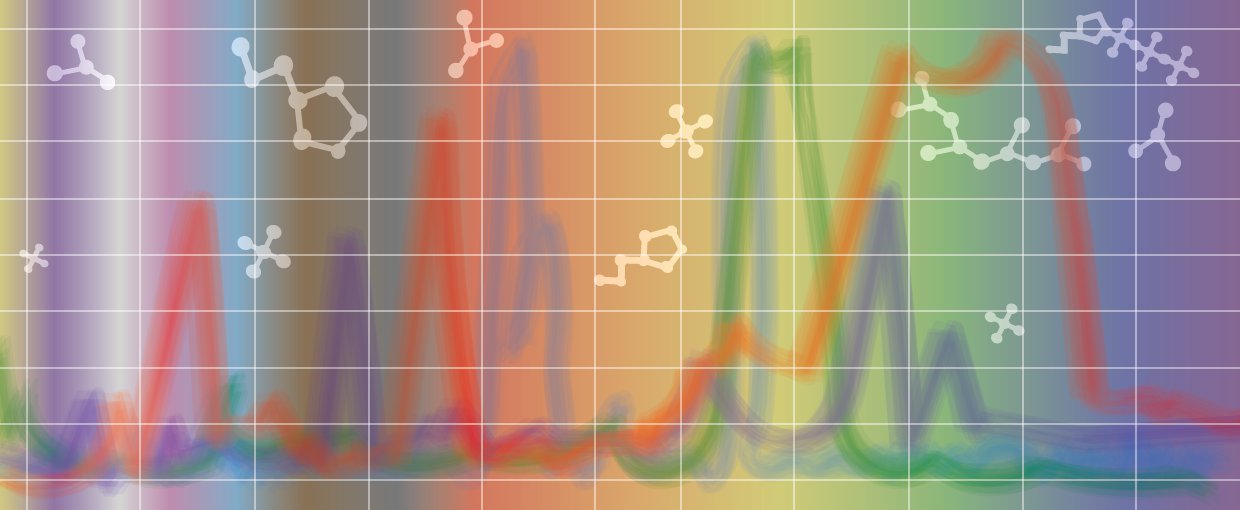
A volcanically active planet is shown in closeup at the left side of the image with glowing eruptions and lines of lava on the surface. To the right and in the distance is a faint blue glowing ball representing the more massive planet in the system.Sixteen frames from Voyager 1's flyby of Jupiter in 1979 were merged to create this image. Jupiter's Great Red Spot is visible in the center. Jupiter's moon Europa can be seen in the foreground at the bottom left of the image.The frame is a horizontal rainbow of color on a grid. Shadows of molecules can be seen through the light as well as the jagged peaks and troughs of spectral lines.
Fizzy Super Earths and Lava Worlds“Fizzy Super-Earths: Impacts of Magma Composition on the Bulk Density and Structure of Lava Worlds.” in The Astrophysical Journal.01/03
Identifying Hydrothermal Activity on Icy Ocean Worlds“Ethene-ethanol ratios as potential indicators of hydrothermal activity at Enceladus, Europa, and other icy ocean worlds.” In Icarus.02/03
NASA Raman Spectroscopic Database"The NASA Raman spectroscopic database: Ramdb version 1.00.” In Icarus.03/03
NextPrevious
Go Explore
January 2015Was the Ediacaran–Cambrian radiation a unique evolutionary event?

Erwin, D. H. (2015). Paleobiology, 41(01), 1–15. doi:10.1017/pab.2014.2

Assessing the distribution of sedimentary C 40 carotenoids through time

French, K. L., Rocher, D., Zumberge, J. E., & Summons, R. E. (2015). Geobiology, 13(2), 139–151. doi:10.1111/gbi.12126

Argon diffusion in Apollo 16 impact glass spherules: Implications for 40Ar/39Ar dating of lunar impact events

Gombosi, D. J., Baldwin, S. L., Watson, E. B., Swindle, T. D., Delano, J. W., & Roberge, W. G. (2015). Geochimica et Cosmochimica Acta, 148(None), 251–268. doi:10.1016/j.gca.2014.09.031

Metagenomic insights into S(0) precipitation in a terrestrial subsurface lithoautotrophic ecosystem

Hamilton, T. L., Jones, D. S., Schaperdoth, I., & Macalady, J. L. (2015). Frontiers in Microbiology, 5(None), None. doi:10.3389/fmicb.2014.00756

Detecting Regular Sound Changes in Linguistics as Events of Concerted Evolution

Hruschka, D. J., Branford, S., Smith, E. D., Wilkins, J., Meade, A., Pagel, M., & Bhattacharya, T. (2015). Current Biology, 25(1), 1–9. doi:10.1016/j.cub.2014.10.064

EXO-ZODI MODELING FOR THE LARGE BINOCULAR TELESCOPE INTERFEROMETER

Kennedy, G. M., Wyatt, M. C., Bailey, V., Bryden, G., Danchi, W. C., Defrère, D., … Haniff, C. (2015). The Astrophysical Journal Supplement Series, 216(2), 23. doi:10.1088/0067-0049/216/2/23

A morphospace of planktonic marine diatoms. I. Two views of disparity through time

Kotrc, B., & Knoll, A. H. (2015). Paleobiology, 41(01), 45–67. doi:10.1017/pab.2014.4

A morphospace of planktonic marine diatoms. I. Two views of disparity through time

Kotrc, B., & Knoll, A. H. (2015). Paleobiology, 41(01), 45–67. doi:10.1017/pab.2014.4

A morphospace of planktonic marine diatoms. II. Sampling standardization and spatial disparity partitioning

Kotrc, B., & Knoll, A. H. (2015). Paleobiology, 41(01), 68–88. doi:10.1017/pab.2014.5

A morphospace of planktonic marine diatoms. II. Sampling standardization and spatial disparity partitioning

Kotrc, B., & Knoll, A. H. (2015). Paleobiology, 41(01), 68–88. doi:10.1017/pab.2014.5