

This website is currently being migrated. For the most up-to-date astrobiology news, resources, and community announcements, please visit our new home at science.nasa.gov/astrobiology

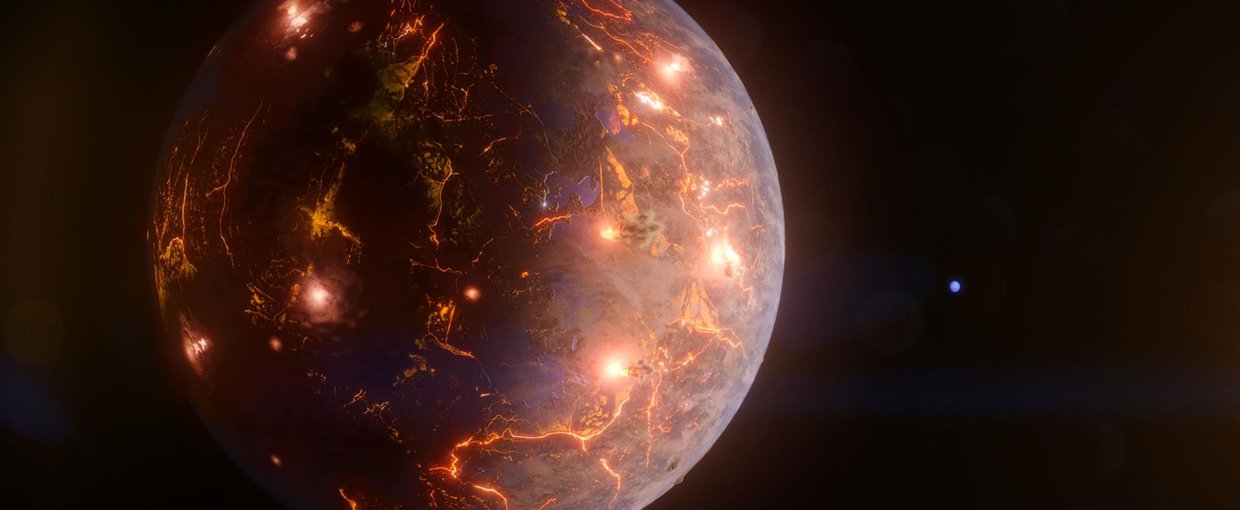
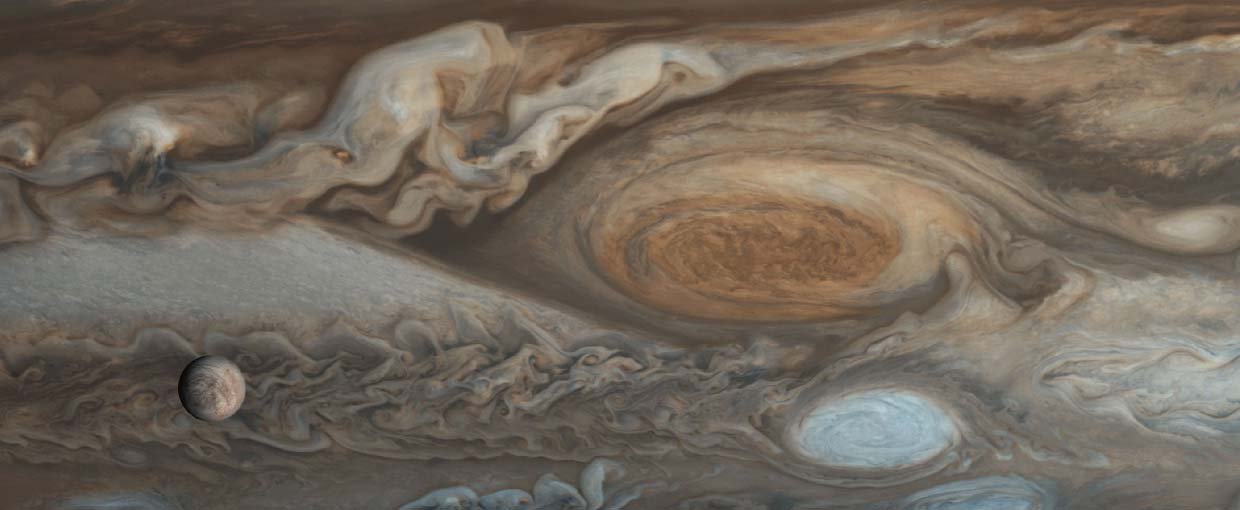
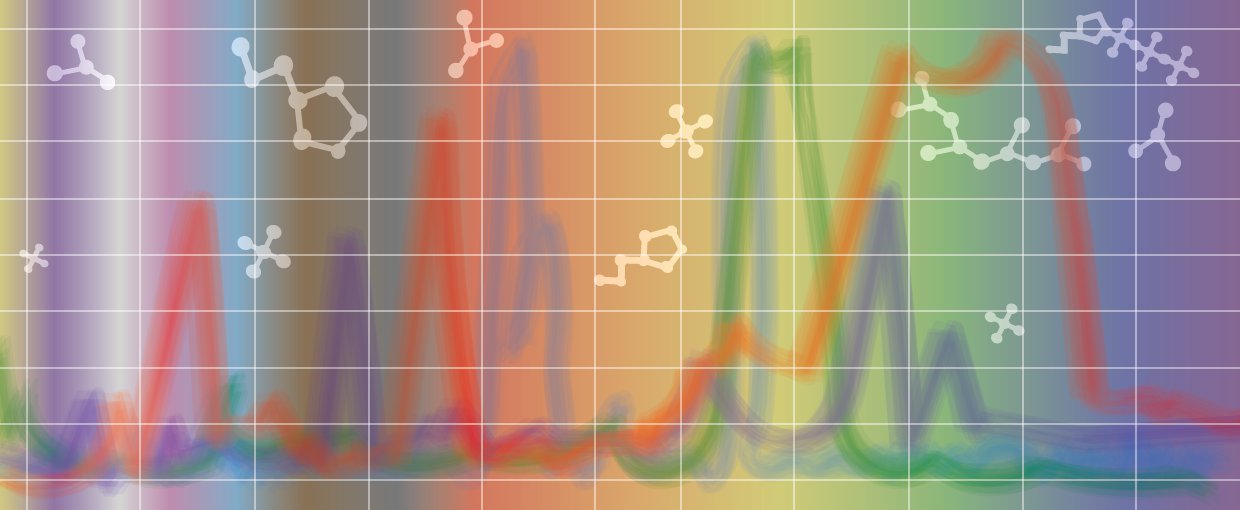
A volcanically active planet is shown in closeup at the left side of the image with glowing eruptions and lines of lava on the surface. To the right and in the distance is a faint blue glowing ball representing the more massive planet in the system.Sixteen frames from Voyager 1's flyby of Jupiter in 1979 were merged to create this image. Jupiter's Great Red Spot is visible in the center. Jupiter's moon Europa can be seen in the foreground at the bottom left of the image.The frame is a horizontal rainbow of color on a grid. Shadows of molecules can be seen through the light as well as the jagged peaks and troughs of spectral lines.
Fizzy Super Earths and Lava Worlds“Fizzy Super-Earths: Impacts of Magma Composition on the Bulk Density and Structure of Lava Worlds.” in The Astrophysical Journal.01/03
Identifying Hydrothermal Activity on Icy Ocean Worlds“Ethene-ethanol ratios as potential indicators of hydrothermal activity at Enceladus, Europa, and other icy ocean worlds.” In Icarus.02/03
NASA Raman Spectroscopic Database"The NASA Raman spectroscopic database: Ramdb version 1.00.” In Icarus.03/03
NextPrevious
Go Explore
January 2015Methane sources in arctic thermokarst lake sediments on the North Slope of Alaska

Matheus Carnevali, P. B., Rohrssen, M., Williams, M. R., Michaud, A. B., Adams, H., Berisford, D., … Love, G. D. (2015). Geobiology, 13(2), 181–197. doi:10.1111/gbi.12124

High pH microbial ecosystems in a newly discovered, ephemeral, serpentinizing fluid seep at YanartaÅŸ (Chimera), Turkey

Meyer-Dombard, D. A. R., Woycheese, K. M., Yargıçoğlu, E. N., Cardace, D., Shock, E. L., Güleçal-Pektas, Y., & Temel, M. (2015). Frontiers in Microbiology, 5(None), None. doi:10.3389/fmicb.2014.00723

Prerequisites for explosive cryovolcanism on dwarf planet-class Kuiper belt objects

Neveu, M., Desch, S. J., Shock, E. L., & Glein, C. R. (2015). Icarus, 246(None), 48–64. doi:10.1016/j.icarus.2014.03.043

Spectroscopy and Viability of Bacillus subtilis Spores after Ultraviolet Irradiation: Implications for the Detection of Potential Bacterial Life on Europa

Noell, A. C., Ely, T., Bolser, D. K., Darrach, H., Hodyss, R., Johnson, P. V., … Hein, J. D. (2015). Astrobiology, 15(1), 20–31. doi:10.1089/ast.2014.1169

Impact synthesis of the RNA bases: Fig. 1.

Rios, A. C. (2015). Proc Natl Acad Sci USA, 112(3), 643–644. doi:10.1073/pnas.1424273112

Activity and phylogenetic diversity of sulfate-reducing microorganisms in low-temperature subsurface fluids within the upper oceanic crust

Robador, A., Jungbluth, S. P., LaRowe, D. E., Bowers, R. M., Rappé, M. S., Amend, J. P., & Cowen, J. P. (2015). Frontiers in Microbiology, 5(None), None. doi:10.3389/fmicb.2014.00748

Cenozoic latitudinal response curves: individualistic changes in the latitudinal distributions of marine bivalves and gastropods

Zaffos, A. A., & Miller, A. I. (2015). Paleobiology, 41(01), 33–44. doi:10.1017/pab.2014.13

Constraints on the gas content of the Fomalhaut debris belt

Cataldi, G., Brandeker, A., Olofsson, G., Chen, C. H., Dent, W. R. F., Kamp, I., … Roberge, A. (2015). A&A, 574(None), L1. doi:10.1051/0004-6361/201425322

PHOTOCHEMISTRY OF POLYCYCLIC AROMATIC HYDROCARBONS IN COSMIC WATER ICE: THE ROLE OF PAH IONIZATION AND CONCENTRATION

Cook, A. M., Ricca, A., Mattioda, A. L., Bouwman, J., Roser, J., Linnartz, H., … Bregman, J. (2015). The Astrophysical Journal, 799(1), 14. doi:10.1088/0004-637x/799/1/14

Character displacement and the evolution of niche complementarity in a model biofilm community

Ellis, C. N., Traverse, C. C., Mayo-Smith, L., Buskirk, S. W., & Cooper, V. S. (2015). Evolution, 69(2), 283–293. doi:10.1111/evo.12581