


This website is currently being migrated. For the most up-to-date astrobiology news, resources, and community announcements, please visit our new home at science.nasa.gov/astrobiology

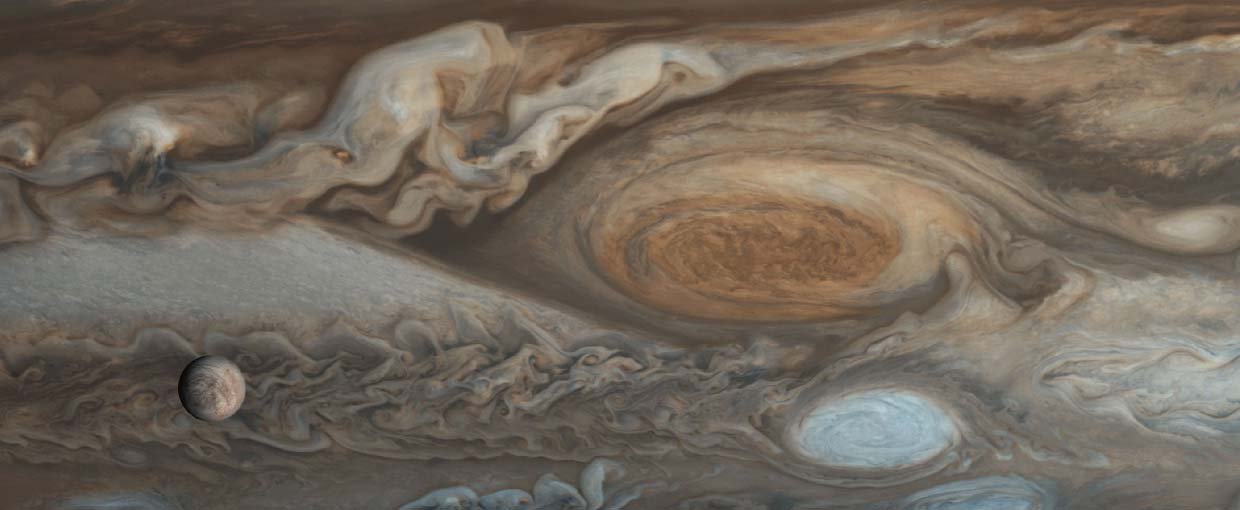
A volcanically active planet is shown in closeup at the left side of the image with glowing eruptions and lines of lava on the surface. To the right and in the distance is a faint blue glowing ball representing the more massive planet in the system.Sixteen frames from Voyager 1's flyby of Jupiter in 1979 were merged to create this image. Jupiter's Great Red Spot is visible in the center. Jupiter's moon Europa can be seen in the foreground at the bottom left of the image.The frame is a horizontal rainbow of color on a grid. Shadows of molecules can be seen through the light as well as the jagged peaks and troughs of spectral lines.
Fizzy Super Earths and Lava Worlds“Fizzy Super-Earths: Impacts of Magma Composition on the Bulk Density and Structure of Lava Worlds.” in The Astrophysical Journal.01/03
Identifying Hydrothermal Activity on Icy Ocean Worlds“Ethene-ethanol ratios as potential indicators of hydrothermal activity at Enceladus, Europa, and other icy ocean worlds.” In Icarus.02/03
NASA Raman Spectroscopic Database"The NASA Raman spectroscopic database: Ramdb version 1.00.” In Icarus.03/03
NextPrevious
Go Explore
February 2015There and back again: consequences of biofilm specialization under selection for dispersal

O’Rourke, D., FitzGerald, C. E., Traverse, C. C., & Cooper, V. S. (2015). Frontiers in Genetics, 6(None), None. doi:10.3389/fgene.2015.00018

Sulfur-cycling fossil bacteria from the 1.8-Ga Duck Creek Formation provide promising evidence of evolution's null hypothesis

Schopf, J. W., Kudryavtsev, A. B., Walter, M. R., Van Kranendonk, M. J., Williford, K. H., Kozdon, R., … Valley, J. W. (2015). Proc Natl Acad Sci USA, 112(7), 2087–2092. doi:10.1073/pnas.1419241112

Stable isotope labeling confirms mixotrophic nature of streamer biofilm communities at alkaline hot springs

Schubotz, F., Hays, L. E., Meyer-Dombard, D. A. R., Gillespie, A., Shock, E. L., & Summons, R. E. (2015). Frontiers in Microbiology, 6(None), None. doi:10.3389/fmicb.2015.00042

Selenium isotopes support free O2 in the latest Archean

Stueken, E. E., Buick, R., & Anbar, A. D. (2015). Geology, 43(3), 259–262. doi:10.1130/g36218.1

Isotopic evidence for biological nitrogen fixation by molybdenum-nitrogenase from 3.2 Gyr

Stüeken, E. E., Buick, R., Guy, B. M., & Koehler, M. C. (2015). Nature, 520(7549), 666–669. doi:10.1038/nature14180

Nitrogen isotope evidence for alkaline lakes on late Archean continents

Stüeken, E. E., Buick, R., & Schauer, A. J. (2015). Earth and Planetary Science Letters, 411(None), 1–10. doi:10.1016/j.epsl.2014.11.037

Taphonomy and morphology of the Ediacara form genus Aspidella

Tarhan, L. G., Droser, M. L., Gehling, J. G., & Dzaugis, M. P. (2015). Precambrian Research, 257(None), 124–136. doi:10.1016/j.precamres.2014.11.026

The catalytic effect of bound extracellular polymeric substances excreted by anaerobic microorganisms on Ca-Mg carbonate precipitation: Implications for the "dolomite problem"

Zhang, F., Xu, H., Shelobolina, E. S., Konishi, H., Converse, B., Shen, Z., & Roden, E. E. (2015). American Mineralogist, 100(2-3), 483–494. doi:10.2138/am-2015-4999

Field effect transistors based on semiconductive microbially synthesized chalcogenide nanofibers

McFarlane, I. R., Lazzari-Dean, J. R., & El-Naggar, M. Y. (2015). Acta Biomaterialia, 13(None), 364–373. doi:10.1016/j.actbio.2014.11.005

Ex-phot: a new take on primitive utilization of solar energy

Nealson, K. H. (2015). Environmental Microbiology Reports, 7(1), 33–35. doi:10.1111/1758-2229.12256