

This website is currently being migrated. For the most up-to-date astrobiology news, resources, and community announcements, please visit our new home at science.nasa.gov/astrobiology

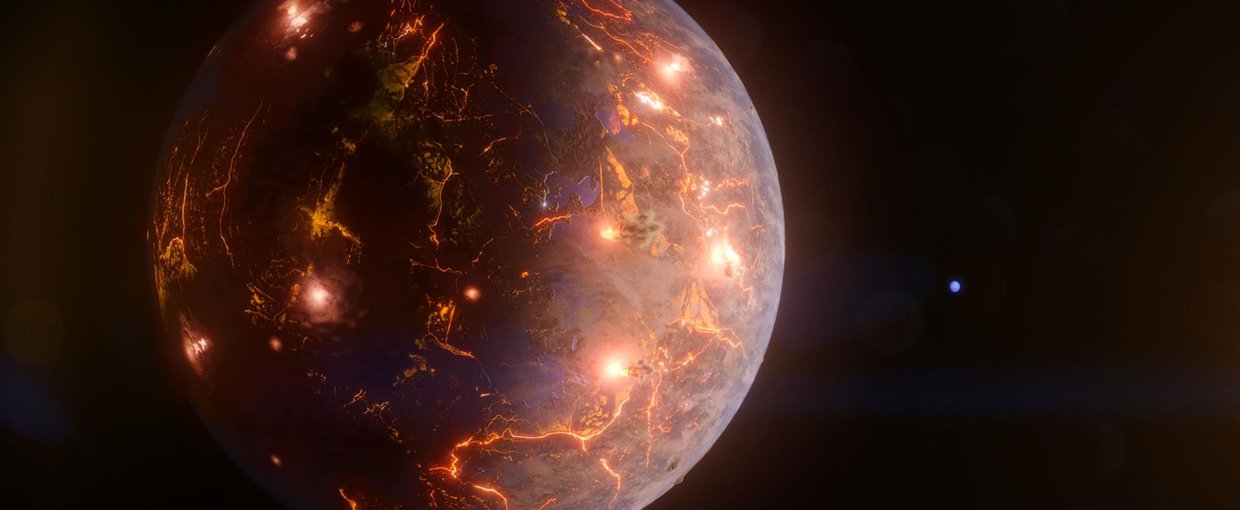
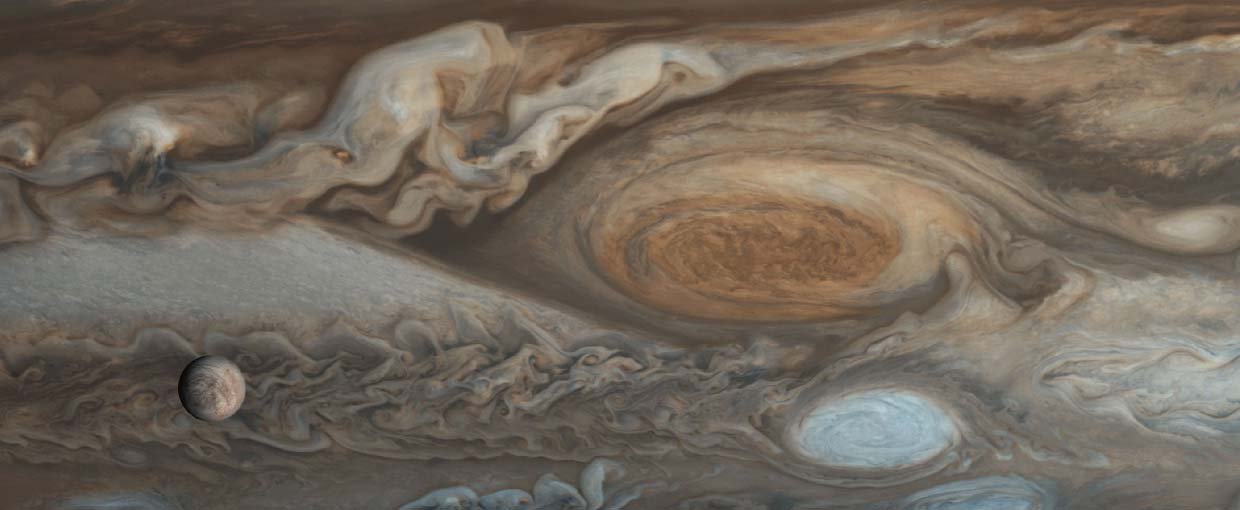
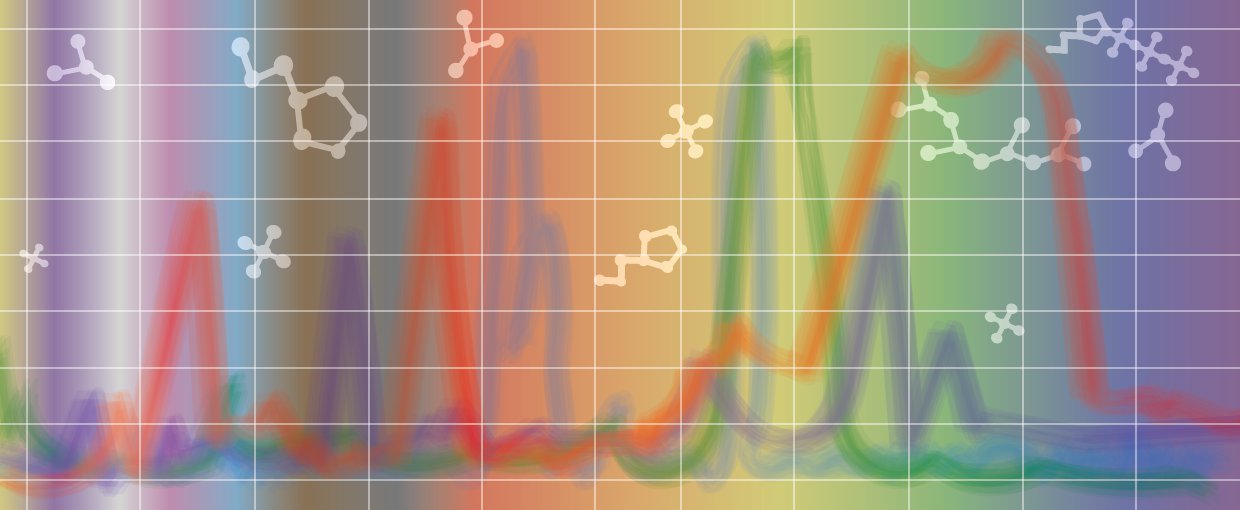
A volcanically active planet is shown in closeup at the left side of the image with glowing eruptions and lines of lava on the surface. To the right and in the distance is a faint blue glowing ball representing the more massive planet in the system.Sixteen frames from Voyager 1's flyby of Jupiter in 1979 were merged to create this image. Jupiter's Great Red Spot is visible in the center. Jupiter's moon Europa can be seen in the foreground at the bottom left of the image.The frame is a horizontal rainbow of color on a grid. Shadows of molecules can be seen through the light as well as the jagged peaks and troughs of spectral lines.
Fizzy Super Earths and Lava Worlds“Fizzy Super-Earths: Impacts of Magma Composition on the Bulk Density and Structure of Lava Worlds.” in The Astrophysical Journal.01/03
Identifying Hydrothermal Activity on Icy Ocean Worlds“Ethene-ethanol ratios as potential indicators of hydrothermal activity at Enceladus, Europa, and other icy ocean worlds.” In Icarus.02/03
NASA Raman Spectroscopic Database"The NASA Raman spectroscopic database: Ramdb version 1.00.” In Icarus.03/03
NextPrevious
Go Explore
February 2015Sulfur-cycling fossil bacteria from the 1.8-Ga Duck Creek Formation provide promising evidence of evolution's null hypothesis

Schopf, J. W., Kudryavtsev, A. B., Walter, M. R., Van Kranendonk, M. J., Williford, K. H., Kozdon, R., … Valley, J. W. (2015). Proc Natl Acad Sci USA, 112(7), 2087–2092. doi:10.1073/pnas.1419241112

Stable isotope labeling confirms mixotrophic nature of streamer biofilm communities at alkaline hot springs

Schubotz, F., Hays, L. E., Meyer-Dombard, D. A. R., Gillespie, A., Shock, E. L., & Summons, R. E. (2015). Frontiers in Microbiology, 6(None), None. doi:10.3389/fmicb.2015.00042

Taphonomy and morphology of the Ediacara form genus Aspidella

Tarhan, L. G., Droser, M. L., Gehling, J. G., & Dzaugis, M. P. (2015). Precambrian Research, 257(None), 124–136. doi:10.1016/j.precamres.2014.11.026

Autonomous soil analysis by the Mars Micro-beam Raman Spectrometer (MMRS) on-board a rover in the Atacama Desert: a terrestrial test for planetary exploration

Wei, J., Wang, A., Lambert, J. L., Wettergreen, D., Cabrol, N., Warren-Rhodes, K., & Zacny, K. (2015). Journal of Raman Spectroscopy, 46(10), 810–821. doi:10.1002/jrs.4656

The catalytic effect of bound extracellular polymeric substances excreted by anaerobic microorganisms on Ca-Mg carbonate precipitation: Implications for the "dolomite problem"

Zhang, F., Xu, H., Shelobolina, E. S., Konishi, H., Converse, B., Shen, Z., & Roden, E. E. (2015). American Mineralogist, 100(2-3), 483–494. doi:10.2138/am-2015-4999

RASTtk: A modular and extensible implementation of the RAST algorithm for building custom annotation pipelines and annotating batches of genomes

Brettin, T., Davis, J. J., Disz, T., Edwards, R. A., Gerdes, S., Olsen, G. J., … Olson, R. (2015). Scientific Reports, 5(None), 8365. doi:10.1038/srep08365

ETHYL CYANIDE ON TITAN: SPECTROSCOPIC DETECTION AND MAPPING USING ALMA

Cordiner, M. A., Palmer, M. Y., Nixon, C. A., Irwin, P. G. J., Teanby, N. A., Charnley, S. B., … Mumma, M. J. (2015). The Astrophysical Journal, 800(1), L14. doi:10.1088/2041-8205/800/1/l14

Effects of clay minerals on the aggregation and subsequent settling of marine Synechococcus

Deng, W., Monks, L., & Neuer, S. (2015). Limnology and Oceanography, 60(3), 805–816. doi:10.1002/lno.10059

Curiosity's Mission of Exploration at Gale Crater, Mars

Grotzinger, J. P., Crisp, J. A., & Vasavada, A. R. (2015). Elements, 11(1), 19–26. doi:10.2113/gselements.11.1.19