

This website is currently being migrated. For the most up-to-date astrobiology news, resources, and community announcements, please visit our new home at science.nasa.gov/astrobiology

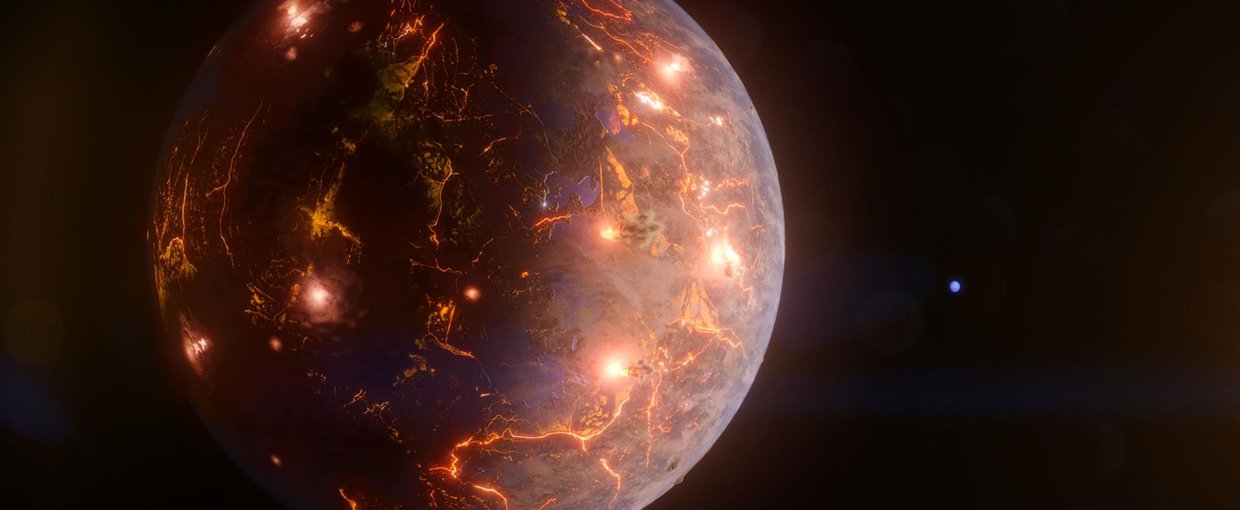
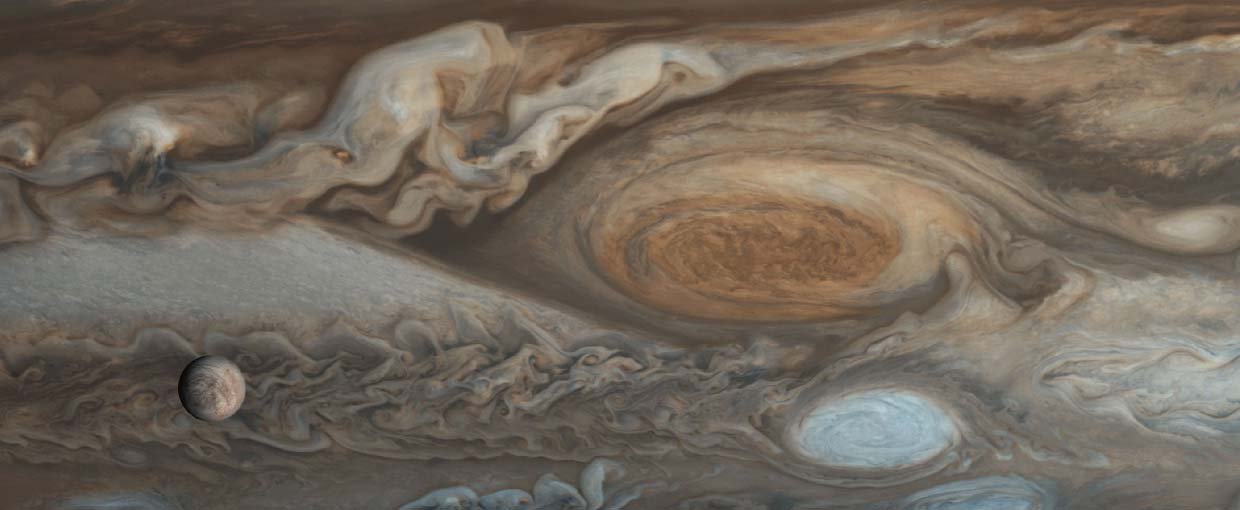
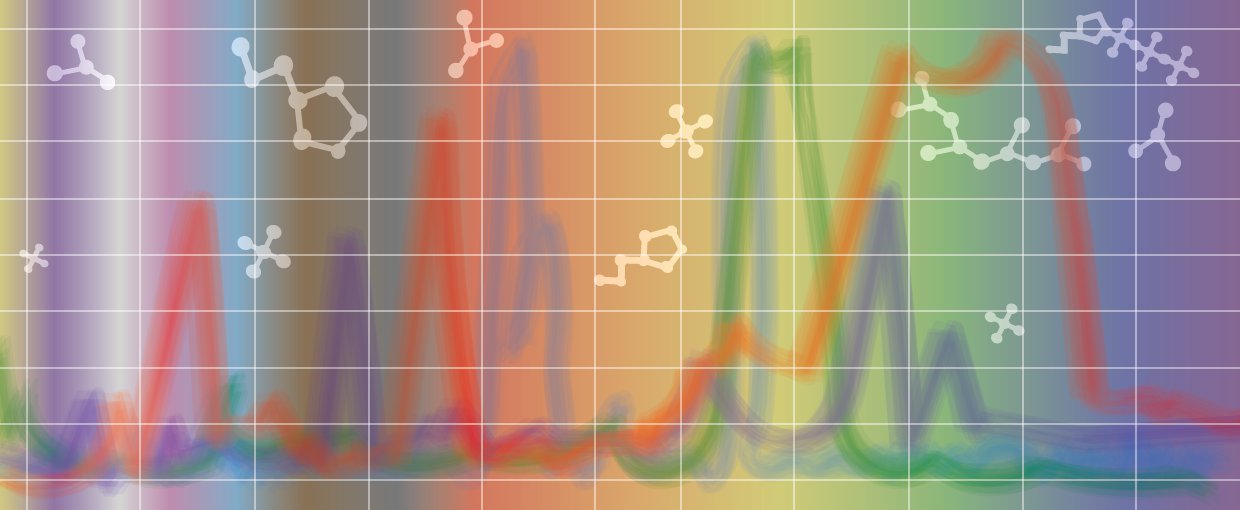
A volcanically active planet is shown in closeup at the left side of the image with glowing eruptions and lines of lava on the surface. To the right and in the distance is a faint blue glowing ball representing the more massive planet in the system.Sixteen frames from Voyager 1's flyby of Jupiter in 1979 were merged to create this image. Jupiter's Great Red Spot is visible in the center. Jupiter's moon Europa can be seen in the foreground at the bottom left of the image.The frame is a horizontal rainbow of color on a grid. Shadows of molecules can be seen through the light as well as the jagged peaks and troughs of spectral lines.
Fizzy Super Earths and Lava Worlds“Fizzy Super-Earths: Impacts of Magma Composition on the Bulk Density and Structure of Lava Worlds.” in The Astrophysical Journal.01/03
Identifying Hydrothermal Activity on Icy Ocean Worlds“Ethene-ethanol ratios as potential indicators of hydrothermal activity at Enceladus, Europa, and other icy ocean worlds.” In Icarus.02/03
NASA Raman Spectroscopic Database"The NASA Raman spectroscopic database: Ramdb version 1.00.” In Icarus.03/03
NextPrevious
Go Explore
February 2015Episodic photic zone euxinia in the northeastern Panthalassic Ocean during the end-Triassic extinction

Kasprak, A. H., Sepulveda, J., Price-Waldman, R., Williford, K. H., Schoepfer, S. D., Haggart, J. W., … Ward, P. D. (2015). Geology, 43(4), 307–310. doi:10.1130/g36371.1

THE CALIFORNIA PLANET SURVEY IV: A PLANET ORBITING THE GIANT STAR HD 145934 AND UPDATES TO SEVEN SYSTEMS WITH LONG-PERIOD PLANETS

Katherina Feng, Y., Wright, J. T., Nelson, B., Wang, S. X., Ford, E. B., Marcy, G. W., … Isaacson, H. (2015). The Astrophysical Journal, 800(1), 22. doi:10.1088/0004-637x/800/1/22

A kinetic pressure effect on the experimental abiotic reduction of aqueous CO2 to methane from 1 to 3.5kbar at 300°C

Lazar, C., Cody, G. D., & Davis, J. M. (2015). Geochimica et Cosmochimica Acta, 151(None), 34–48. doi:10.1016/j.gca.2014.11.010

Alkali influence on the water speciation and the environment of protons in silicate glasses revealed by 1H MAS NMR spectroscopy

Le Losq, C., Cody, G. D., & Mysen, B. O. (2015). American Mineralogist, 100(2-3), 466–473. doi:10.2138/am-2015-5004

Marine redox conditions in the middle Proterozoic ocean and isotopic constraints on authigenic carbonate formation: Insights from the Chuanlinggou Formation, Yanshan Basin, North China

Li, C., Planavsky, N. J., Love, G. D., Reinhard, C. T., Hardisty, D., Feng, L., … Bates, S. M. (2015). Geochimica et Cosmochimica Acta, 150(None), 90–105. doi:10.1016/j.gca.2014.12.005

Enriching distinctive microbial communities from marine sediments via an electrochemical-sulfide-oxidizing process on carbon electrodes

Li, S-L., & Nealson, K. H. (2015). Frontiers in Microbiology, 6(None), None. doi:10.3389/fmicb.2015.00111

Extreme Water Loss and Abiotic O 2 Buildup on Planets Throughout the Habitable Zones of M Dwarfs

Luger, R., & Barnes, R. (2015). Astrobiology, 15(2), 119–143. doi:10.1089/ast.2014.1231

Comparative microbial diversity and redox environments of black shale and stromatolite facies in the Mesoproterozoic Xiamaling Formation

Luo, G., Hallmann, C., Xie, S., Ruan, X., & Summons, R. E. (2015). Geochimica et Cosmochimica Acta, 151(None), 150–167. doi:10.1016/j.gca.2014.12.022

Field effect transistors based on semiconductive microbially synthesized chalcogenide nanofibers

McFarlane, I. R., Lazzari-Dean, J. R., & El-Naggar, M. Y. (2015). Acta Biomaterialia, 13(None), 364–373. doi:10.1016/j.actbio.2014.11.005

Core cracking and hydrothermal circulation can profoundly affect Ceres' geophysical evolution

Neveu, M., Desch, S. J., & Castillo-Rogez, J. C. (2015). Journal of Geophysical Research: Planets, 120(2), 123–154. doi:10.1002/2014je004714