

This website is currently being migrated. For the most up-to-date astrobiology news, resources, and community announcements, please visit our new home at science.nasa.gov/astrobiology

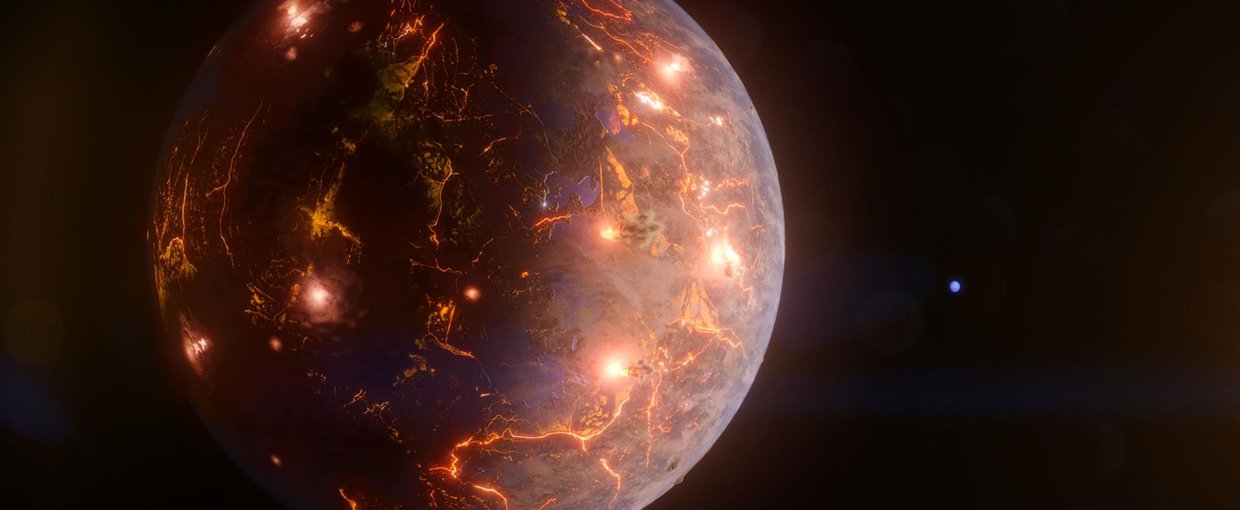
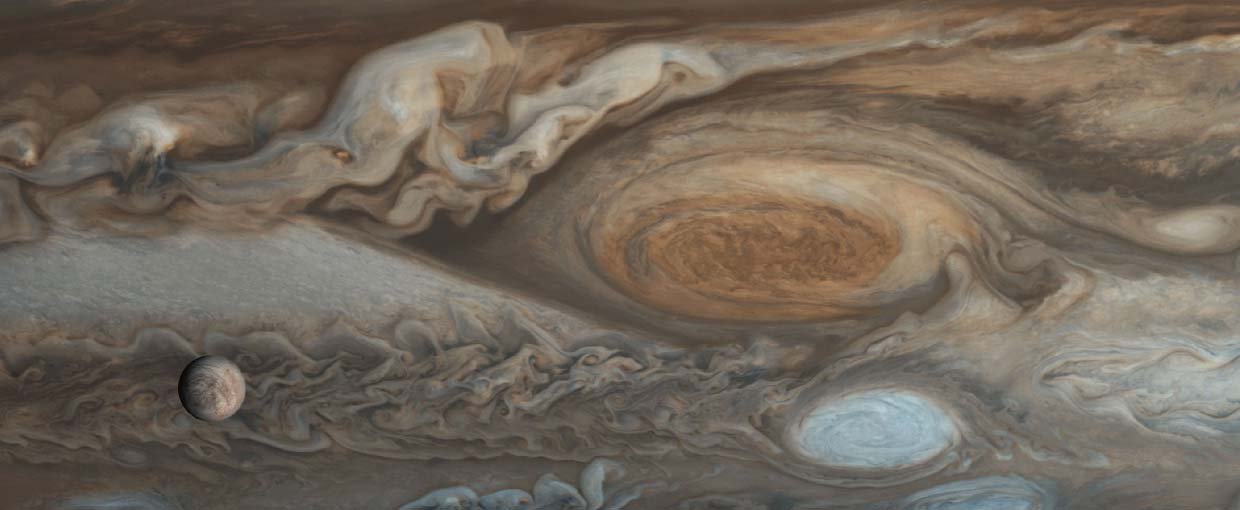
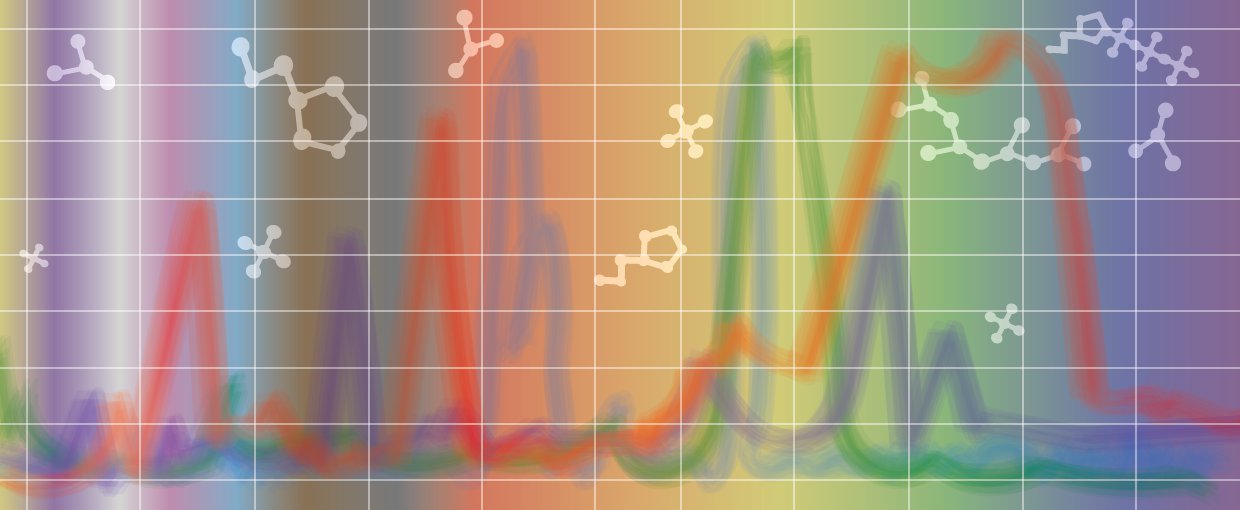
A volcanically active planet is shown in closeup at the left side of the image with glowing eruptions and lines of lava on the surface. To the right and in the distance is a faint blue glowing ball representing the more massive planet in the system.Sixteen frames from Voyager 1's flyby of Jupiter in 1979 were merged to create this image. Jupiter's Great Red Spot is visible in the center. Jupiter's moon Europa can be seen in the foreground at the bottom left of the image.The frame is a horizontal rainbow of color on a grid. Shadows of molecules can be seen through the light as well as the jagged peaks and troughs of spectral lines.
Fizzy Super Earths and Lava Worlds“Fizzy Super-Earths: Impacts of Magma Composition on the Bulk Density and Structure of Lava Worlds.” in The Astrophysical Journal.01/03
Identifying Hydrothermal Activity on Icy Ocean Worlds“Ethene-ethanol ratios as potential indicators of hydrothermal activity at Enceladus, Europa, and other icy ocean worlds.” In Icarus.02/03
NASA Raman Spectroscopic Database"The NASA Raman spectroscopic database: Ramdb version 1.00.” In Icarus.03/03
NextPrevious
Go Explore
March 2015M2 Proton Channel: Toward a Model of a Primitive Proton Pump

Wei, C., & Pohorille, A. (2015). Orig Life Evol Biosph, 45(1-2), 241–248. doi:10.1007/s11084-015-9421-x

Cyanobacterial diversity in benthic mats of the McMurdo Dry Valley lakes, Antarctica

Zhang, L., Jungblut, A. D., Hawes, I., Andersen, D. T., Sumner, D. Y., & Mackey, T. J. (2015). Polar Biology, 38(8), 1097–1110. doi:10.1007/s00300-015-1669-0

Catabolic rates, population sizes and doubling/replacement times of microorganisms in natural settings

LaRowe, D. E., & Amend, J. P. (2015). American Journal of Science, 315(3), 167–203. doi:10.2475/03.2015.01

Evidence for indigenous nitrogen in sedimentary and aeolian deposits from the Curiosity rover investigations at Gale crater, Mars

Stern, J. C., Sutter, B., Freissinet, C., Navarro-González, R., McKay, C. P., Archer, P. D., … Buch, A. (2015). Proc Natl Acad Sci USA, 112(14), 4245–4250. doi:10.1073/pnas.1420932112

February 2015Nanoscale records of ancient shock deformation: Reidite (ZrSiO4) in sandstone at the Ordovician Rock Elm impact crater

Cavosie, A. J., Erickson, T. M., & Timms, N. E. (2015). Nanoscale records of ancient shock deformation: Reidite (ZrSiO4) in sandstone at the Ordovician Rock Elm impact crater. Geology, 43(4), 315–318. doi:10.1130/g36489.1

ETHYL CYANIDE ON TITAN: SPECTROSCOPIC DETECTION AND MAPPING USING ALMA

Cordiner, M. A., Palmer, M. Y., Nixon, C. A., Irwin, P. G. J., Teanby, N. A., Charnley, S. B., … Wang, K-S. (2015). ETHYL CYANIDE ON TITAN: SPECTROSCOPIC DETECTION AND MAPPING USING ALMA. The Astrophysical Journal, 800(1), L14. doi:10.1088/2041-8205/800/1/l14

Synthesis of orotidine by intramolecular nucleosidation

Kim, E-K., & Krishnamurthy, R. (2015). Chem. Commun., 51(26), 5618–5621. doi:10.1039/c5cc00111k

On the Emergence of RNA

Krishnamurthy, R. (2015). On the Emergence of RNA. Israel Journal of Chemistry, 55(8), 837–850. doi:10.1002/ijch.201400180

RASTtk: A modular and extensible implementation of the RAST algorithm for building custom annotation pipelines and annotating batches of genomes

Brettin, T., Davis, J. J., Disz, T., Edwards, R. A., Gerdes, S., Olsen, G. J., … Olson, R. (2015). Scientific Reports, 5(None), 8365. doi:10.1038/srep08365

Next Generation Laser-Based Standoff Spectroscopy Techniques for Mars Exploration

Gasda, P. J., Acosta-Maeda, T. E., Lucey, P. G., Misra, A. K., Sharma, S. K., & Jeffrey Taylor, G. (2015). appl spectrosc, 69(2), 173–192. doi:10.1366/14-07483