

This website is currently being migrated. For the most up-to-date astrobiology news, resources, and community announcements, please visit our new home at science.nasa.gov/astrobiology

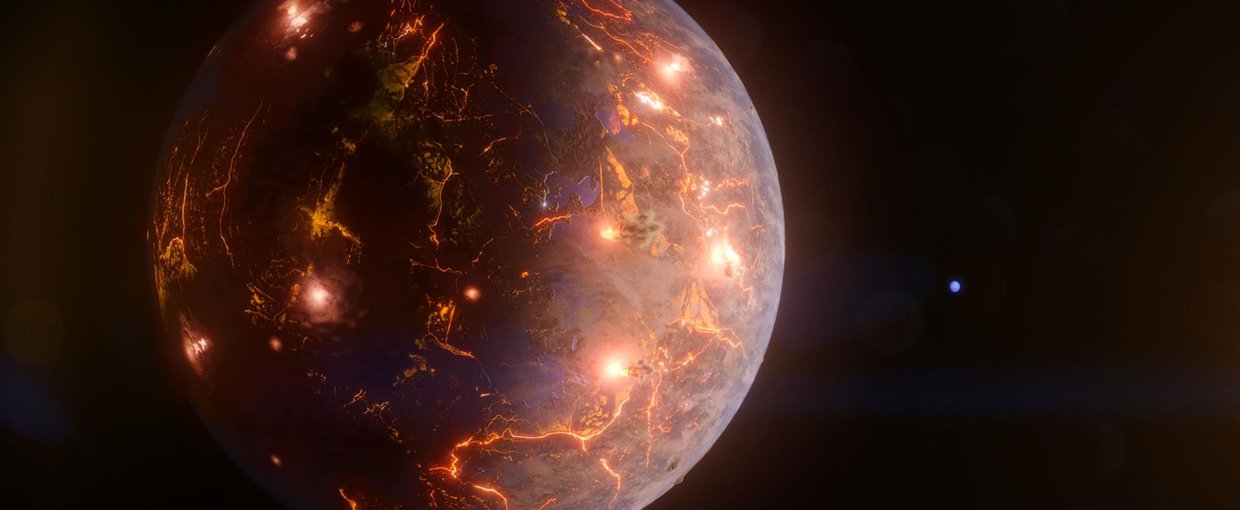
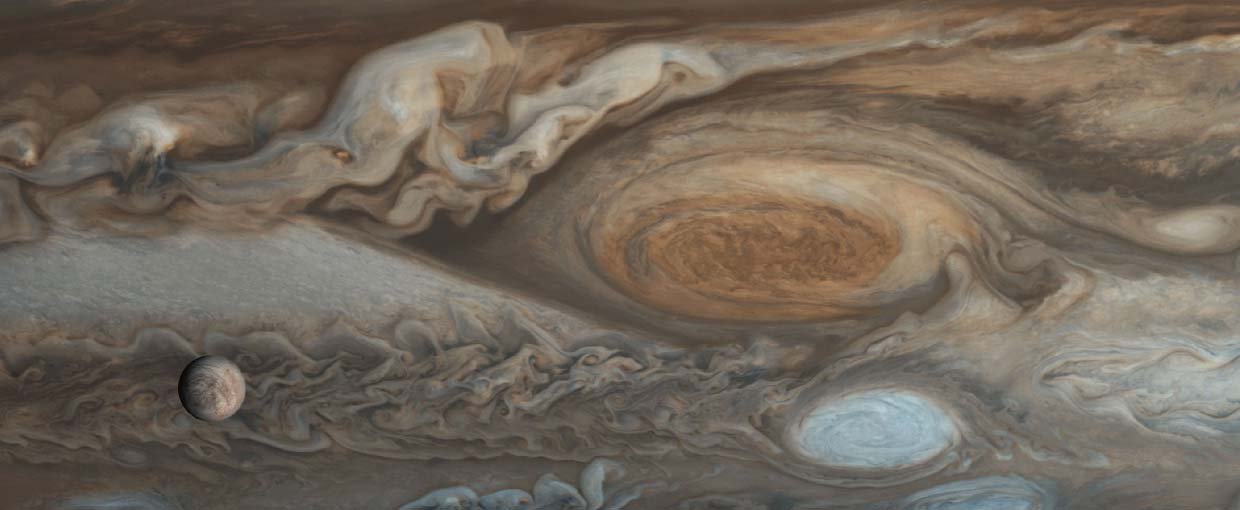
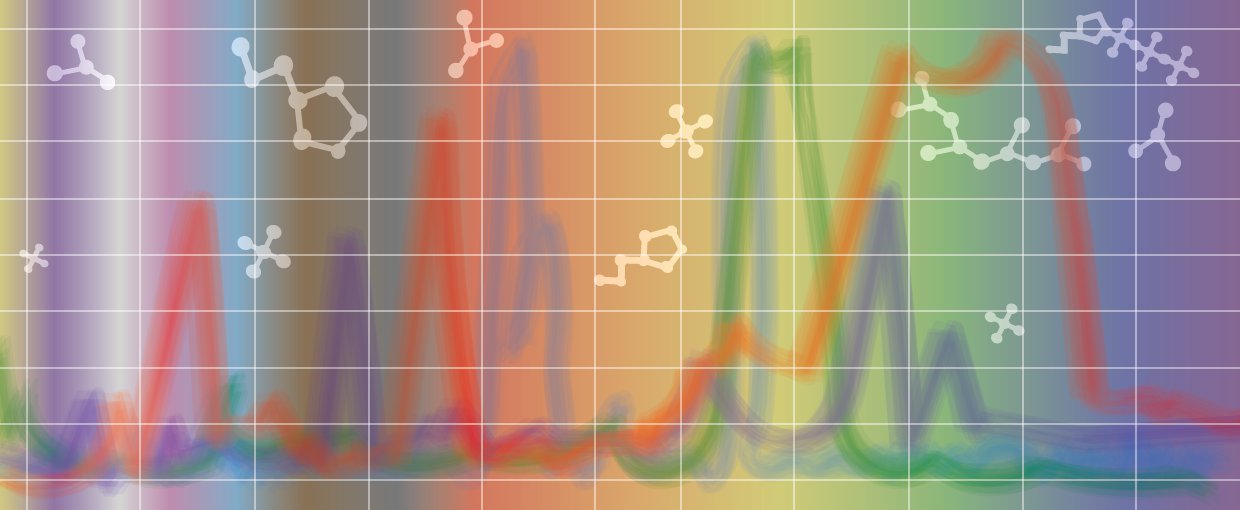
A volcanically active planet is shown in closeup at the left side of the image with glowing eruptions and lines of lava on the surface. To the right and in the distance is a faint blue glowing ball representing the more massive planet in the system.Sixteen frames from Voyager 1's flyby of Jupiter in 1979 were merged to create this image. Jupiter's Great Red Spot is visible in the center. Jupiter's moon Europa can be seen in the foreground at the bottom left of the image.The frame is a horizontal rainbow of color on a grid. Shadows of molecules can be seen through the light as well as the jagged peaks and troughs of spectral lines.
Fizzy Super Earths and Lava Worlds“Fizzy Super-Earths: Impacts of Magma Composition on the Bulk Density and Structure of Lava Worlds.” in The Astrophysical Journal.01/03
Identifying Hydrothermal Activity on Icy Ocean Worlds“Ethene-ethanol ratios as potential indicators of hydrothermal activity at Enceladus, Europa, and other icy ocean worlds.” In Icarus.02/03
NASA Raman Spectroscopic Database"The NASA Raman spectroscopic database: Ramdb version 1.00.” In Icarus.03/03
NextPrevious
Go Explore
March 2015Ancestral Reconstruction of a Pre-LUCA Aminoacyl-tRNA Synthetase Ancestor Supports the Late Addition of Trp to the Genetic Code

Fournier, G. P., & Alm, E. J. (2015). Journal of Molecular Evolution, 80(3-4), 171–185. doi:10.1007/s00239-015-9672-1

Organic molecules in the Sheepbed Mudstone, Gale Crater, Mars

Freissinet, C., Glavin, D. P., Mahaffy, P. R., Miller, K. E., Eigenbrode, J. L., Summons, R. E., … Brunner, A. E. (2015). Journal of Geophysical Research: Planets, 120(3), 495–514. doi:10.1002/2014je004737

Volvocine Algae: From Simple to Complex Multicellularity

Herron, M. D., & Nedelcu, A. M. (2015). Advances in Marine Genomics, None(None), 129–152. doi:10.1007/978-94-017-9642-2_7

Decline in oceanic sulfate levels during the early Mesoproterozoic

Luo, G., Ono, S., Huang, J., Algeo, T. J., Li, C., Zhou, L., … Robinson, A. (2015). Precambrian Research, 258(None), 36–47. doi:10.1016/j.precamres.2014.12.014

Chemical variations in Yellowknife Bay formation sedimentary rocks analyzed by ChemCam on board the Curiosity rover on Mars

Mangold, N., Forni, O., Dromart, G., Stack, K., Wiens, R. C., Gasnault, O., … Sumner, D. Y. (2015). Journal of Geophysical Research: Planets, 120(3), 452–482. doi:10.1002/2014je004681

A passive probe for subsurface oceans and liquid water in Jupiter’s icy moons

Romero-Wolf, A., Vance, S., Maiwald, F., Heggy, E., Ries, P., & Liewer, K. (2015). Icarus, 248(None), 463–477. doi:10.1016/j.icarus.2014.10.043

Modeling circulation and seasonal fluctuations in perennially ice-covered and ice-walled Lake Untersee, Antarctica

Steel, H. C. B., McKay, C. P., & Andersen, D. T. (2015). Limnology and Oceanography, 60(4), 1139–1155. doi:10.1002/lno.10086

Carbon Source Preference in Chemosynthetic Hot Spring Communities

Urschel, M. R., Kubo, M. D., Hoehler, T. M., Peters, J. W., & Boyd, E. S. (2015). Appl. Environ. Microbiol., 81(11), 3834–3847. doi:10.1128/aem.00511-15

Strong water isotopic anomalies in the martian atmosphere: Probing current and ancient reservoirs

Villanueva, G. L., Mumma, M. J., Novak, R. E., Kaufl, H. U., Hartogh, P., Encrenaz, T., … Tokunaga, A. (2015). Science, 348(6231), 218–221. doi:10.1126/science.aaa3630