

This website is currently being migrated. For the most up-to-date astrobiology news, resources, and community announcements, please visit our new home at science.nasa.gov/astrobiology

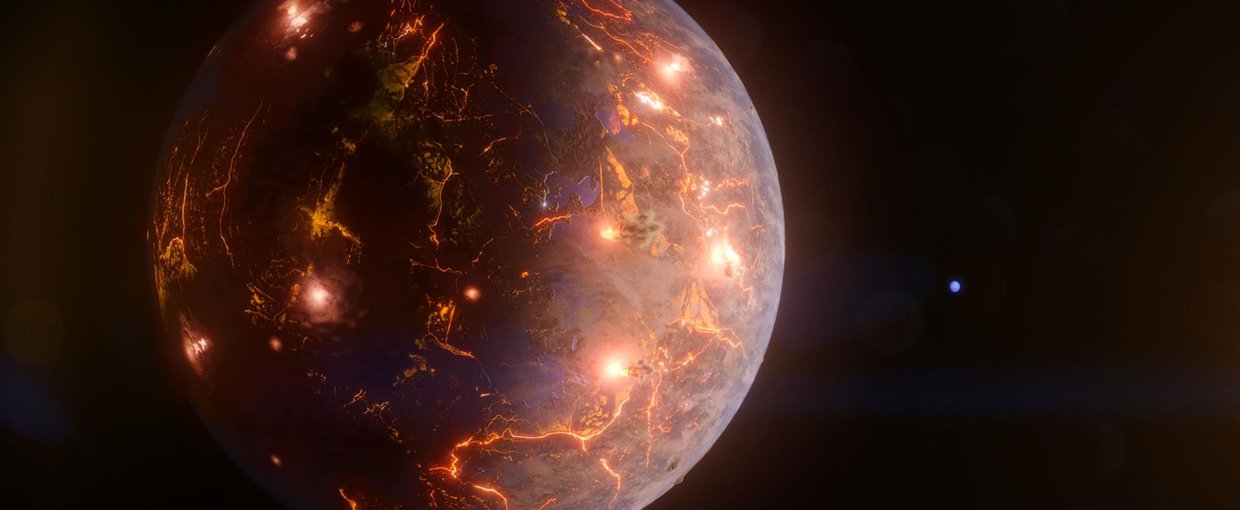
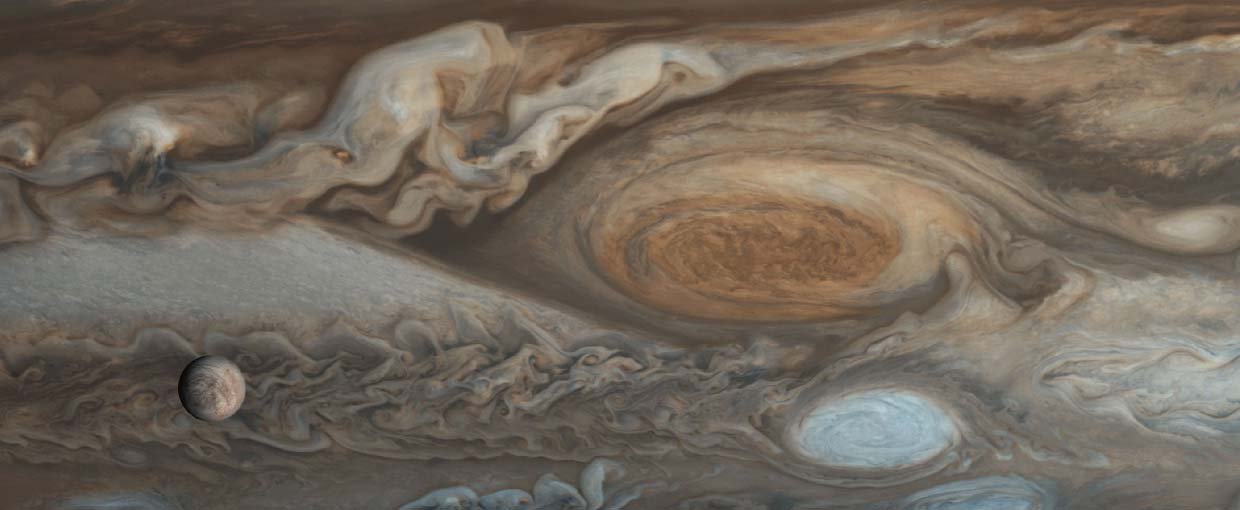
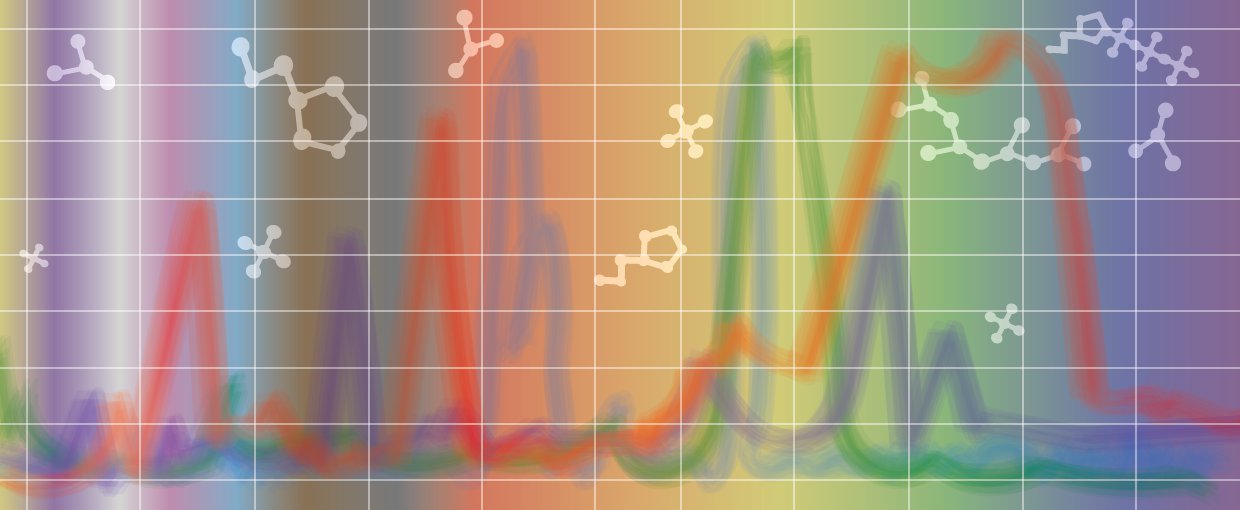
A volcanically active planet is shown in closeup at the left side of the image with glowing eruptions and lines of lava on the surface. To the right and in the distance is a faint blue glowing ball representing the more massive planet in the system.Sixteen frames from Voyager 1's flyby of Jupiter in 1979 were merged to create this image. Jupiter's Great Red Spot is visible in the center. Jupiter's moon Europa can be seen in the foreground at the bottom left of the image.The frame is a horizontal rainbow of color on a grid. Shadows of molecules can be seen through the light as well as the jagged peaks and troughs of spectral lines.
Fizzy Super Earths and Lava Worlds“Fizzy Super-Earths: Impacts of Magma Composition on the Bulk Density and Structure of Lava Worlds.” in The Astrophysical Journal.01/03
Identifying Hydrothermal Activity on Icy Ocean Worlds“Ethene-ethanol ratios as potential indicators of hydrothermal activity at Enceladus, Europa, and other icy ocean worlds.” In Icarus.02/03
NASA Raman Spectroscopic Database"The NASA Raman spectroscopic database: Ramdb version 1.00.” In Icarus.03/03
NextPrevious
Go Explore
March 2015Strong water isotopic anomalies in the martian atmosphere: Probing current and ancient reservoirs

Villanueva, G. L., Mumma, M. J., Novak, R. E., Kaufl, H. U., Hartogh, P., Encrenaz, T., … Tokunaga, A. (2015). Science, 348(6231), 218–221. doi:10.1126/science.aaa3630

Micro-scale quadruple sulfur isotope analysis of pyrite from the ∼3480Ma Dresser Formation: New insights into sulfur cycling on the early Earth

Wacey, D., Noffke, N., Cliff, J., Barley, M. E., & Farquhar, J. (2015). Precambrian Research, 258(None), 24–35. doi:10.1016/j.precamres.2014.12.012

Mars Reconnaissance Orbiter and Opportunity observations of the Burns formation: Crater hopping at Meridiani Planum

Arvidson, R. E., Bell, J. F., Catalano, J. G., Clark, B. C., Fox, V. K., Gellert, R., … Grotzinger, J. P. (2015). Journal of Geophysical Research: Planets, 120(3), 429–451. doi:10.1002/2014je004686

Mars Reconnaissance Orbiter and Opportunity observations of the Burns formation: Crater hopping at Meridiani Planum

Arvidson, R. E., Bell, J. F., Catalano, J. G., Clark, B. C., Fox, V. K., Gellert, R., … Grotzinger, J. P. (2015). Journal of Geophysical Research: Planets, 120(3), 429–451. doi:10.1002/2014je004686

LONG-LIVED CHAOTIC ORBITAL EVOLUTION OF EXOPLANETS IN MEAN MOTION RESONANCES WITH MUTUAL INCLINATIONS

Barnes, R., Deitrick, R., Greenberg, R., Quinn, T. R., & Raymond, S. N. (2015). The Astrophysical Journal, 801(2), 101. doi:10.1088/0004-637x/801/2/101

Evolution of Molybdenum Nitrogenase during the Transition from Anaerobic to Aerobic Metabolism

Boyd, E. S., Costas, A. M. G., Hamilton, T. L., Mus, F., & Peters, J. W. (2015). J. Bacteriol., 197(9), 1690–1699. doi:10.1128/jb.02611-14

Extraordinary fossils reveal the nature of Cambrian life: a commentary on Whittington (1975) 'The enigmatic animal Opabinia regalis, Middle Cambrian, Burgess Shale, British Columbia'

Briggs, D. E. G. (2015). Philosophical Transactions of the Royal Society B: Biological Sciences, 370(1666), 20140313–20140313. doi:10.1098/rstb.2014.0313

Amino acid analyses of R and CK chondrites

Burton, A. S., McLain, H., Glavin, D. P., Elsila, J. E., Davidson, J., Miller, K. E., … Andronikov, A. V. (2015). Meteoritics & Planetary Science, 50(3), 470–482. doi:10.1111/maps.12433

FOSSILS OF PUTATIVE MARINE ALGAE FROM THE CRYOGENIAN GLACIAL INTERLUDE OF MONGOLIA

Cohen, P. A., Macdonald, F. A., Pruss, S., Matys, E., & Bosak, T. (2015). PALAIOS, 30(3), 238–247. doi:10.2110/palo.2014.069

Dynamics on Networks of Manifolds

DeVille, L. (2015). SIGMA. doi:10.3842/sigma.2015.022