


This website is currently being migrated. For the most up-to-date astrobiology news, resources, and community announcements, please visit our new home at science.nasa.gov/astrobiology

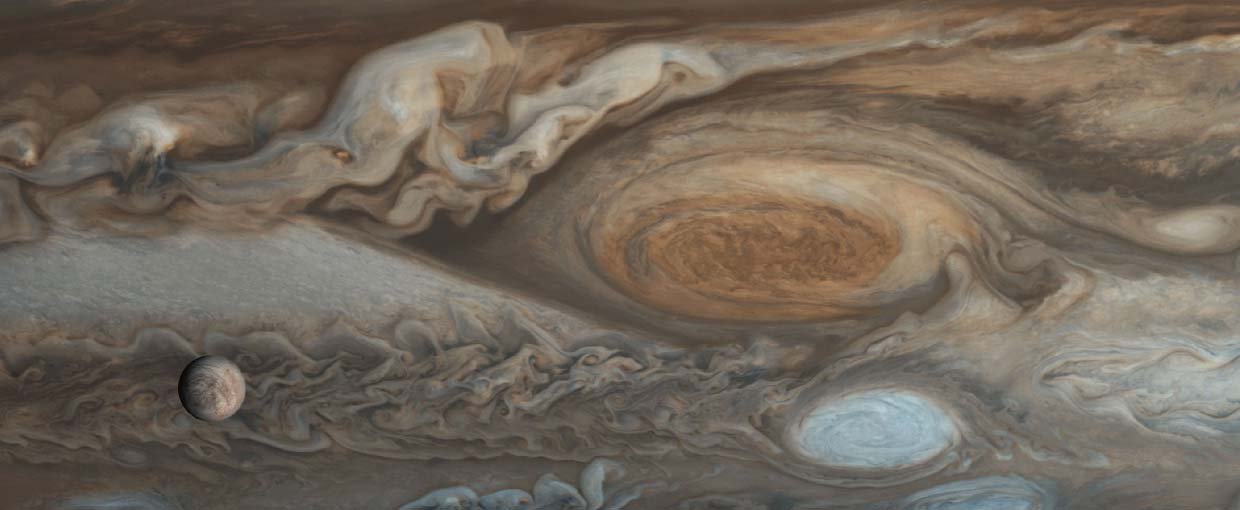
A volcanically active planet is shown in closeup at the left side of the image with glowing eruptions and lines of lava on the surface. To the right and in the distance is a faint blue glowing ball representing the more massive planet in the system.Sixteen frames from Voyager 1's flyby of Jupiter in 1979 were merged to create this image. Jupiter's Great Red Spot is visible in the center. Jupiter's moon Europa can be seen in the foreground at the bottom left of the image.The frame is a horizontal rainbow of color on a grid. Shadows of molecules can be seen through the light as well as the jagged peaks and troughs of spectral lines.
Fizzy Super Earths and Lava Worlds“Fizzy Super-Earths: Impacts of Magma Composition on the Bulk Density and Structure of Lava Worlds.” in The Astrophysical Journal.01/03
Identifying Hydrothermal Activity on Icy Ocean Worlds“Ethene-ethanol ratios as potential indicators of hydrothermal activity at Enceladus, Europa, and other icy ocean worlds.” In Icarus.02/03
NASA Raman Spectroscopic Database"The NASA Raman spectroscopic database: Ramdb version 1.00.” In Icarus.03/03
NextPrevious
Go Explore
March 2015Amino acid analyses of R and CK chondrites

Burton, A. S., McLain, H., Glavin, D. P., Elsila, J. E., Davidson, J., Miller, K. E., … Andronikov, A. V. (2015). Meteoritics & Planetary Science, 50(3), 470–482. doi:10.1111/maps.12433

FOSSILS OF PUTATIVE MARINE ALGAE FROM THE CRYOGENIAN GLACIAL INTERLUDE OF MONGOLIA

Cohen, P. A., Macdonald, F. A., Pruss, S., Matys, E., & Bosak, T. (2015). PALAIOS, 30(3), 238–247. doi:10.2110/palo.2014.069

The main-belt comets: The Pan-STARRS1 perspective

Hsieh, H. H., Denneau, L., Wainscoat, R. J., Schörghofer, N., Bolin, B., Fitzsimmons, A., … Jedicke, R. (2015). Icarus, 248(None), 289–312. doi:10.1016/j.icarus.2014.10.031

Extraordinarily Adaptive Properties of the Genetically Encoded Amino Acids

Ilardo, M., Meringer, M., Freeland, S., Rasulev, B., & James Cleaves II, H. (2015). Scientific Reports, 5(None), 9414. doi:10.1038/srep09414

Catabolic rates, population sizes and doubling/replacement times of microorganisms in natural settings

LaRowe, D. E., & Amend, J. P. (2015). American Journal of Science, 315(3), 167–203. doi:10.2475/03.2015.01

Decline in oceanic sulfate levels during the early Mesoproterozoic

Luo, G., Ono, S., Huang, J., Algeo, T. J., Li, C., Zhou, L., … Robinson, A. (2015). Precambrian Research, 258(None), 36–47. doi:10.1016/j.precamres.2014.12.014

Solubility of Polyethers in Hydrocarbons at Low Temperatures. A Model for Potential Genetic Backbones on Warm Titans

McLendon, C., Opalko, F. J., Illangkoon, H. I., & Benner, S. A. (2015). Astrobiology, 15(3), 200–206. doi:10.1089/ast.2014.1212

THE COMPOSITION OF INTERSTELLAR GRAINS TOWARD ζ OPHIUCHI: CONSTRAINING THE ELEMENTAL BUDGET NEAR THE DIFFUSE-DENSE CLOUD TRANSITION

Poteet, C. A., Whittet, D. C. B., & Draine, B. T. (2015). The Astrophysical Journal, 801(2), 110. doi:10.1088/0004-637x/801/2/110

M DWARF LUMINOSITY, RADIUS, AND α -ENRICHMENT FROM I -BAND SPECTRAL FEATURES

Terrien, R. C., Mahadevan, S., Bender, C. F., Deshpande, R., & Robertson, P. (2015). The Astrophysical Journal, 802(1), L10. doi:10.1088/2041-8205/802/1/l10