

This website is currently being migrated. For the most up-to-date astrobiology news, resources, and community announcements, please visit our new home at science.nasa.gov/astrobiology

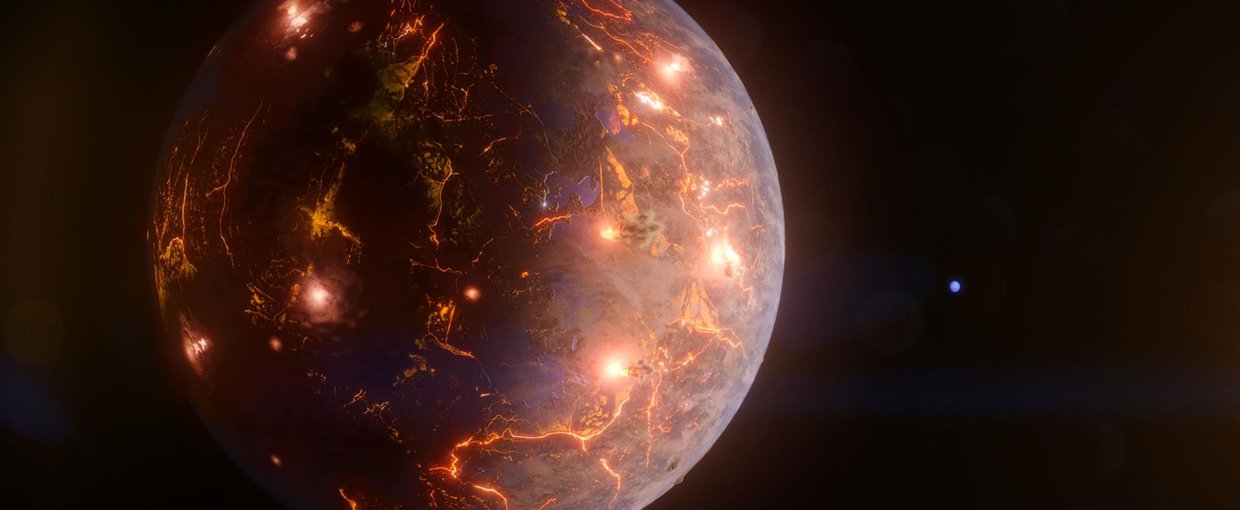
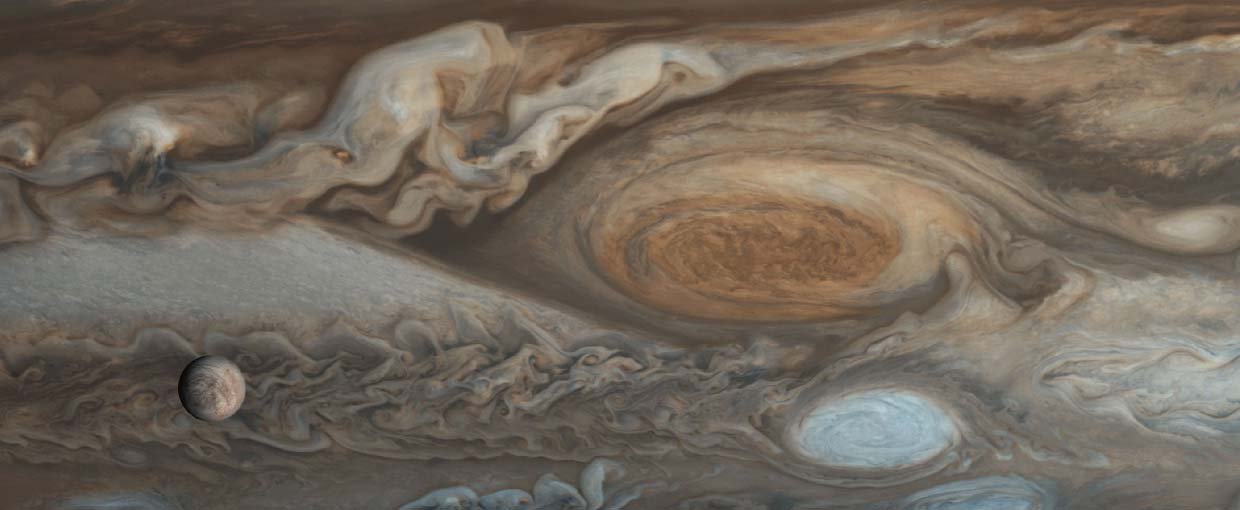
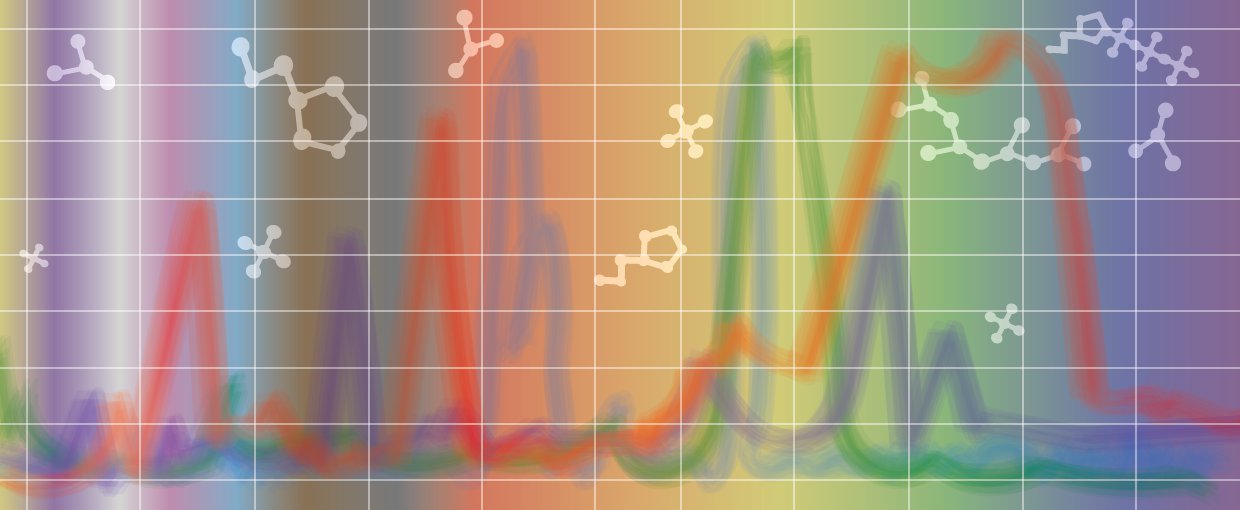
A volcanically active planet is shown in closeup at the left side of the image with glowing eruptions and lines of lava on the surface. To the right and in the distance is a faint blue glowing ball representing the more massive planet in the system.Sixteen frames from Voyager 1's flyby of Jupiter in 1979 were merged to create this image. Jupiter's Great Red Spot is visible in the center. Jupiter's moon Europa can be seen in the foreground at the bottom left of the image.The frame is a horizontal rainbow of color on a grid. Shadows of molecules can be seen through the light as well as the jagged peaks and troughs of spectral lines.
Fizzy Super Earths and Lava Worlds“Fizzy Super-Earths: Impacts of Magma Composition on the Bulk Density and Structure of Lava Worlds.” in The Astrophysical Journal.01/03
Identifying Hydrothermal Activity on Icy Ocean Worlds“Ethene-ethanol ratios as potential indicators of hydrothermal activity at Enceladus, Europa, and other icy ocean worlds.” In Icarus.02/03
NASA Raman Spectroscopic Database"The NASA Raman spectroscopic database: Ramdb version 1.00.” In Icarus.03/03
NextPrevious
Go Explore
April 2015MEASUREMENT OF PLANET MASSES WITH TRANSIT TIMING VARIATIONS DUE TO SYNODIC “CHOPPING” EFFECTS

Deck, K. M., & Agol, E. (2015). The Astrophysical Journal, 802(2), 116. doi:10.1088/0004-637x/802/2/116

A public goods approach to major evolutionary innovations

Erwin, D. H. (2015). Geobiology, 13(4), 308–315. doi:10.1111/gbi.12137

OlsG (Sinac_1600) Is an Ornithine Lipid N -Methyltransferase from the Planctomycete Singulisphaera acidiphila

Escobedo-Hinojosa, W. I., Vences-Guzmán, M. Á., Schubotz, F., Sandoval-Calderón, M., Summons, R. E., López-Lara, I. M., … Geiger, O. (2015). J. Biol. Chem., 290(24), 15102–15111. doi:10.1074/jbc.m115.639575

Ancient horizontal gene transfer and the last common ancestors

Fournier, G. P., Andam, C. P., & Gogarten, J. P. (2015). BMC Evolutionary Biology, 15(1), None. doi:10.1186/s12862-015-0350-0

Activation of weak IR fundamentals of two species of astrochemical interest in the T d point group – the importance of amorphous ices

Hudson, R. L., Gerakines, P. A., & Loeffler, M. J. (2015). Phys. Chem. Chem. Phys., 17(19), 12545–12552. doi:10.1039/c5cp00975h

Diverse impactors in Apollo 15 and 16 impact melt rocks: Evidence from osmium isotopes and highly siderophile elements

Liu, J., Sharp, M., Ash, R. D., Kring, D. A., & Walker, R. J. (2015). Geochimica et Cosmochimica Acta, 155(None), 122–153. doi:10.1016/j.gca.2015.02.004

Growth of modern branched columnar stromatolites in Lake Joyce, Antarctica

Mackey, T. J., Sumner, D. Y., Hawes, I., Jungblut, A. D., & Andersen, D. T. (2015). Geobiology, 13(4), 373–390. doi:10.1111/gbi.12138

Transient liquid water and water activity at Gale crater on Mars

Martín-Torres, F. J., Zorzano, M-P., Valentín-Serrano, P., Harri, A-M., Genzer, M., Kemppinen, O., … Rivera-Valentin, E. G. (2015). Nature Geosci, 8(5), 357–361. doi:10.1038/ngeo2412

A primordial origin for the compositional similarity between the Earth and the Moon

Mastrobuono-Battisti, A., Perets, H. B., & Raymond, S. N. (2015). Nature, 520(7546), 212–215. doi:10.1038/nature14333

FACTORS CONTROLLING EXCEPTIONAL PRESERVATION IN CONCRETIONS

McCoy, V. E., Young, R. T., & Briggs, D. E. G. (2015). PALAIOS, 30(4), 272–280. doi:10.2110/palo.2014.081