

This website is currently being migrated. For the most up-to-date astrobiology news, resources, and community announcements, please visit our new home at science.nasa.gov/astrobiology

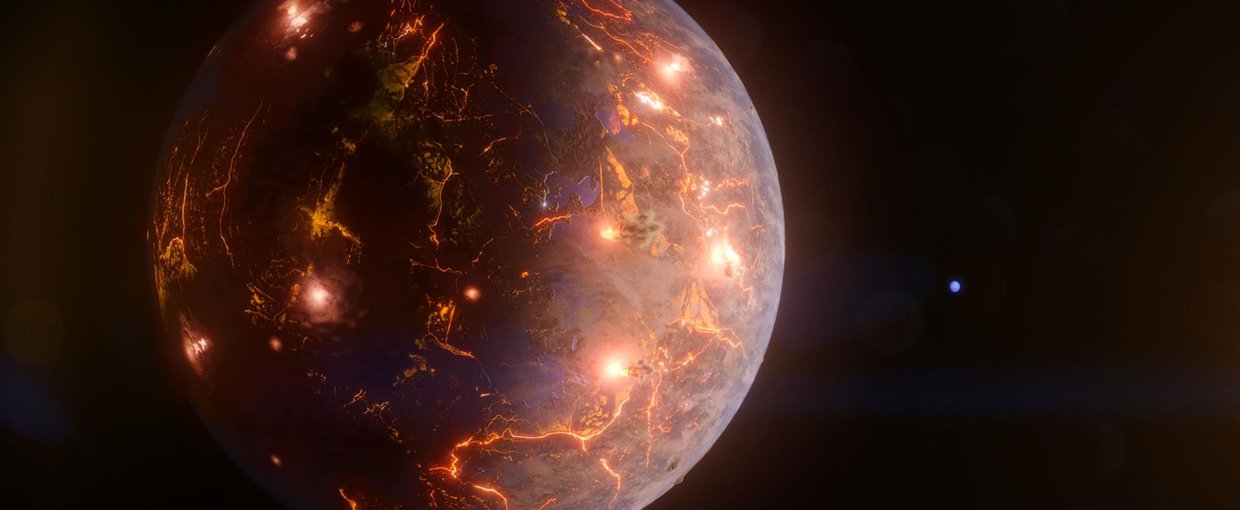
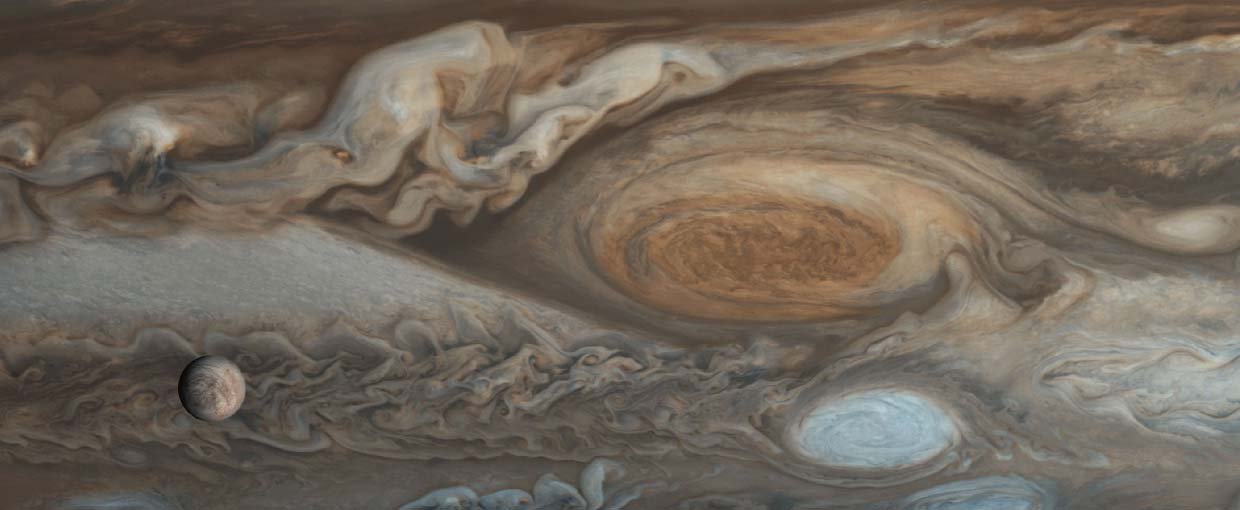
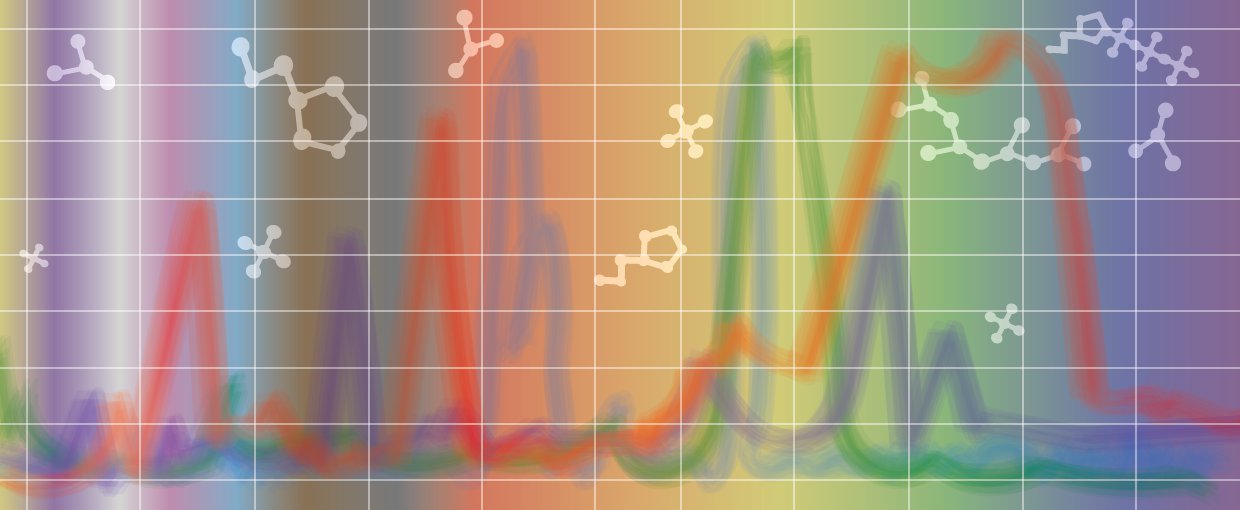
A volcanically active planet is shown in closeup at the left side of the image with glowing eruptions and lines of lava on the surface. To the right and in the distance is a faint blue glowing ball representing the more massive planet in the system.Sixteen frames from Voyager 1's flyby of Jupiter in 1979 were merged to create this image. Jupiter's Great Red Spot is visible in the center. Jupiter's moon Europa can be seen in the foreground at the bottom left of the image.The frame is a horizontal rainbow of color on a grid. Shadows of molecules can be seen through the light as well as the jagged peaks and troughs of spectral lines.
Fizzy Super Earths and Lava Worlds“Fizzy Super-Earths: Impacts of Magma Composition on the Bulk Density and Structure of Lava Worlds.” in The Astrophysical Journal.01/03
Identifying Hydrothermal Activity on Icy Ocean Worlds“Ethene-ethanol ratios as potential indicators of hydrothermal activity at Enceladus, Europa, and other icy ocean worlds.” In Icarus.02/03
NASA Raman Spectroscopic Database"The NASA Raman spectroscopic database: Ramdb version 1.00.” In Icarus.03/03
NextPrevious
Go Explore
April 2015 Purification, Biochemical Characterization, and Implications of an Alkali-Tolerant Catalase from the Spacecraft-Associated and Oxidation-Resistant Acinetobacter gyllenbergii 2P01AA

Muster, N., Derecho, I., Dallal, F., Alvarez, R., McCoy, K. B., & Mogul, R. (2015). Astrobiology, 15(4), 291–300. doi:10.1089/ast.2014.1242

BROWN DWARF BINARIES FROM DISINTEGRATING TRIPLE SYSTEMS

Reipurth, B., & Mikkola, S. (2015). The Astronomical Journal, 149(4), 145. doi:10.1088/0004-6256/149/4/145

Modeling near-infrared reflectance spectra of clay and sulfate mixtures and implications for Mars

Stack, K. M., & Milliken, R. E. (2015). Icarus, 250(None), 332–356. doi:10.1016/j.icarus.2014.12.009

Modeling salt precipitation from brines on Mars: Evaporation versus freezing origin for soil salts

Toner, J. D., Catling, D. C., & Light, B. (2015). Icarus, 250(None), 451–461. doi:10.1016/j.icarus.2014.12.013

Reconstruction of secular variation in seawater sulfate concentrations

Algeo, T. J., Luo, G. M., Song, H. Y., Lyons, T. W., & Canfield, D. E. (2015). Biogeosciences, 12(7), 2131–2151. doi:10.5194/bg-12-2131-2015

The origin and implications of clay minerals from Yellowknife Bay, Gale crater, Mars

Bristow, T. F., Bish, D. L., Vaniman, D. T., Morris, R. V., Blake, D. F., Grotzinger, J. P., … Rampe, E. B. (2015). American Mineralogist, 100(4), 824–836. doi:10.2138/am-2015-5077ccbyncnd

The origin and implications of clay minerals from Yellowknife Bay, Gale crater, Mars

Bristow, T. F., Bish, D. L., Vaniman, D. T., Morris, R. V., Blake, D. F., Grotzinger, J. P., … Rampe, E. B. (2015). American Mineralogist, 100(4), 824–836. doi:10.2138/am-2015-5077ccbyncnd

A Single Nucleotide Polymorphism Uncovers a Novel Function for the Transcription Factor Ace2 during Candida albicans Hyphal Development

Calderón-NoreñA, D. M., González-Novo, A., Orellana-Muñoz, S., Gutiérrez-Escribano, P., Arnáiz-Pita, Y., DueñAs-Santero, E., … Belén Suárez, M. (2015). PLOS Genetics, 11(4), e1005152. doi:10.1371/journal.pgen.1005152

Planetary Atmospheres

Catling, D. C. (2015). Treatise on Geophysics, None(None), 429–472. doi:10.1016/b978-0-444-53802-4.00185-8

Methane storms as a driver of Titan’s dune orientation

Charnay, B., Barth, E., Rafkin, S., Narteau, C., Lebonnois, S., Rodriguez, S., … Pont, S. C. d. (2015). Nature Geosci, 8(5), 362–366. doi:10.1038/ngeo2406