

This website is currently being migrated. For the most up-to-date astrobiology news, resources, and community announcements, please visit our new home at science.nasa.gov/astrobiology

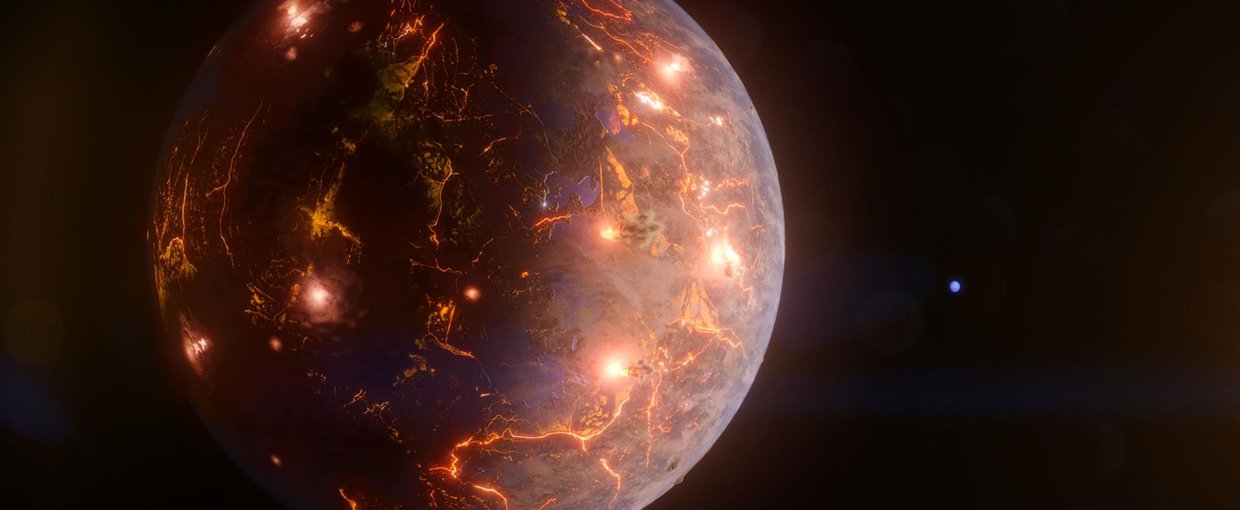
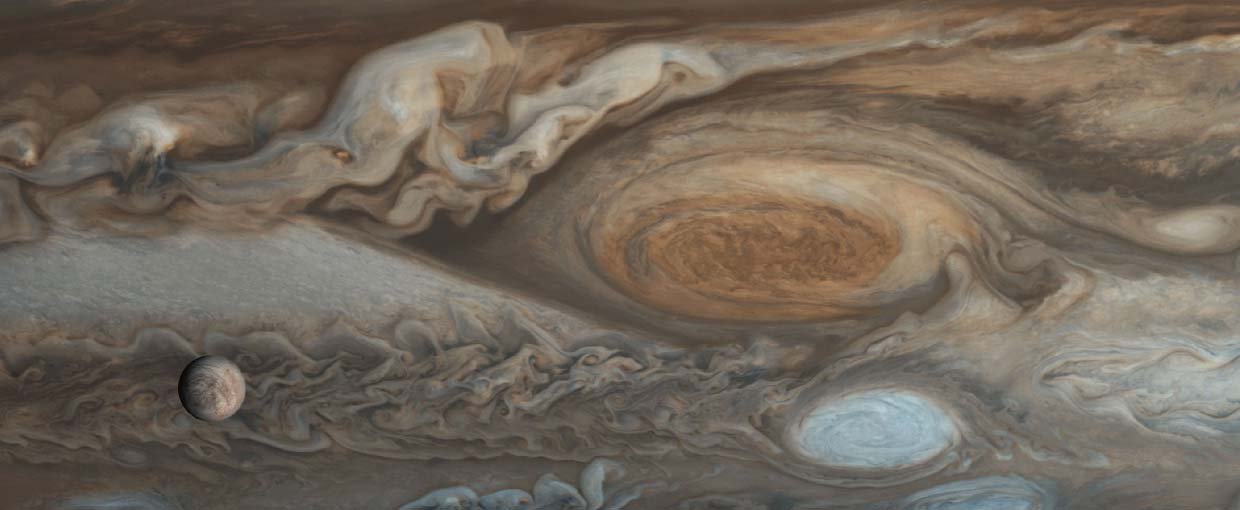
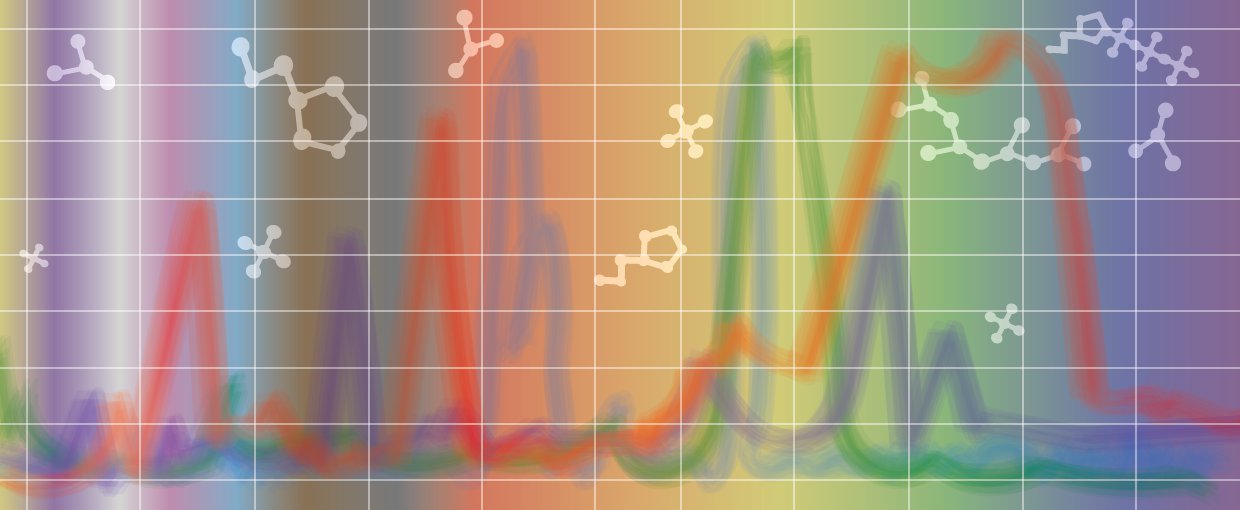
A volcanically active planet is shown in closeup at the left side of the image with glowing eruptions and lines of lava on the surface. To the right and in the distance is a faint blue glowing ball representing the more massive planet in the system.Sixteen frames from Voyager 1's flyby of Jupiter in 1979 were merged to create this image. Jupiter's Great Red Spot is visible in the center. Jupiter's moon Europa can be seen in the foreground at the bottom left of the image.The frame is a horizontal rainbow of color on a grid. Shadows of molecules can be seen through the light as well as the jagged peaks and troughs of spectral lines.
Fizzy Super Earths and Lava Worlds“Fizzy Super-Earths: Impacts of Magma Composition on the Bulk Density and Structure of Lava Worlds.” in The Astrophysical Journal.01/03
Identifying Hydrothermal Activity on Icy Ocean Worlds“Ethene-ethanol ratios as potential indicators of hydrothermal activity at Enceladus, Europa, and other icy ocean worlds.” In Icarus.02/03
NASA Raman Spectroscopic Database"The NASA Raman spectroscopic database: Ramdb version 1.00.” In Icarus.03/03
NextPrevious
Go Explore
February 2022A nitrogen-rich atmosphere on ancient Mars consistent with isotopic evolution models

Hu, R., & Thomas, T. B. (2022). A nitrogen-rich atmosphere on ancient Mars consistent with isotopic evolution models. Nature Geoscience, 15(2), 106–111. doi:10.1038/s41561-021-00886-y

Desulfovulcanus ferrireducens gen. nov., sp. nov., a thermophilic autotrophic iron and sulfate-reducing bacterium from subseafloor basalt that grows on akaganéite and lepidocrocite minerals

Kashyap, S., Musa, M., Neat, K. A., Leopo, D. A., & Holden, J. F. (2022). Desulfovulcanus ferrireducens gen. nov., sp. nov., a thermophilic autotrophic iron and sulfate-reducing bacterium from subseafloor basalt that grows on akaganéite and lepidocrocite minerals. Extremophiles, 26(1), None. doi:10.1007/s00792-022-01263-2

Reconstruction of Nitrogenase Predecessors Suggests Origin from Maturase-Like Proteins

Garcia, A. K., Kolaczkowski, B., & Kaçar, B. (2022). Reconstruction of Nitrogenase Predecessors Suggests Origin from Maturase-Like Proteins. Genome Biology and Evolution, 14(3), None. doi:10.1093/gbe/evac031

Evidence for the oxidation of Earth’s crust from the evolution of manganese minerals

Hummer, D. R., Golden, J. J., Hystad, G., Downs, R. T., Eleish, A., Liu, C., … Hazen, R. M. (2022). Evidence for the oxidation of Earth’s crust from the evolution of manganese minerals. Nature Communications, 13(1), None. doi:10.1038/s41467-022-28589-x

Building Terrestrial Planets: Why Results of Perfect-merging Simulations Are Not Quantitatively Reliable Approximations to Accurate Modeling of Terrestrial Planet Formation

Haghighipour, N., & Maindl, T. I. (2022). Building Terrestrial Planets: Why Results of Perfect-merging Simulations Are Not Quantitatively Reliable Approximations to Accurate Modeling of Terrestrial Planet Formation. The Astrophysical Journal, 926(2), 197. doi:10.3847/1538-4357/ac4969

Determining Dispersal Mechanisms of Protoplanetary Disks Using Accretion and Wind Mass Loss Rates

Hasegawa, Y., Haworth, T. J., Hoadley, K., Kim, J. S., Goto, H., Juzikenaite, A., … Hamden, E. T. (2022). Determining Dispersal Mechanisms of Protoplanetary Disks Using Accretion and Wind Mass Loss Rates. The Astrophysical Journal Letters, 926(2), L23. doi:10.3847/2041-8213/ac50aa

Chemical characteristics of iron meteorite parent bodies

Hilton, C. D., Ash, R. D., & Walker, R. J. (2022). Chemical characteristics of iron meteorite parent bodies. Geochimica et Cosmochimica Acta, 318, 112–125. doi:10.1016/j.gca.2021.11.035

Quantitative and Compositional Analysis of Trace Amino Acids in Icy Moon Analogues Using a Microcapillary Electrophoresis Laser-Induced Fluorescence Detection System

Duca, Z. A., Craft, K. L., Cable, M. L., & Stockton, A. M. (2022). Quantitative and Compositional Analysis of Trace Amino Acids in Icy Moon Analogues Using a Microcapillary Electrophoresis Laser-Induced Fluorescence Detection System. ACS Earth and Space Chemistry. doi:10.1021/acsearthspacechem.1c00297

Uniform initial 10Be/9Be inferred from refractory inclusions in CV3, CO3, CR2, and CH/CB chondrites

Dunham, E. T., Wadhwa, M., Desch, S. J., Liu, M. C., Fukuda, K., Kita, N., … Fujimoto, Y. (2022). Uniform initial 10Be/9Be inferred from refractory inclusions in CV3, CO3, CR2, and CH/CB chondrites. Geochimica et Cosmochimica Acta. doi:10.1016/j.gca.2022.02.002

Impact-formed complex diamond-graphite nanostructures

Németh, P., McColl, K., Garvie, L. A. J., Corà, F., Salzmann, C. G., & McMillan, P. F. (2022). Impact-formed complex diamond-graphite nanostructures. Resolution and Discovery. doi:10.1556/2051.2021.00089