


This website is currently being migrated. For the most up-to-date astrobiology news, resources, and community announcements, please visit our new home at science.nasa.gov/astrobiology

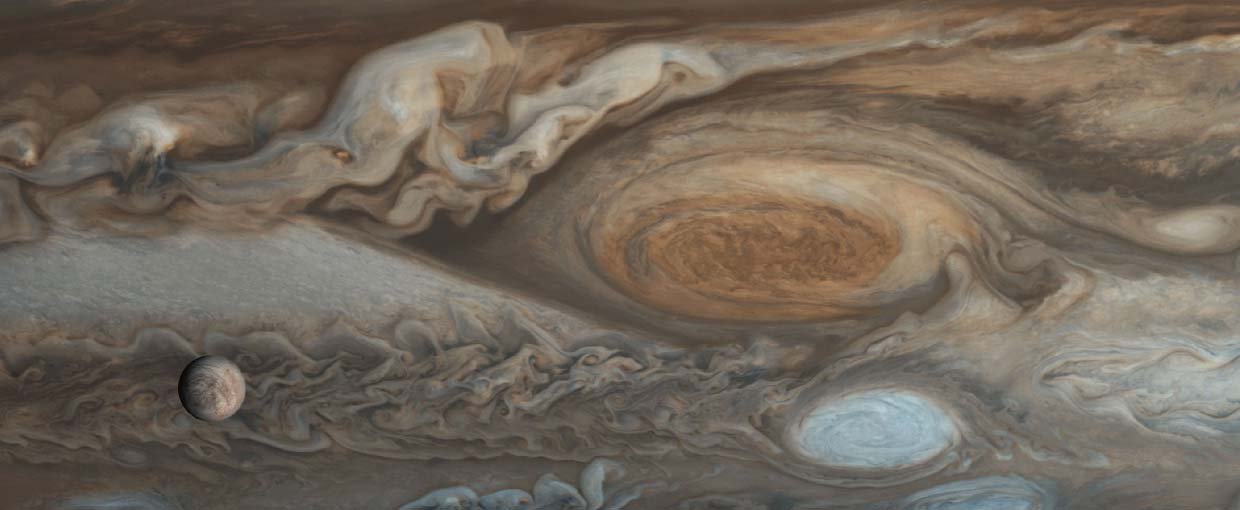
A volcanically active planet is shown in closeup at the left side of the image with glowing eruptions and lines of lava on the surface. To the right and in the distance is a faint blue glowing ball representing the more massive planet in the system.Sixteen frames from Voyager 1's flyby of Jupiter in 1979 were merged to create this image. Jupiter's Great Red Spot is visible in the center. Jupiter's moon Europa can be seen in the foreground at the bottom left of the image.The frame is a horizontal rainbow of color on a grid. Shadows of molecules can be seen through the light as well as the jagged peaks and troughs of spectral lines.
Fizzy Super Earths and Lava Worlds“Fizzy Super-Earths: Impacts of Magma Composition on the Bulk Density and Structure of Lava Worlds.” in The Astrophysical Journal.01/03
Identifying Hydrothermal Activity on Icy Ocean Worlds“Ethene-ethanol ratios as potential indicators of hydrothermal activity at Enceladus, Europa, and other icy ocean worlds.” In Icarus.02/03
NASA Raman Spectroscopic Database"The NASA Raman spectroscopic database: Ramdb version 1.00.” In Icarus.03/03
NextPrevious
Go Explore
August 2015Structured nucleosome fingerprints enable high-resolution mapping of chromatin architecture within regulatory regions

Schep, A. N., Buenrostro, J. D., Denny, S. K., Schwartz, K., Sherlock, G., & Greenleaf, W. J. (2015). Genome Res., 25(11), 1757–1770. doi:10.1101/gr.192294.115

DETECTING AND CONSTRAINING N 2 ABUNDANCES IN PLANETARY ATMOSPHERES USING COLLISIONAL PAIRS

Schwieterman, E. W., Robinson, T. D., Meadows, V. S., Misra, A., & Domagal-Goldman, S. (2015). The Astrophysical Journal, 810(1), 57. doi:10.1088/0004-637x/810/1/57

DETECTING AND CONSTRAINING N 2 ABUNDANCES IN PLANETARY ATMOSPHERES USING COLLISIONAL PAIRS

Schwieterman, E. W., Robinson, T. D., Meadows, V. S., Misra, A., & Domagal-Goldman, S. (2015). The Astrophysical Journal, 810(1), 57. doi:10.1088/0004-637x/810/1/57

Secondary Ion Mass Spectrometry Bias on Isotope Ratios in Dolomite-Ankerite, Part I: δ 18 O Matrix Effects

Śliwiński, M. G., Kitajima, K., Kozdon, R., Spicuzza, M. J., Fournelle, J. H., Denny, A., & Valley, J. W. (2015). Geostand Geoanal Res, None(None), n/a–n/a. doi:10.1111/j.1751-908x.2015.00364.x

Secondary Ion Mass Spectrometry Bias on Isotope Ratios in Dolomite-Ankerite, Part I: δ 18 O Matrix Effects

Śliwiński, M. G., Kitajima, K., Kozdon, R., Spicuzza, M. J., Fournelle, J. H., Denny, A., & Valley, J. W. (2015). Geostand Geoanal Res, None(None), n/a–n/a. doi:10.1111/j.1751-908x.2015.00364.x

The evolution of the global selenium cycle: Secular trends in Se isotopes and abundances

Stüeken, E. E., Buick, R., Bekker, A., Catling, D., Foriel, J., Guy, B. M., … Kah, L. C. (2015). Geochimica et Cosmochimica Acta, 162(None), 109–125. doi:10.1016/j.gca.2015.04.033

Antarctic microbial mats: A modern analog for Archean lacustrine oxygen oases

Sumner, D. Y., Hawes, I., Mackey, T. J., Jungblut, A. D., & Doran, P. T. (2015). Geology, 43(10), 887–890. doi:10.1130/g36966.1

Ecoenzymatic stoichiometry at the extremes: How microbes cope in an ultra-oligotrophic desert soil

Tapia-Torres, Y., Elser, J. J., Souza, V., & GarcíA-Oliva, F. (2015). Soil Biology and Biochemistry, 87(None), 34–42. doi:10.1016/j.soilbio.2015.04.007

Preserved Filamentous Microbial Biosignatures in the Brick Flat Gossan, Iron Mountain, California

Williams, A. J., Sumner, D. Y., Alpers, C. N., Karunatillake, S., & Hofmann, B. A. (2015). Astrobiology, 15(8), 637–668. doi:10.1089/ast.2014.1235

A framework for stochastic simulations and visualization of biological electron-transfer dynamics

Nakano, C. M., Byun, H. S., Ma, H., Wei, T., & El-Naggar, M. Y. (2015). Computer Physics Communications, 193(None), 1–9. doi:10.1016/j.cpc.2015.03.009