

This website is currently being migrated. For the most up-to-date astrobiology news, resources, and community announcements, please visit our new home at science.nasa.gov/astrobiology

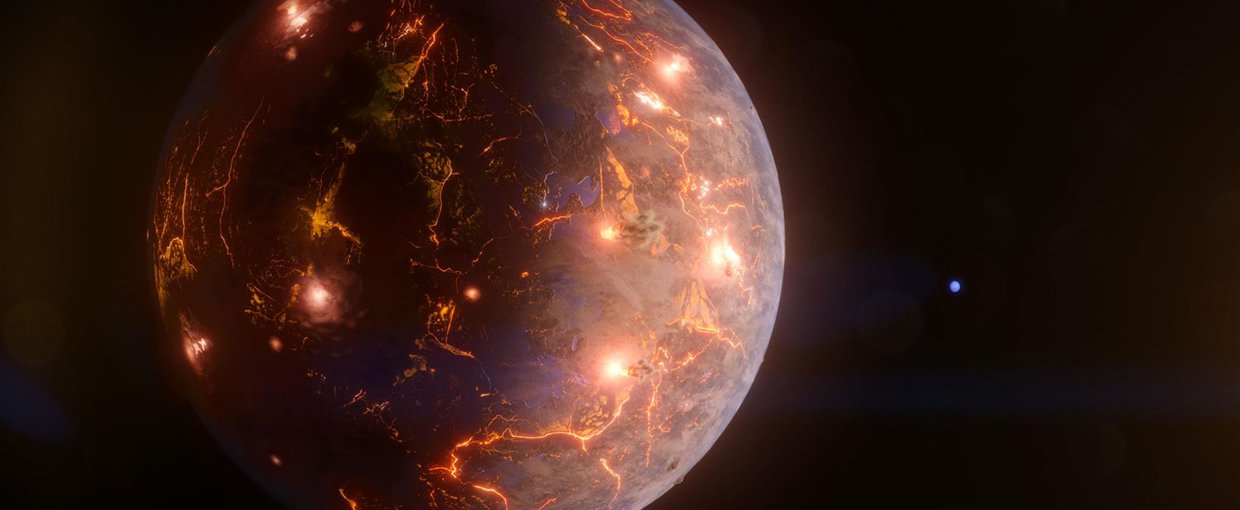
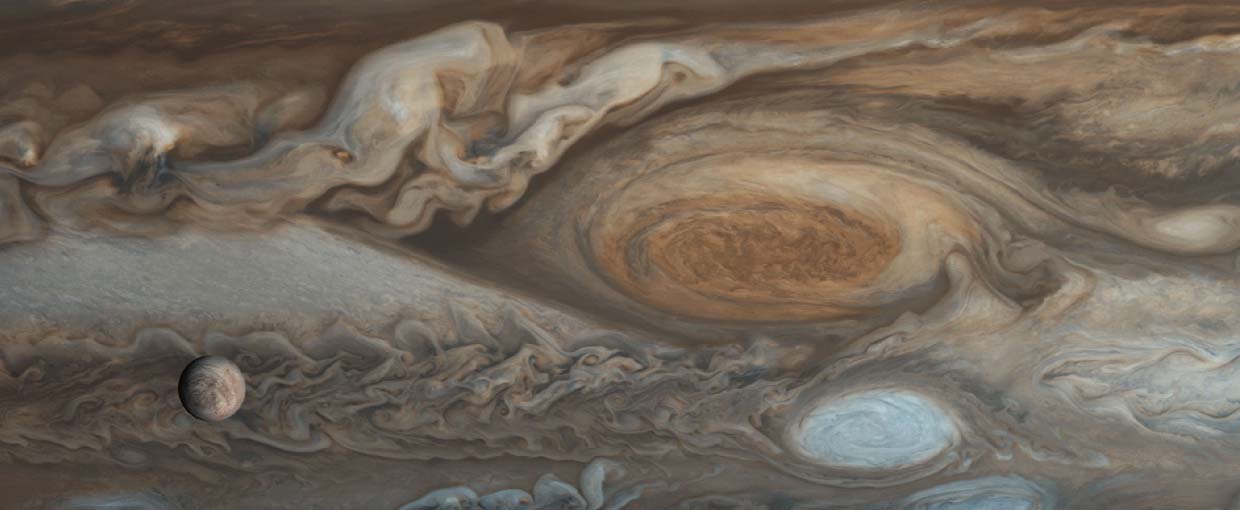
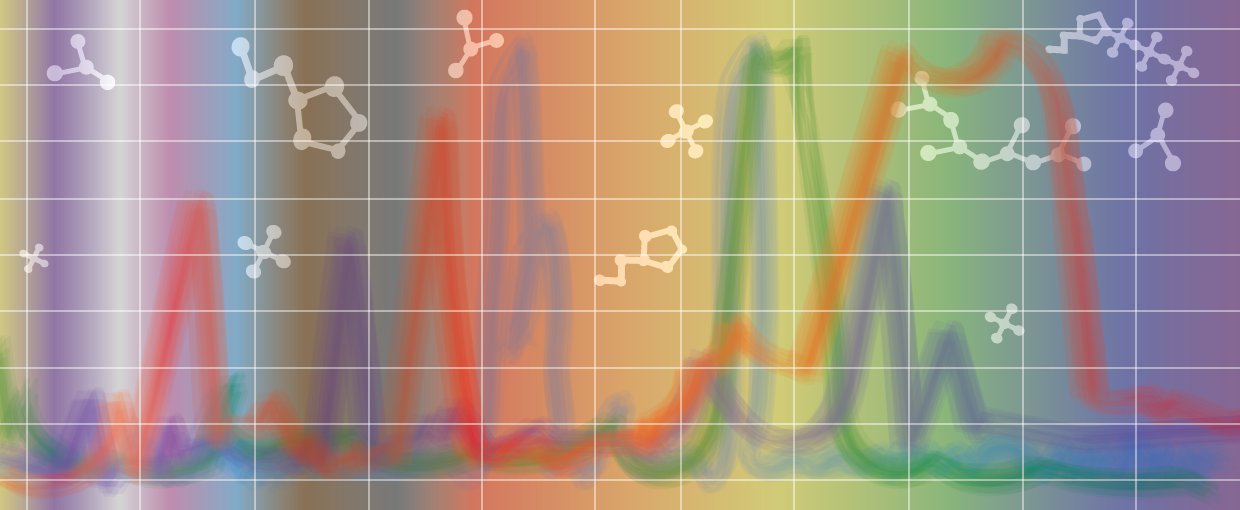
A volcanically active planet is shown in closeup at the left side of the image with glowing eruptions and lines of lava on the surface. To the right and in the distance is a faint blue glowing ball representing the more massive planet in the system.Sixteen frames from Voyager 1's flyby of Jupiter in 1979 were merged to create this image. Jupiter's Great Red Spot is visible in the center. Jupiter's moon Europa can be seen in the foreground at the bottom left of the image.The frame is a horizontal rainbow of color on a grid. Shadows of molecules can be seen through the light as well as the jagged peaks and troughs of spectral lines.
Fizzy Super Earths and Lava Worlds“Fizzy Super-Earths: Impacts of Magma Composition on the Bulk Density and Structure of Lava Worlds.” in The Astrophysical Journal.01/03
Identifying Hydrothermal Activity on Icy Ocean Worlds“Ethene-ethanol ratios as potential indicators of hydrothermal activity at Enceladus, Europa, and other icy ocean worlds.” In Icarus.02/03
NASA Raman Spectroscopic Database"The NASA Raman spectroscopic database: Ramdb version 1.00.” In Icarus.03/03
NextPrevious
Go Explore
September 2015An examination of the evolution of Ediacaran paleoenvironmental and paleoecological research

Tarhan, L., & Laflamme, M. (2015). Palaeogeography, Palaeoclimatology, Palaeoecology, 434(None), 1–3. doi:10.1016/j.palaeo.2015.04.012

Refining the extraction methodology of carbonate associated sulfate: Evidence from synthetic and natural carbonate samples

Theiling, B. P., & Coleman, M. (2015). Chemical Geology, 411(None), 36–48. doi:10.1016/j.chemgeo.2015.06.018

Adaptation strategies of endolithic chlorophototrophs to survive the hyperarid and extreme solar radiation environment of the Atacama Desert

Wierzchos, J., DiRuggiero, J., Vítek, P., Artieda, O., Souza-Egipsy, V., Škaloud, P., … Tisza, M. (2015). Frontiers in Microbiology, 6(None), None. doi:10.3389/fmicb.2015.00934

Dissolved amino acids in oceanic basaltic basement fluids

Lin, H-T., Amend, J. P., LaRowe, D. E., Bingham, J-P., & Cowen, J. P. (2015). Geochimica et Cosmochimica Acta, 164(None), 175–190. doi:10.1016/j.gca.2015.04.044

August 2015Communication: Spectroscopic consequences of proton delocalization in OCHCO+

Fortenberry, R. C., Yu, Q., Mancini, J. S., Bowman, J. M., Lee, T. J., Crawford, T. D., … Francisco, J. S. (2015). Communication: Spectroscopic consequences of proton delocalization in OCHCO+. The Journal of Chemical Physics, 143(7), 071102. doi:10.1063/1.4929345

15N fractionation in star-forming regions and Solar System objects

Wirström, E. S., Adande, G., Milam, S. N., Charnley, S. B., & Cordiner, M. A. (2015). 15N fractionation in star-forming regions and Solar System objects. Proceedings of the International Astronomical Union, 11(A29A), 271–274. doi:10.1017/s1743921316003033

From Chemical Gardens to Chemobrionics

Barge, L. M., Cardoso, S. S. S., Cartwright, J. H. E., Cooper, G. J. T., Cronin, L., De Wit, A., … Doloboff, I. J. (2015). Chem. Rev., 115(16), 8652–8703. doi:10.1021/acs.chemrev.5b00014

Lineage-specific patterns of genome deterioration in obligate symbionts of sharpshooter leafhoppers

Bennett, G. M., McCutcheon, J. P., McDonald, B. R., & Moran, N. A. (2015). Genome Biology and Evolution, None(None), evv159. doi:10.1093/gbe/evv159

Structural and Developmental Disparity in the Tentacles of the Moon Jellyfish Aurelia sp.1

Gold, D. A., Nakanishi, N., Hensley, N. M., Cozzolino, K., Tabatabaee, M., Martin, M., … Hartenstein, V. (2015). PLoS ONE, 10(8), e0134741. doi:10.1371/journal.pone.0134741

Symbiosis becoming permanent: Survival of the luckiest

Keeling, P. J., McCutcheon, J. P., & Ford Doolittle, W. (2015). Proc Natl Acad Sci USA, 112(33), 10101–10103. doi:10.1073/pnas.1513346112