

This website is currently being migrated. For the most up-to-date astrobiology news, resources, and community announcements, please visit our new home at science.nasa.gov/astrobiology

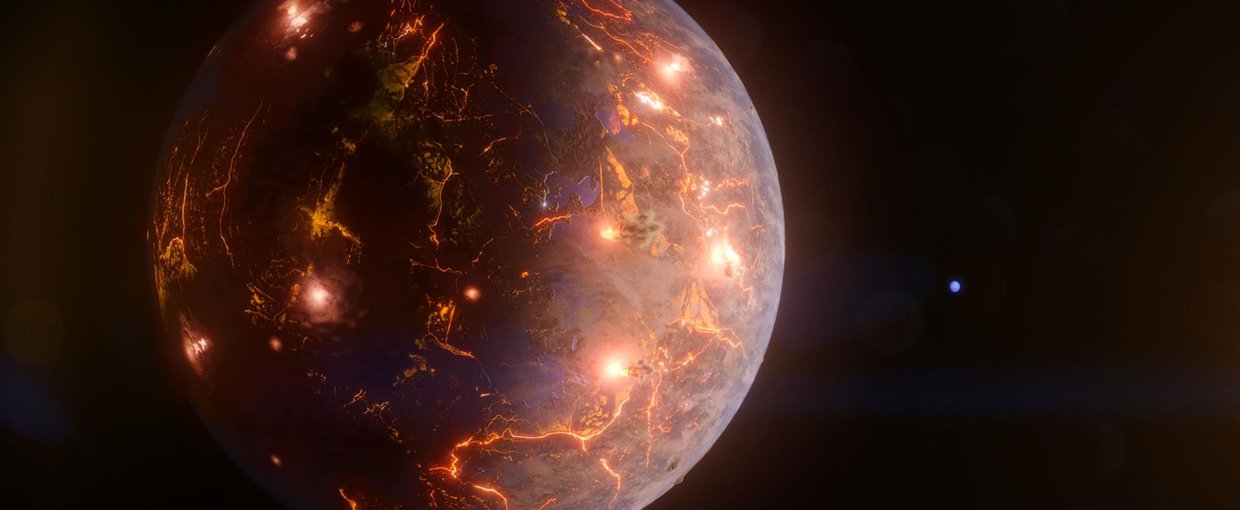
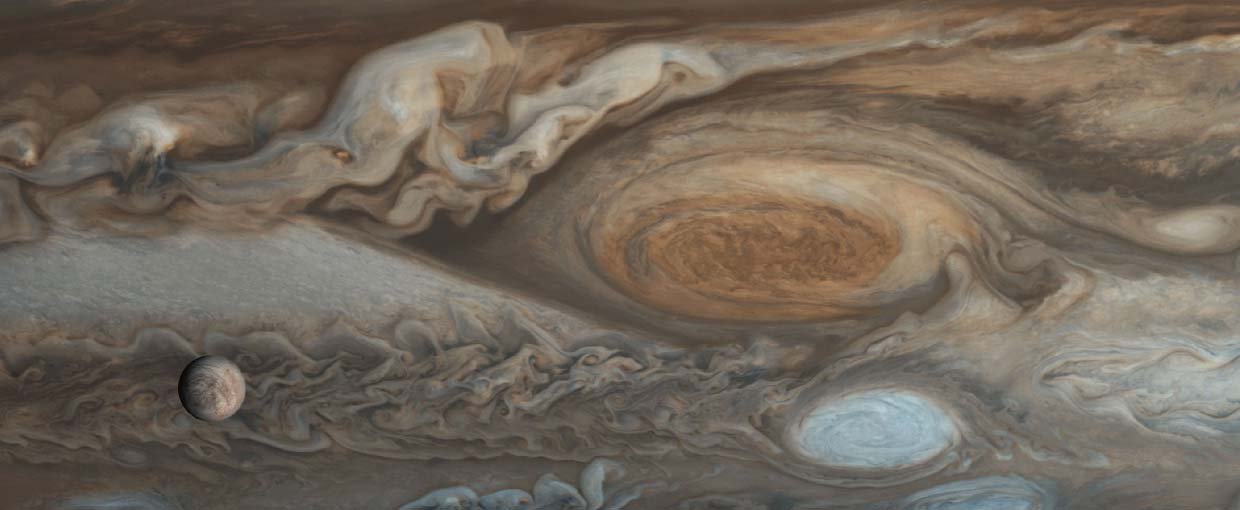
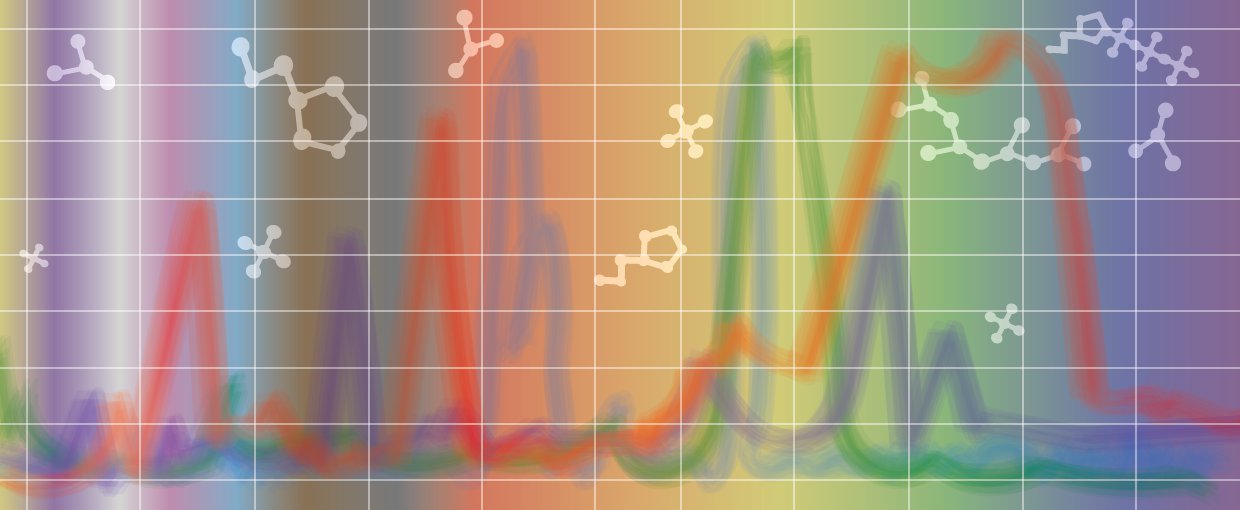
A volcanically active planet is shown in closeup at the left side of the image with glowing eruptions and lines of lava on the surface. To the right and in the distance is a faint blue glowing ball representing the more massive planet in the system.Sixteen frames from Voyager 1's flyby of Jupiter in 1979 were merged to create this image. Jupiter's Great Red Spot is visible in the center. Jupiter's moon Europa can be seen in the foreground at the bottom left of the image.The frame is a horizontal rainbow of color on a grid. Shadows of molecules can be seen through the light as well as the jagged peaks and troughs of spectral lines.
Fizzy Super Earths and Lava Worlds“Fizzy Super-Earths: Impacts of Magma Composition on the Bulk Density and Structure of Lava Worlds.” in The Astrophysical Journal.01/03
Identifying Hydrothermal Activity on Icy Ocean Worlds“Ethene-ethanol ratios as potential indicators of hydrothermal activity at Enceladus, Europa, and other icy ocean worlds.” In Icarus.02/03
NASA Raman Spectroscopic Database"The NASA Raman spectroscopic database: Ramdb version 1.00.” In Icarus.03/03
NextPrevious
Go Explore
October 2015Noise-Induced Mechanism for Biological Homochirality of Early Life Self-Replicators

Jafarpour, F., Biancalani, T., & Goldenfeld, N. (2015). Physical Review Letters, 115(15), None. doi:10.1103/physrevlett.115.158101

STRATOSPHERIC TEMPERATURES AND WATER LOSS FROM MOIST GREENHOUSE ATMOSPHERES OF EARTH-LIKE PLANETS

Kasting, J. F., Chen, H., & Kopparapu, R. K. (2015). The Astrophysical Journal, 813(1), L3. doi:10.1088/2041-8205/813/1/l3

STRATOSPHERIC TEMPERATURES AND WATER LOSS FROM MOIST GREENHOUSE ATMOSPHERES OF EARTH-LIKE PLANETS

Kasting, J. F., Chen, H., & Kopparapu, R. K. (2015). The Astrophysical Journal, 813(1), L3. doi:10.1088/2041-8205/813/1/l3

RAPID WATER LOSS CAN EXTEND THE LIFETIME OF PLANETARY HABITABILITY

Kodama, T., Genda, H., Abe, Y., & Zahnle, K. J. (2015). The Astrophysical Journal, 812(2), 165. doi:10.1088/0004-637x/812/2/165

Roles of Nucleoid-Associated Proteins in Stress-Induced Mutagenic Break Repair in Starving Escherichia coli

Moore, J. M., Magnan, D., Mojica, A. K., Nunez, M. A. B., Bates, D., Rosenberg, S. M., & Hastings, P. J. (2015). Genetics, 201(4), 1349–1362. doi:10.1534/genetics.115.178970

Erratum: Martian outflow channels: How did their source aquifers form, and why did they drain so rapidly?

Rodriguez, J. A. P., Kargel, J. S., Baker, V. R., Gulick, V. C., Berman, D. C., Fairén, A. G., … Linares, R. (2015). Scientific Reports, 5(None), 15092. doi:10.1038/srep15092

Rock comminution as a source of hydrogen for subglacial ecosystems

Telling, J., Boyd, E. S., Bone, N., Jones, E. L., Tranter, M., MacFarlane, J. W., … Martin, P. G. (2015). Nature Geosci, 8(11), 851–855. doi:10.1038/ngeo2533

A revised Pitzer model for low-temperature soluble salt assemblages at the Phoenix site, Mars

Toner, J. D., Catling, D. C., & Light, B. (2015). Geochimica et Cosmochimica Acta, 166(None), 327–343. doi:10.1016/j.gca.2015.06.011

A GROUND-BASED ALBEDO UPPER LIMIT FOR HD 189733b FROM POLARIMETRY

Wiktorowicz, S. J., Nofi, L. A., Jontof-Hutter, D., Kopparla, P., Laughlin, G. P., Hermis, N., … Yung, Y. L. (2015). The Astrophysical Journal, 813(1), 48. doi:10.1088/0004-637x/813/1/48

The tethered Moon

Zahnle, K. J., Lupu, R., Dobrovolskis, A., & Sleep, N. H. (2015). Earth and Planetary Science Letters, 427(None), 74–82. doi:10.1016/j.epsl.2015.06.058