

This website is currently being migrated. For the most up-to-date astrobiology news, resources, and community announcements, please visit our new home at science.nasa.gov/astrobiology

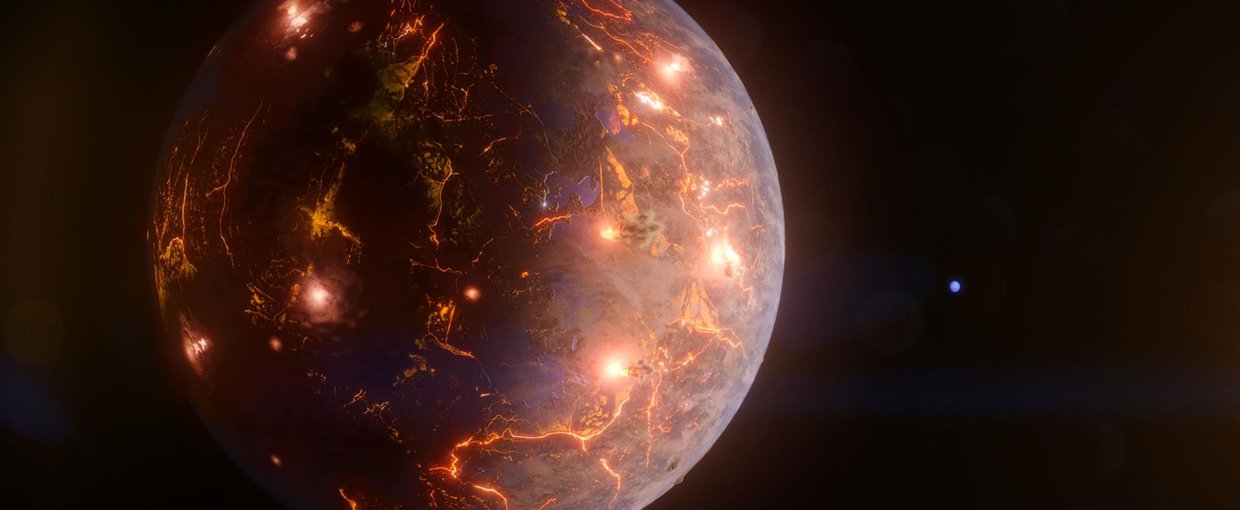
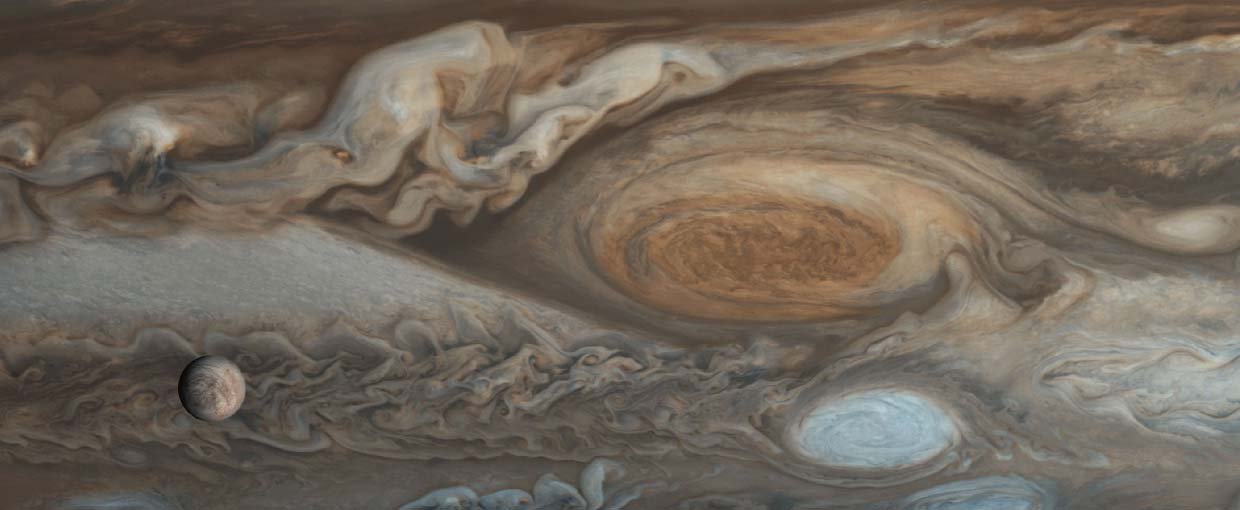
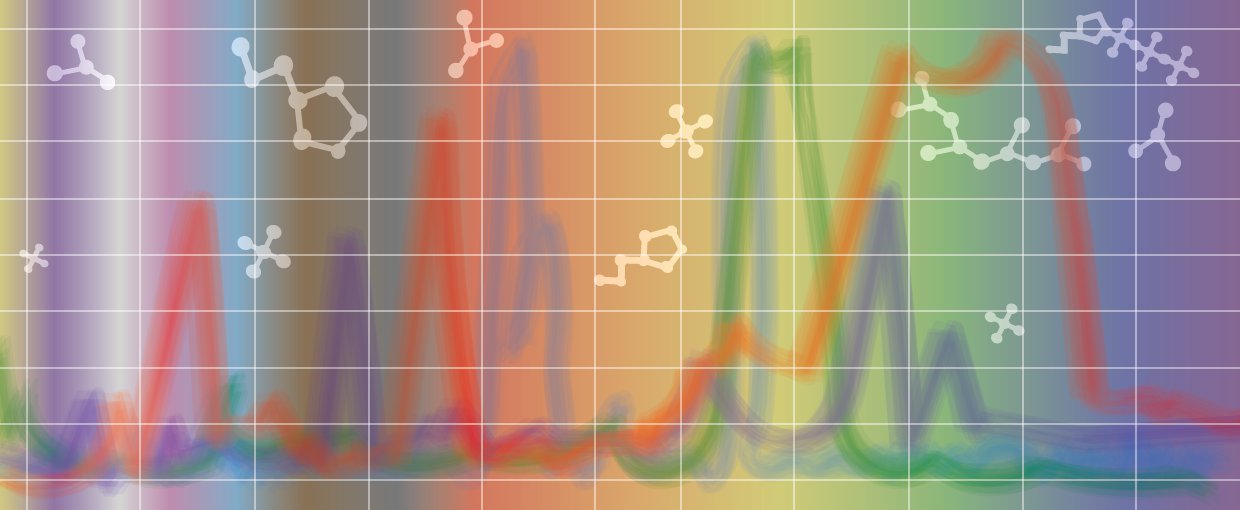
A volcanically active planet is shown in closeup at the left side of the image with glowing eruptions and lines of lava on the surface. To the right and in the distance is a faint blue glowing ball representing the more massive planet in the system.Sixteen frames from Voyager 1's flyby of Jupiter in 1979 were merged to create this image. Jupiter's Great Red Spot is visible in the center. Jupiter's moon Europa can be seen in the foreground at the bottom left of the image.The frame is a horizontal rainbow of color on a grid. Shadows of molecules can be seen through the light as well as the jagged peaks and troughs of spectral lines.
Fizzy Super Earths and Lava Worlds“Fizzy Super-Earths: Impacts of Magma Composition on the Bulk Density and Structure of Lava Worlds.” in The Astrophysical Journal.01/03
Identifying Hydrothermal Activity on Icy Ocean Worlds“Ethene-ethanol ratios as potential indicators of hydrothermal activity at Enceladus, Europa, and other icy ocean worlds.” In Icarus.02/03
NASA Raman Spectroscopic Database"The NASA Raman spectroscopic database: Ramdb version 1.00.” In Icarus.03/03
NextPrevious
Go Explore
November 2015Transient episodes of mild environmental oxygenation and oxidative continental weathering during the late Archean

Kendall, B., Creaser, R. A., Reinhard, C. T., Lyons, T. W., & Anbar, A. D. (2015). Science Advances, 1(10), e1500777–e1500777. doi:10.1126/sciadv.1500777

Marine organic matter cycling during the Ediacaran Shuram excursion

Lee, C., Love, G. D., Fischer, W. W., Grotzinger, J. P., & Halverson, G. P. (2015). Geology, None(None), G37236.1. doi:10.1130/g37236.1

Ediacaran Marine Redox Heterogeneity and Early Animal Ecosystems

Li, C., Planavsky, N. J., Shi, W., Zhang, Z., Zhou, C., Cheng, M., … Tarhan, L. G. (2015). Scientific Reports, 5(None), 17097. doi:10.1038/srep17097

Emerging Biogeochemical Views of Earth's Ancient Microbial Worlds

Lyons, T. W., Fike, D. A., & Zerkle, A. (2015). ELEMENTS, 11(6), 415–421. doi:10.2113/gselements.11.6.415

A redox-stratified ocean 3.2 billion years ago

Satkoski, A. M., Beukes, N. J., Li, W., Beard, B. L., & Johnson, C. M. (2015). Earth and Planetary Science Letters, 430(None), 43–53. doi:10.1016/j.epsl.2015.08.007

Principles of Geobiochemistry

Shock, E. L., & Boyd, E. S. (2015). ELEMENTS, 11(6), 395–401. doi:10.2113/gselements.11.6.395

Secondary Ion Mass Spectrometry Bias on Isotope Ratios in Dolomite-Ankerite, Part II: δ 13 C Matrix Effects

Śliwiński, M. G., Kitajima, K., Kozdon, R., Spicuzza, M. J., Fournelle, J. H., Denny, A., & Valley, J. W. (2015). Geostand Geoanal Res, None(None), n/a–n/a. doi:10.1111/j.1751-908x.2015.00380.x

Oxygen, facies, and secular controls on the appearance of Cryogenian and Ediacaran body and trace fossils in the Mackenzie Mountains of northwestern Canada

Sperling, E. A., Carbone, C., Strauss, J. V., Johnston, D. T., Narbonne, G. M., & Macdonald, F. A. (2015). Geological Society of America Bulletin, 128(3-4), 558–575. doi:10.1130/b31329.1

Emerging Frontiers in Geomicrobiology

Templeton, A., & Benzerara, K. (2015). ELEMENTS, 11(6), 423–429. doi:10.2113/gselements.11.6.423

Mackinawite and greigite in ancient alkaline hydrothermal chimneys: Identifying potential key catalysts for emergent life

White, L. M., Bhartia, R., Stucky, G. D., Kanik, I., & Russell, M. J. (2015). Earth and Planetary Science Letters, 430(None), 105–114. doi:10.1016/j.epsl.2015.08.013