


This website is currently being migrated. For the most up-to-date astrobiology news, resources, and community announcements, please visit our new home at science.nasa.gov/astrobiology

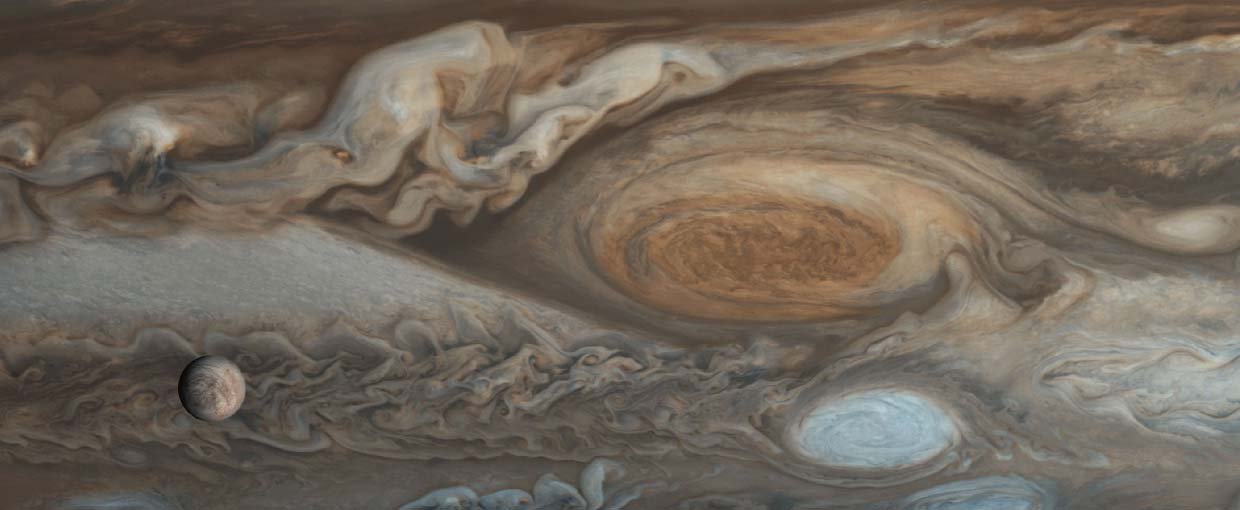
A volcanically active planet is shown in closeup at the left side of the image with glowing eruptions and lines of lava on the surface. To the right and in the distance is a faint blue glowing ball representing the more massive planet in the system.Sixteen frames from Voyager 1's flyby of Jupiter in 1979 were merged to create this image. Jupiter's Great Red Spot is visible in the center. Jupiter's moon Europa can be seen in the foreground at the bottom left of the image.The frame is a horizontal rainbow of color on a grid. Shadows of molecules can be seen through the light as well as the jagged peaks and troughs of spectral lines.
Fizzy Super Earths and Lava Worlds“Fizzy Super-Earths: Impacts of Magma Composition on the Bulk Density and Structure of Lava Worlds.” in The Astrophysical Journal.01/03
Identifying Hydrothermal Activity on Icy Ocean Worlds“Ethene-ethanol ratios as potential indicators of hydrothermal activity at Enceladus, Europa, and other icy ocean worlds.” In Icarus.02/03
NASA Raman Spectroscopic Database"The NASA Raman spectroscopic database: Ramdb version 1.00.” In Icarus.03/03
NextPrevious
Go Explore
May 2016SIMULATIONS OF THE CHEMISTRY IN THE SMALL MAGELLANIC CLOUD

Kinsuk Acharyya and Eric Herbst, (2016 May 11) The Astrophysical Journal, Volume 822, Number 2

PCNA is involved in the EndoQ-mediated DNA repair process in Thermococcales

Shiraishi, M., Ishino, S., Yoshida, K., Yamagami, T., Cann, I., & Ishino, Y. (2016). Scientific Reports, 6(None), 25532. doi:10.1038/srep25532

Long-Term Evolution ofBurkholderia multivoransduring a Chronic Cystic Fibrosis Infection Reveals Shifting Forces of Selection

Silva, I. N., Santos, P. M., Santos, M. R., Zlosnik, J. E. A., Speert, D. P., Buskirk, S. W., … Bruger, E. L. (2016). mSystems, 1(3), e00029–16. doi:10.1128/msystems.00029-16

Earth's air pressure 2.7 billion years ago constrained to less than half of modern levels

Som, S. M., Buick, R., Hagadorn, J. W., Blake, T. S., Perreault, J. M., Harnmeijer, J. P., & Catling, D. C. (2016). Nature Geosci, 9(6), 448–451. doi:10.1038/ngeo2713

Atmospheric science: Ancient air caught by shooting stars

Zahnle, K., & Buick, R. (2016). Nature, 533(7602), 184–186. doi:10.1038/533184a

Decimetre-scale multicellular eukaryotes from the 1.56-billion-year-old Gaoyuzhuang Formation in North China

Zhu, S., Zhu, M., Knoll, A. H., Yin, Z., Zhao, F., Sun, S., … Qu, Y. (2016). Nat Comms, 7(None), 11500. doi:10.1038/ncomms11500

April 2016PHYSIOLOGICAL RESPONSE OF NITRATE REDUCING MICROORGANISMS TO STEEP ANTIBIOTIC CONCENTRATION GRADIENTS

Alcalde, R. E., , ., Zhou, L., Deng, J., Sanford, R. A., Fouke, B. W., & Werth, C. J. (2016). PHYSIOLOGICAL RESPONSE OF NITRATE REDUCING MICROORGANISMS TO STEEP ANTIBIOTIC CONCENTRATION GRADIENTS. None. doi:10.1130/abs/2016nc-275254

Reflectance Spectroscopy for Organic Detection And Quantification in Clay-bearing Samples: Effects of Albedo, Clay Type, and Water Content

Kaplan, H. H., & Milliken, R. E. (2016). Reflectance Spectroscopy for Organic Detection And Quantification in Clay-bearing Samples: Effects of Albedo, Clay Type, and Water Content. Clays and Clay Minerals, 64(2), 167–184. doi:10.1346/ccmn.2016.0640207

Novel archaeal tetraether lipids with a cyclohexyl ring identified in Fayetteville Green Lake, NY, and other sulfidic lacustrine settings

Liu, X-L., De Santiago Torio, A., Bosak, T., & Summons, R. E. (2016). Novel archaeal tetraether lipids with a cyclohexyl ring identified in Fayetteville Green Lake, NY, and other sulfidic lacustrine settings . Rapid Communications in Mass Spectrometry, 30(10), 1197–1205. doi:10.1002/rcm.7549

Microbial Origin of Early Animal Trace Fossils?

Mariotti, G., Pruss, S. B., Ai, X., Perron, J. T., & Bosak, T. (2016). Microbial Origin of Early Animal Trace Fossils? Journal of Sedimentary Research, 86(4), 287–293. doi:10.2110/jsr.2016.19