


This website is currently being migrated. For the most up-to-date astrobiology news, resources, and community announcements, please visit our new home at science.nasa.gov/astrobiology

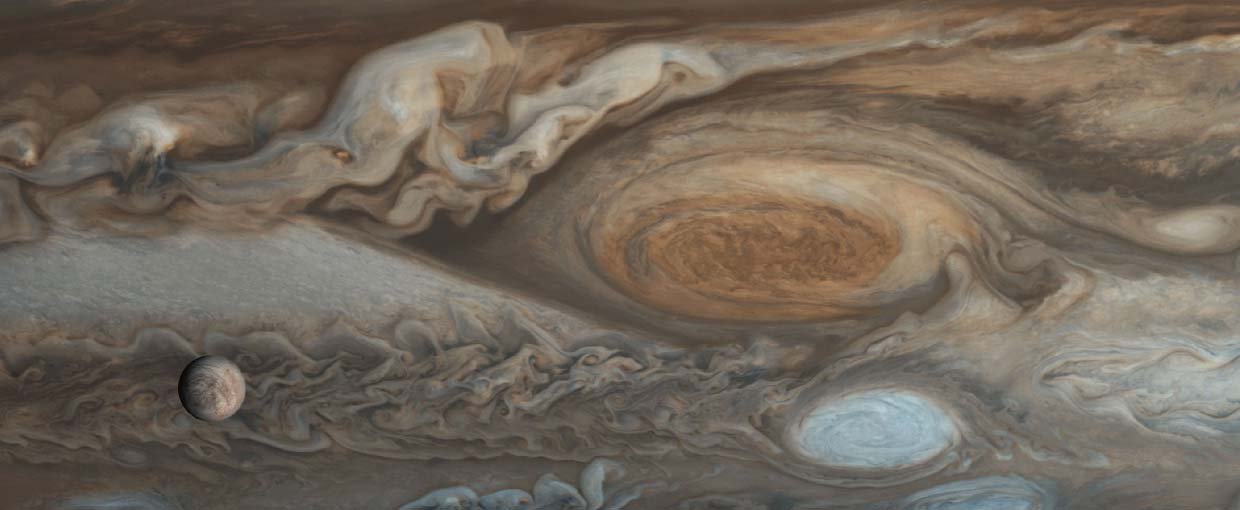
A volcanically active planet is shown in closeup at the left side of the image with glowing eruptions and lines of lava on the surface. To the right and in the distance is a faint blue glowing ball representing the more massive planet in the system.Sixteen frames from Voyager 1's flyby of Jupiter in 1979 were merged to create this image. Jupiter's Great Red Spot is visible in the center. Jupiter's moon Europa can be seen in the foreground at the bottom left of the image.The frame is a horizontal rainbow of color on a grid. Shadows of molecules can be seen through the light as well as the jagged peaks and troughs of spectral lines.
Fizzy Super Earths and Lava Worlds“Fizzy Super-Earths: Impacts of Magma Composition on the Bulk Density and Structure of Lava Worlds.” in The Astrophysical Journal.01/03
Identifying Hydrothermal Activity on Icy Ocean Worlds“Ethene-ethanol ratios as potential indicators of hydrothermal activity at Enceladus, Europa, and other icy ocean worlds.” In Icarus.02/03
NASA Raman Spectroscopic Database"The NASA Raman spectroscopic database: Ramdb version 1.00.” In Icarus.03/03
NextPrevious
Go Explore
January 2018De novo origins of multicellularity in response to predation

Herron, M. D., Borin, J. M., Boswell, J. C., Walker, J., Chen, I-C., Knox, C. A., … Ratcliff, W. C. (2018). De novo origins of multicellularity in response to predation. None. doi:10.1101/247361

Disequilibrium biosignatures over Earth history and implications for detecting exoplanet life

Krissansen-Totton, J., Olson, S., & Catling, D. C. (2018). Disequilibrium biosignatures over Earth history and implications for detecting exoplanet life. Science Advances, 4(1), eaao5747. doi:10.1126/sciadv.aao5747

Metagenomic investigation of vestimentiferan tubeworm endosymbionts from Mid-Cayman Rise reveals new insights into metabolism and diversity

Reveillaud, J., Anderson, R., Reves-Sohn, S., Cavanaugh, C., & Huber, J. A. (2018). Metagenomic investigation of vestimentiferan tubeworm endosymbionts from Mid-Cayman Rise reveals new insights into metabolism and diversity. Microbiome, 6(1), None. doi:10.1186/s40168-018-0411-x

1I/‘Oumuamua as a Tidal Disruption Fragment from a Binary Star System

Ćuk, M. (2018). 1I/‘Oumuamua as a Tidal Disruption Fragment from a Binary Star System. The Astrophysical Journal, 852(1), L15. doi:10.3847/2041-8213/aaa3db

Neoproterozoic marine carbonates and their paleoceanographic significance

Hood, A. v. S., & Wallace, M. W. (2018). Neoproterozoic marine carbonates and their paleoceanographic significance. Global and Planetary Change, 160, 28–45. doi:10.1016/j.gloplacha.2017.11.006

Thermal effects of late accretion to the crust and mantle of Mercury

Mojzsis, S. J., Abramov, O., Frank, E. A., & Brasser, R. (2018). Thermal effects of late accretion to the crust and mantle of Mercury. Earth and Planetary Science Letters, 482, 536–544. doi:10.1016/j.epsl.2017.11.023

Nickel isotope fractionation during continental weathering

Spivak-Birndorf, L. J., Wang, S-J., Bish, D. L., & Wasylenki, L. E. (2018). Nickel isotope fractionation during continental weathering. Chemical Geology, 476, 316–326. doi:10.1016/j.chemgeo.2017.11.028

Ecological advantages and evolutionary limitations of aggregative multicellular development

Pentz, J. T., Márquez-ZacaríAs, P., Yunker, P. J., Libby, E., & Ratcliff, W. C. (2018). Ecological advantages and evolutionary limitations of aggregative multicellular development. None. doi:10.1101/255307

Microstructural characterization and in-situ sulfur isotopic analysis of silver-bearing sphalerite from the Edmond hydrothermal field, Central Indian Ridge

Wu, Z., Sun, X., Xu, H., Konishi, H., Wang, Y., Lu, Y., … Zhou, H. (2018). Microstructural characterization and in-situ sulfur isotopic analysis of silver-bearing sphalerite from the Edmond hydrothermal field, Central Indian Ridge. Ore Geology Reviews, 92, 318–347. doi:10.1016/j.oregeorev.2017.11.024

Effect of Mica and Hematite (001) Surfaces on the Precipitation of Calcite

Xu, H., Zhou, M., Fang, Y., & Teng, H. (2018). Effect of Mica and Hematite (001) Surfaces on the Precipitation of Calcite. Minerals, 8(1), 17. doi:10.3390/min8010017