

This website is currently being migrated. For the most up-to-date astrobiology news, resources, and community announcements, please visit our new home at science.nasa.gov/astrobiology

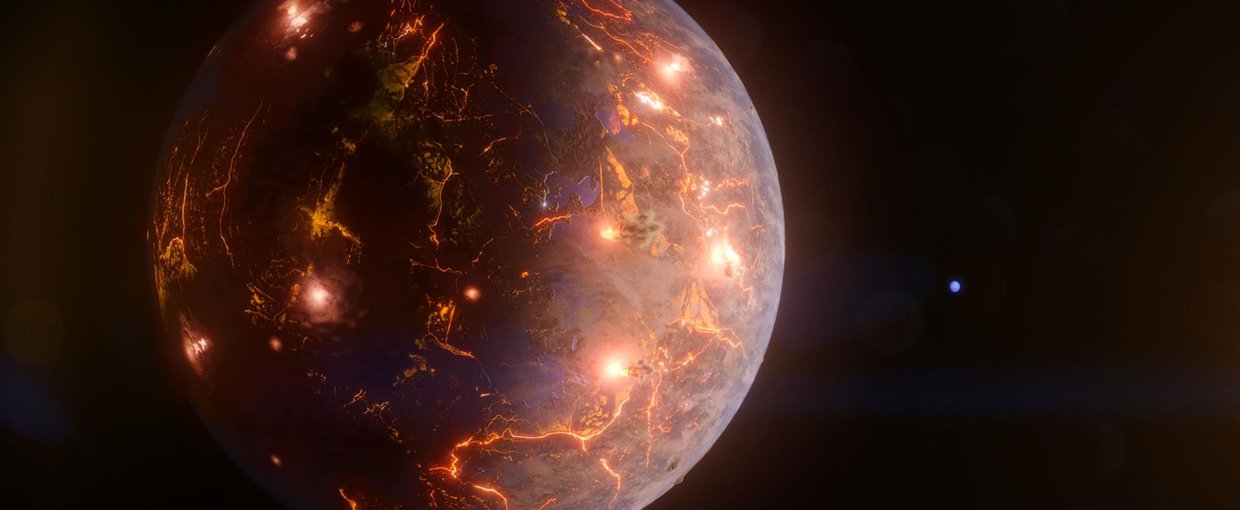
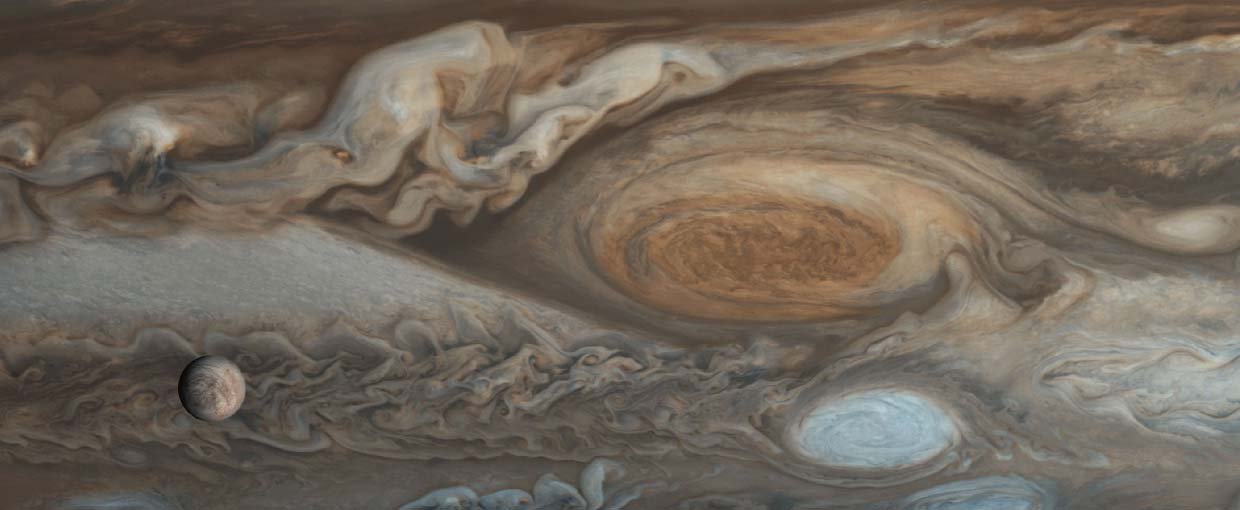
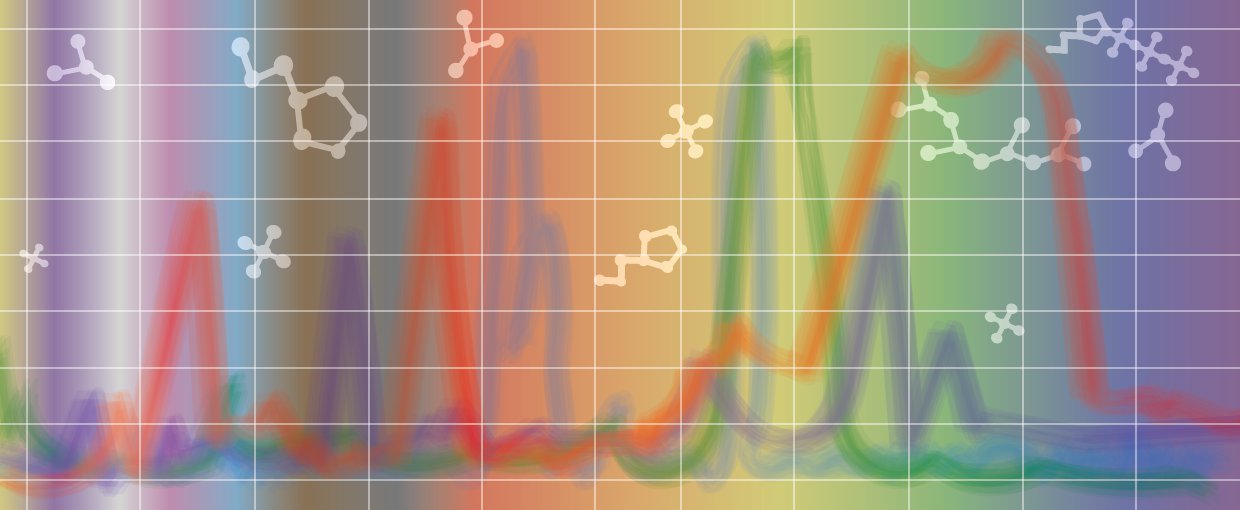
A volcanically active planet is shown in closeup at the left side of the image with glowing eruptions and lines of lava on the surface. To the right and in the distance is a faint blue glowing ball representing the more massive planet in the system.Sixteen frames from Voyager 1's flyby of Jupiter in 1979 were merged to create this image. Jupiter's Great Red Spot is visible in the center. Jupiter's moon Europa can be seen in the foreground at the bottom left of the image.The frame is a horizontal rainbow of color on a grid. Shadows of molecules can be seen through the light as well as the jagged peaks and troughs of spectral lines.
Fizzy Super Earths and Lava Worlds“Fizzy Super-Earths: Impacts of Magma Composition on the Bulk Density and Structure of Lava Worlds.” in The Astrophysical Journal.01/03
Identifying Hydrothermal Activity on Icy Ocean Worlds“Ethene-ethanol ratios as potential indicators of hydrothermal activity at Enceladus, Europa, and other icy ocean worlds.” In Icarus.02/03
NASA Raman Spectroscopic Database"The NASA Raman spectroscopic database: Ramdb version 1.00.” In Icarus.03/03
NextPrevious
Go Explore
May 2021Rates of protoplanetary accretion and differentiation set nitrogen budget of rocky planets

Grewal, D. S., Dasgupta, R., Hough, T., & Farnell, A. (2021). Rates of protoplanetary accretion and differentiation set nitrogen budget of rocky planets. Nature Geoscience, 14(6), 369–376. doi:10.1038/s41561-021-00733-0

April 2021Building the Galilean moons system via pebble accretion and migration: a primordial resonant chain

Madeira, G., Izidoro, A., & Winter, S. M. G. (2021). Building the Galilean moons system via pebble accretion and migration: a primordial resonant chain. Monthly Notices of the Royal Astronomical Society, 504(2), 1854–1872. doi:10.1093/mnras/stab986

March 2021Tracing a modern biosphere on Mars

Cabrol, N. A. (2021). Tracing a modern biosphere on Mars. Nature Astronomy, 5(3), 210–212. doi:10.1038/s41550-021-01327-x

To cool is to keep: residual H/He atmospheres of super-Earths and sub-Neptunes

Misener, W., & Schlichting, H. E. (2021). To cool is to keep: residual H/He atmospheres of super-Earths and sub-Neptunes. Monthly Notices of the Royal Astronomical Society, 503(4), 5658–5674. doi:10.1093/mnras/stab895

February 2021Convective and Tectonic Plate Velocities in a Mixed Heating Mantle

Lenardic, A., Seales, J., Moore, W., & Weller, M. (2021). Convective and Tectonic Plate Velocities in a Mixed Heating Mantle. Geochemistry, Geophysics, Geosystems, 22(2), None. doi:10.1029/2020gc009278

January 2021Cluster Analysis of Presolar Silicon Carbide Grains: Evaluation of Their Classification and Astrophysical Implications

Boujibar, A., Howell, S., Zhang, S., Hystad, G., Prabhu, A., Liu, N., … Nittler, L. R. (2021). Cluster Analysis of Presolar Silicon Carbide Grains: Evaluation of Their Classification and Astrophysical Implications. The Astrophysical Journal, 907(2), L39. doi:10.3847/2041-8213/abd102

Could Uranus and Neptune form by collisions of planetary embryos?

Chau, A., Reinhardt, C., Izidoro, A., Stadel, J., & Helled, R. (2021). Could Uranus and Neptune form by collisions of planetary embryos? Monthly Notices of the Royal Astronomical Society, 502(2), 1647–1660. doi:10.1093/mnras/staa4021

Habitability: a process versus a state variable framework with observational tests and theoretical implications

Lenardic, A., & Seales, J. (2021). Habitability: a process versus a state variable framework with observational tests and theoretical implications. International Journal of Astrobiology, 20(2), 125–132. doi:10.1017/s1473550420000415

November 2020The eccentricity distribution of giant planets and their relation to super-Earths in the pebble accretion scenario

Bitsch, B., Trifonov, T., & Izidoro, A. (2020). The eccentricity distribution of giant planets and their relation to super-Earths in the pebble accretion scenario. Astronomy & Astrophysics, 643, A66. doi:10.1051/0004-6361/202038856

October 2020Microsensors in Icy Environments to Detect Microbial Activities

McGlennen, M., Neubauer, M., Driesler, M., Dieser, M., Foreman, C. M., & Warnat, S. (2020). Microsensors in Icy Environments to Detect Microbial Activities. Journal of Microelectromechanical Systems, 29(5), 853–859. doi:10.1109/jmems.2020.3012420