

This website is currently being migrated. For the most up-to-date astrobiology news, resources, and community announcements, please visit our new home at science.nasa.gov/astrobiology

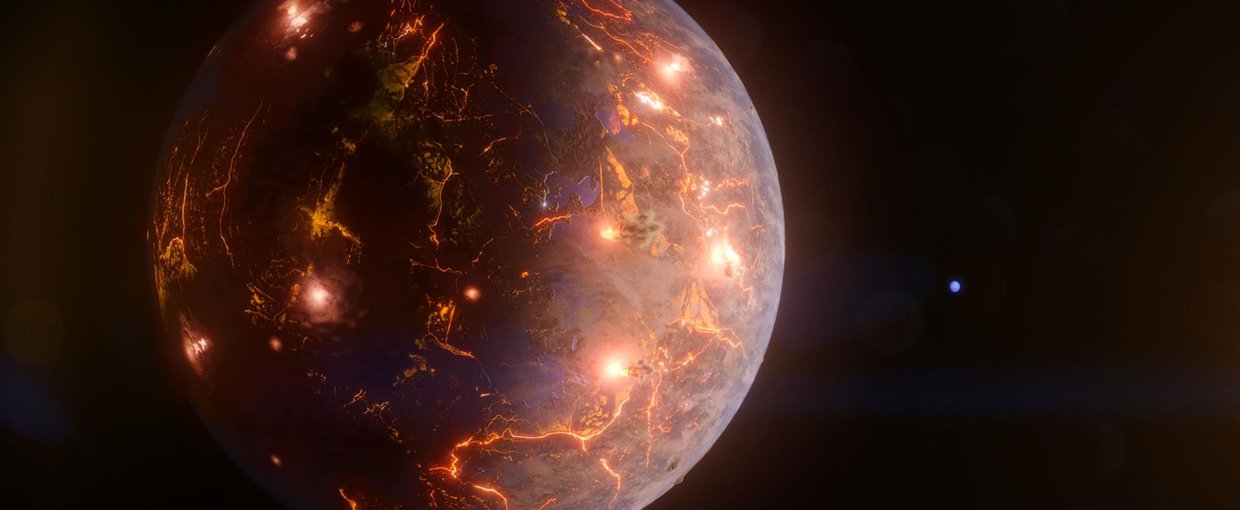
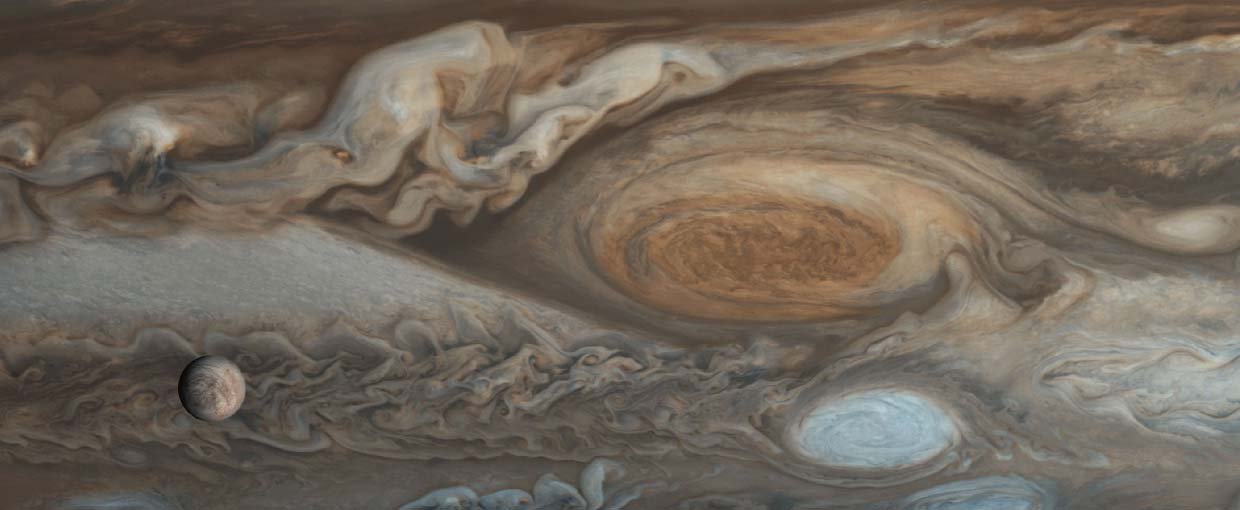
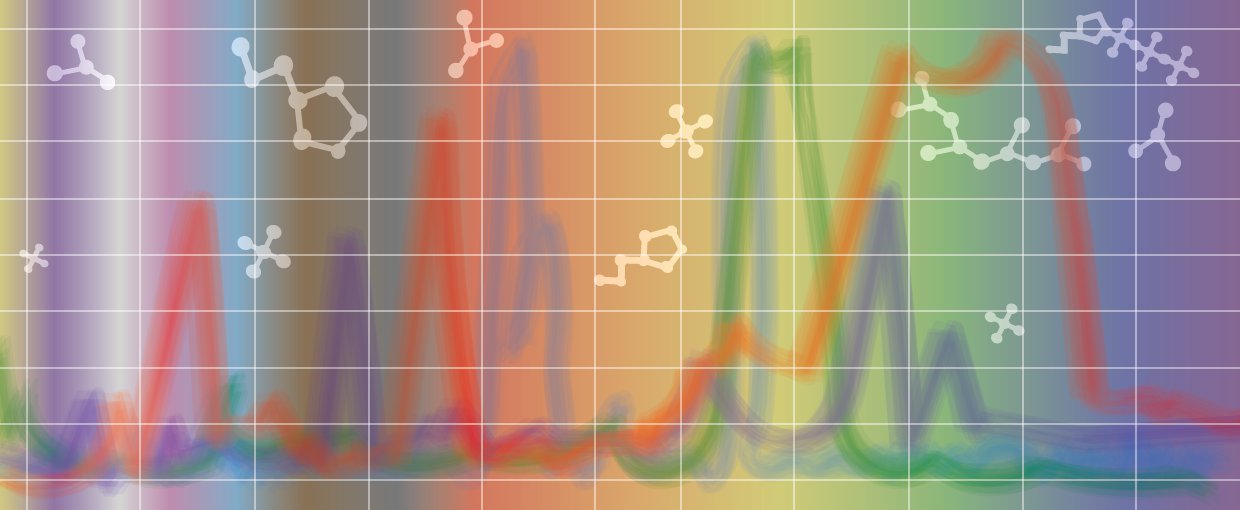
A volcanically active planet is shown in closeup at the left side of the image with glowing eruptions and lines of lava on the surface. To the right and in the distance is a faint blue glowing ball representing the more massive planet in the system.Sixteen frames from Voyager 1's flyby of Jupiter in 1979 were merged to create this image. Jupiter's Great Red Spot is visible in the center. Jupiter's moon Europa can be seen in the foreground at the bottom left of the image.The frame is a horizontal rainbow of color on a grid. Shadows of molecules can be seen through the light as well as the jagged peaks and troughs of spectral lines.
Fizzy Super Earths and Lava Worlds“Fizzy Super-Earths: Impacts of Magma Composition on the Bulk Density and Structure of Lava Worlds.” in The Astrophysical Journal.01/03
Identifying Hydrothermal Activity on Icy Ocean Worlds“Ethene-ethanol ratios as potential indicators of hydrothermal activity at Enceladus, Europa, and other icy ocean worlds.” In Icarus.02/03
NASA Raman Spectroscopic Database"The NASA Raman spectroscopic database: Ramdb version 1.00.” In Icarus.03/03
NextPrevious
Go Explore
May 2026Simultaneous analysis of long-chain alkenones and chlorophyll derivatives offers new insights into the ecology of Isochrysis algae in the Holocene Black Sea

Alo, O. O., Fu, J., Zhao, W., Zhang, Y. G., Huang, Y., & Liu, X-L. (2026). Simultaneous analysis of long-chain alkenones and chlorophyll derivatives offers new insights into the ecology of Isochrysis algae in the Holocene Black Sea. Marine Chemistry, 276, 104634. doi:10.1016/j.marchem.2026.104634

Limit cycles and the climate history of Mars

Haqq-Misra, J. (2026). Limit cycles and the climate history of Mars. Icarus, 449, 116945. doi:10.1016/j.icarus.2026.116945

March 2026The relationship between organic matgrounds and sedimentary packaging: examples from the Ediacaran and early Cambrian

Droser, M. L., Surprenant, R. L., McCandless, H. K., & Gaines, R. R. (2026). The relationship between organic matgrounds and sedimentary packaging: examples from the Ediacaran and early Cambrian. Sedimentology. doi:10.1111/sed.70094

Microbial growth rates captured using Raman-SIP reveal a highly active subsurface biosphere fueled by serpentinization

Kashyap, S., Caro, T. A., & Templeton, A. S. (2026). Microbial growth rates captured using Raman-SIP reveal a highly active subsurface biosphere fueled by serpentinization. Nature Communications. doi:10.1038/s41467-026-70622-w

Rethinking Seawater Mo Isotope Mass‐Balance and the Sedimentary Mo Record

Ostrander, C. M., & Dellwig, O. (2026). Rethinking Seawater Mo Isotope Mass‐Balance and the Sedimentary Mo Record. Paleoceanography and Paleoclimatology, 41(3), None. doi:10.1029/2025pa005313

The Formose Reaction with SO2: A Computational Study

Sisson, E. M., & Kua, J. (2026). The Formose Reaction with SO2: A Computational Study. Life, 16(3), 513. doi:10.3390/life16030513

Variability of Europa’s Optical Aurora on Orbital and Multiyear Timescales

Milby, Z., De Kleer, K., Schmidt, C., & Camarca, M. (2026). Variability of Europa’s Optical Aurora on Orbital and Multiyear Timescales. The Planetary Science Journal, 7(3), 60. doi:10.3847/psj/ae47f4

Super P-mediated in-situ growth of FeTe2 in carbon nanofibers for flexible, binder-free sodium-ion battery anodes

Liu, Z., Li, X., He, Z., Li, Y., Kharbouch, Z., Wei, Z., … Fei, L. (2026). Super P-mediated in-situ growth of FeTe2 in carbon nanofibers for flexible, binder-free sodium-ion battery anodes. Journal of Energy Storage, 149, 120409. doi:10.1016/j.est.2026.120409

Calcium isotopes support rapid condensation of CAIs in the early solar nebula

Parendo, C. A., Jacobsen, S. B., & Petaev, M. I. (2026). Calcium isotopes support rapid condensation of CAIs in the early solar nebula. Earth and Planetary Science Letters, 678, 119825. doi:10.1016/j.epsl.2026.119825

Rover‐Induced Mineral Transformations: Extent of the Effect for the Mars Science Laboratory and Opportunities for Future Landed Mission

Meusburger, J. M., Bristow, T. F., Vaniman, D. T., Rampe, E. B., Chipera, S. J., Blake, D. F., … Berlanga, G. (2026). Rover‐Induced Mineral Transformations: Extent of the Effect for the Mars Science Laboratory and Opportunities for Future Landed Mission. Journal of Geophysical Research: Planets, 131(3), None. doi:10.1029/2025je009631

PREV
1/2/3/4/5/6...105
NEXT