

This website is currently being migrated. For the most up-to-date astrobiology news, resources, and community announcements, please visit our new home at science.nasa.gov/astrobiology

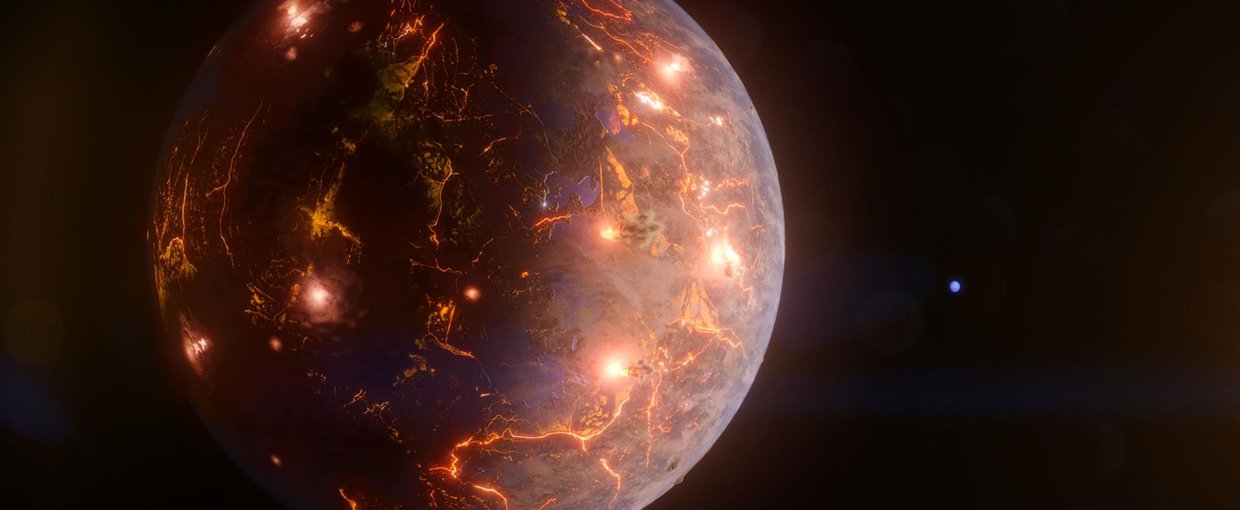
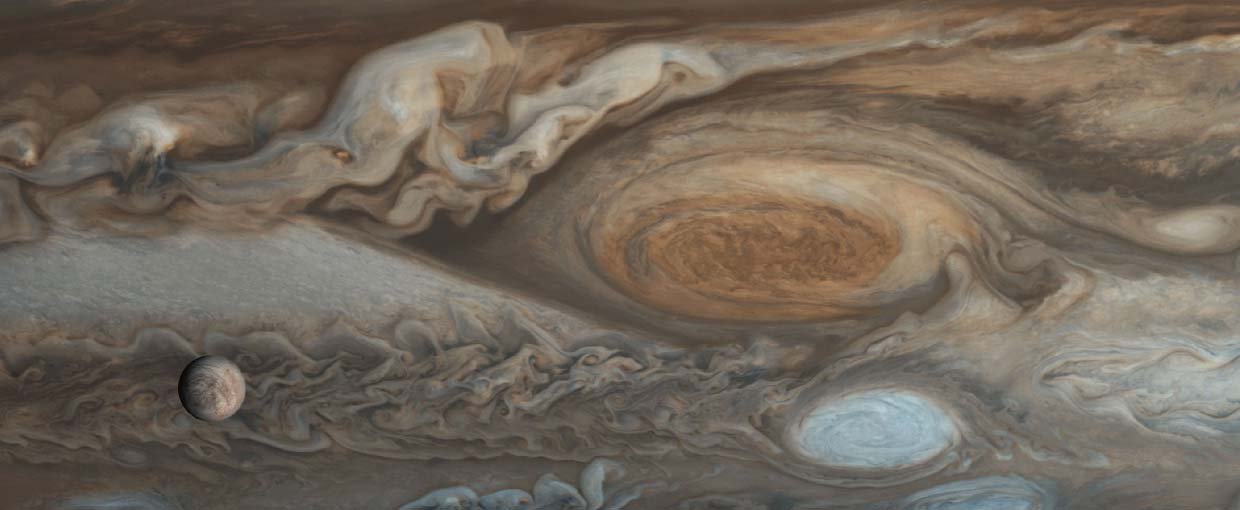
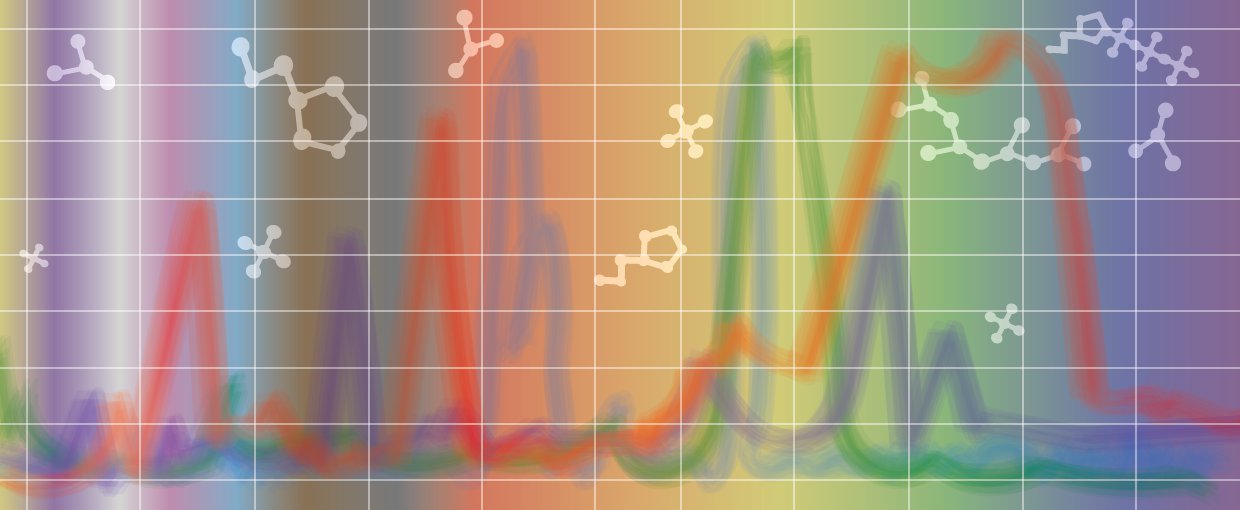
A volcanically active planet is shown in closeup at the left side of the image with glowing eruptions and lines of lava on the surface. To the right and in the distance is a faint blue glowing ball representing the more massive planet in the system.Sixteen frames from Voyager 1's flyby of Jupiter in 1979 were merged to create this image. Jupiter's Great Red Spot is visible in the center. Jupiter's moon Europa can be seen in the foreground at the bottom left of the image.The frame is a horizontal rainbow of color on a grid. Shadows of molecules can be seen through the light as well as the jagged peaks and troughs of spectral lines.
Fizzy Super Earths and Lava Worlds“Fizzy Super-Earths: Impacts of Magma Composition on the Bulk Density and Structure of Lava Worlds.” in The Astrophysical Journal.01/03
Identifying Hydrothermal Activity on Icy Ocean Worlds“Ethene-ethanol ratios as potential indicators of hydrothermal activity at Enceladus, Europa, and other icy ocean worlds.” In Icarus.02/03
NASA Raman Spectroscopic Database"The NASA Raman spectroscopic database: Ramdb version 1.00.” In Icarus.03/03
NextPrevious
Go Explore
March 2022Compositional Maps of the Lunar Polar Regions Derived from the Kaguya Spectral Profiler and the Lunar Orbiter Laser Altimeter Data

Lemelin, M., Lucey, P. G., & Camon, A. (2022). Compositional Maps of the Lunar Polar Regions Derived from the Kaguya Spectral Profiler and the Lunar Orbiter Laser Altimeter Data. The Planetary Science Journal, 3(3), 63. doi:10.3847/psj/ac532c

Science Objectives for Flagship-Class Mission Concepts for the Search for Evidence of Life at Enceladus

MacKenzie, S. M., Neveu, M., Davila, A. F., Lunine, J. I., Cable, M. L., Phillips-Lander, C. M., … Heldmann, J. (2022). Science Objectives for Flagship-Class Mission Concepts for the Search for Evidence of Life at Enceladus. Astrobiology. doi:10.1089/ast.2020.2425

Effects of UV Stellar Spectral Uncertainty on the Chemistry of Terrestrial Atmospheres

Teal, D. J., Kempton, E-R., Bastelberger, S., Youngblood, A., & Arney, G. (2022). Effects of UV Stellar Spectral Uncertainty on the Chemistry of Terrestrial Atmospheres. The Astrophysical Journal, 927(1), 90. doi:10.3847/1538-4357/ac4d99

Five Decades of Chromospheric Activity in 59 Sun-like Stars and New Maunder Minimum Candidate HD 166620

Baum, A. C., Wright, J. T., Luhn, J. K., & Isaacson, H. (2022). Five Decades of Chromospheric Activity in 59 Sun-like Stars and New Maunder Minimum Candidate HD 166620. The Astronomical Journal, 163(4), 183. doi:10.3847/1538-3881/ac5683

Detection of Near-infrared Water Ice at the Surface of the (Pre)Transitional Disk of AB Aur: Informing Icy Grain Abundance, Composition, and Size

Betti, S. K., Follette, K., Jorquera, S., Duchêne, G., Mazoyer, J., Bonnefoy, M., … Vaz, A. (2022). Detection of Near-infrared Water Ice at the Surface of the (Pre)Transitional Disk of AB Aur: Informing Icy Grain Abundance, Composition, and Size. The Astronomical Journal, 163(4), 145. doi:10.3847/1538-3881/ac4d9b

The Contribution of M-dwarf Flares to the Thermal Escape of Potentially Habitable Planet Atmospheres

Do Amaral, L. N. R., Barnes, R., Segura, A., & Luger, R. (2022). The Contribution of M-dwarf Flares to the Thermal Escape of Potentially Habitable Planet Atmospheres. The Astrophysical Journal, 928(1), 12. doi:10.3847/1538-4357/ac53af

Cool microrefugia accumulate and conserve biodiversity under climate change

Nadeau, C. P., Giacomazzo, A., & Urban, M. C. (2022). Cool microrefugia accumulate and conserve biodiversity under climate change. Global Change Biology. doi:10.1111/gcb.16143

Coaccretion + Giant-impact Origin of the Uranus System: Tilting Impact

Rufu, R., & Canup, R. M. (2022). Coaccretion + Giant-impact Origin of the Uranus System: Tilting Impact. The Astrophysical Journal, 928(2), 123. doi:10.3847/1538-4357/ac525a

Habitable Planet Formation around Low-mass Stars: Rapid Accretion, Rapid Debris Removal, and the Essential Contribution of External Giants

Clement, M. S., Quintana, E. V., & Quarles, B. L. (2022). Habitable Planet Formation around Low-mass Stars: Rapid Accretion, Rapid Debris Removal, and the Essential Contribution of External Giants. The Astrophysical Journal, 928(1), 91. doi:10.3847/1538-4357/ac549e

Proterozoic supercontinent break-up as a driver for oxygenation events and subsequent carbon isotope excursions

Eguchi, J., Diamond, C. W., & Lyons, T. W. (2022). Proterozoic supercontinent break-up as a driver for oxygenation events and subsequent carbon isotope excursions. PNAS Nexus, 1(2), None. doi:10.1093/pnasnexus/pgac036