

This website is currently being migrated. For the most up-to-date astrobiology news, resources, and community announcements, please visit our new home at science.nasa.gov/astrobiology

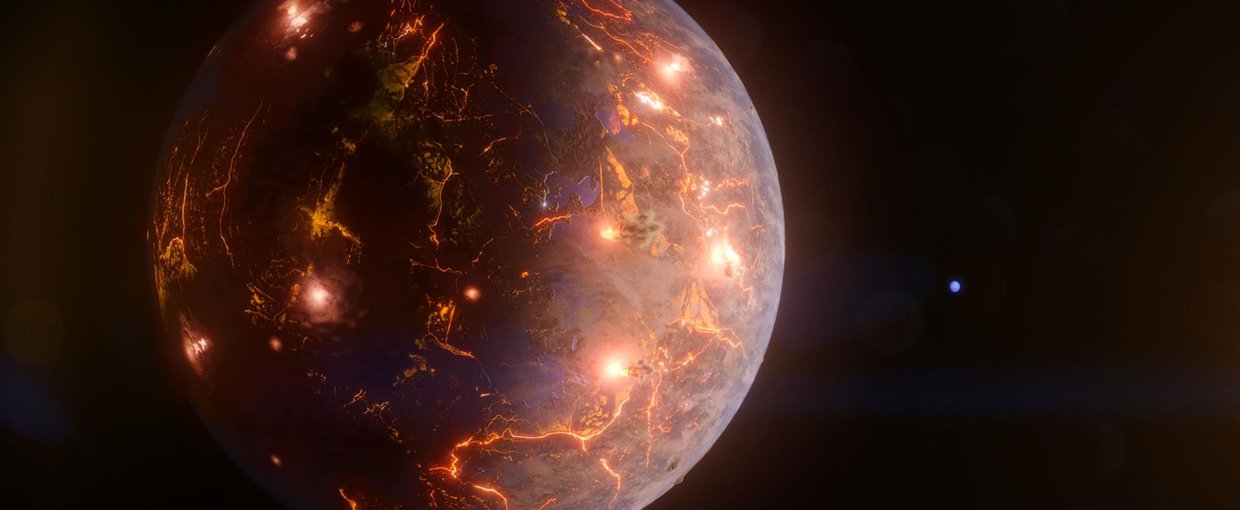
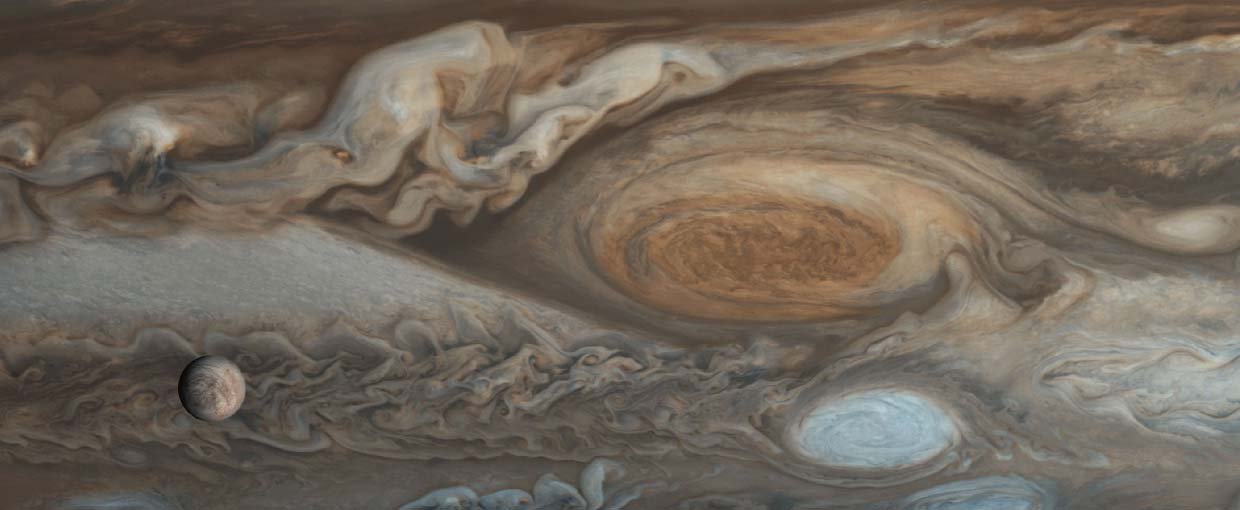
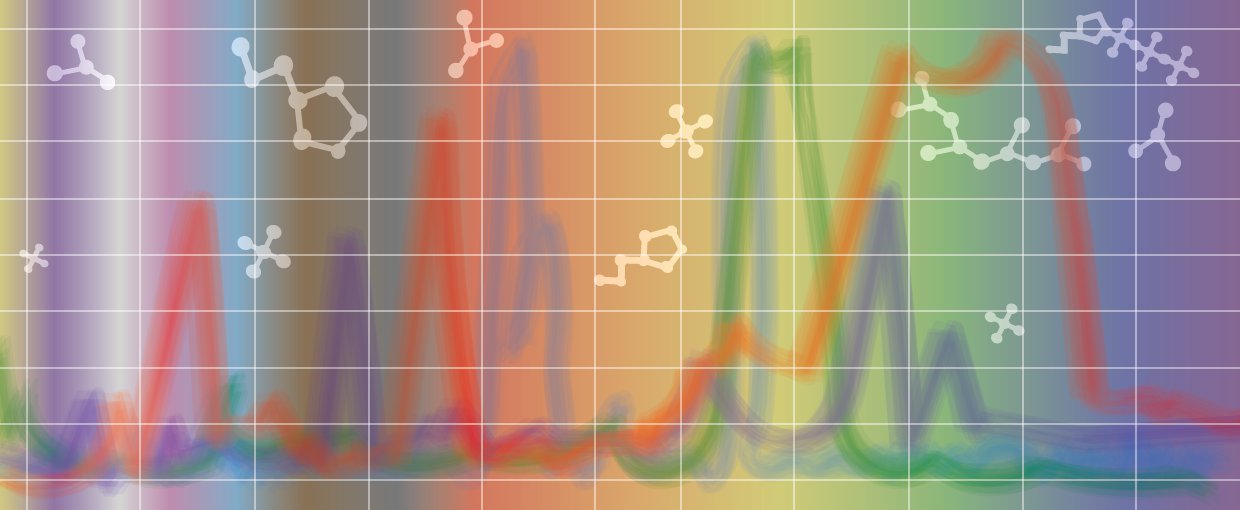
A volcanically active planet is shown in closeup at the left side of the image with glowing eruptions and lines of lava on the surface. To the right and in the distance is a faint blue glowing ball representing the more massive planet in the system.Sixteen frames from Voyager 1's flyby of Jupiter in 1979 were merged to create this image. Jupiter's Great Red Spot is visible in the center. Jupiter's moon Europa can be seen in the foreground at the bottom left of the image.The frame is a horizontal rainbow of color on a grid. Shadows of molecules can be seen through the light as well as the jagged peaks and troughs of spectral lines.
Fizzy Super Earths and Lava Worlds“Fizzy Super-Earths: Impacts of Magma Composition on the Bulk Density and Structure of Lava Worlds.” in The Astrophysical Journal.01/03
Identifying Hydrothermal Activity on Icy Ocean Worlds“Ethene-ethanol ratios as potential indicators of hydrothermal activity at Enceladus, Europa, and other icy ocean worlds.” In Icarus.02/03
NASA Raman Spectroscopic Database"The NASA Raman spectroscopic database: Ramdb version 1.00.” In Icarus.03/03
NextPrevious
Go Explore
June 2022Seasonal Variations of Chemical Species and Haze in Titan's Upper Atmosphere

Fan, S., Zhao, D., Li, C., Shemansky, D. E., Liang, M-C., & Yung, Y. L. (2022). Seasonal Variations of Chemical Species and Haze in Titan's Upper Atmosphere. The Planetary Science Journal, 3(6), 130. doi:10.3847/psj/ac6953

The dynamic formation process of the CB chondrite Gujba

Koefoed, P., Pravdivtseva, O., Ogliore, R., Jiang, Y., Lodders, K., Neuman, M., & Wang, K. (2022). The dynamic formation process of the CB chondrite Gujba. Geochimica et Cosmochimica Acta. doi:10.1016/j.gca.2022.06.021

Origin of Water in the Terrestrial Planets: Insights from Meteorite Data and Planet Formation Models

Izidoro, A., & Piani, L. (2022). Origin of Water in the Terrestrial Planets: Insights from Meteorite Data and Planet Formation Models. Elements, 18(3), 181–186. doi:10.2138/gselements.18.3.181

Hype, skin in the game, and the stability of cooperative science

Lenardic, A., Seales, J., & Covington, A. (2022). Hype, skin in the game, and the stability of cooperative science. International Journal of Astrobiology, 21(6), 484–496. doi:10.1017/s1473550422000222

Effects of phosphorus on partial melting of the Martian Mantle and compositions of the Martian Crust

Payré, V., & Dasgupta, R. (2022). Effects of phosphorus on partial melting of the Martian Mantle and compositions of the Martian Crust. Geochimica et Cosmochimica Acta, 327, 229–246. doi:10.1016/j.gca.2022.03.034

Atmosphere loss by aerial bursts

Trierweiler, I. L., & Schlichting, H. E. (2022). Atmosphere loss by aerial bursts. Monthly Notices of the Royal Astronomical Society, 514(3), 3650–3659. doi:10.1093/mnras/stac1509

May 2022The Appearance of Vortices in Protoplanetary Disks in Near-infrared Scattered Light

Marr, M., & Dong, R. (2022). The Appearance of Vortices in Protoplanetary Disks in Near-infrared Scattered Light. The Astrophysical Journal, 930(1), 80. doi:10.3847/1538-4357/ac63ab

Observing Planet-driven Dust Spirals with ALMA

Speedie, J., Booth, R. A., & Dong, R. (2022). Observing Planet-driven Dust Spirals with ALMA. The Astrophysical Journal, 930(1), 40. doi:10.3847/1538-4357/ac5cc0

TRAPPIST-1h as an Exo-Titan. I. The Role of Assumptions about Atmospheric Parameters in Understanding an Exoplanet Atmosphere

Mandt, K., Luspay-Kuti, A., Lustig-Yaeger, J., Felton, R., & Domagal-Goldman, S. (2022). TRAPPIST-1h as an Exo-Titan. I. The Role of Assumptions about Atmospheric Parameters in Understanding an Exoplanet Atmosphere. The Astrophysical Journal, 930(1), 73. doi:10.3847/1538-4357/ac59bb

Limited Stability of Multicomponent Brines on the Surface of Mars

Chevrier, V. F., Fitting, A. B., & Rivera-Valentín, E. G. (2022). Limited Stability of Multicomponent Brines on the Surface of Mars. The Planetary Science Journal, 3(5), 125. doi:10.3847/psj/ac6603