

This website is currently being migrated. For the most up-to-date astrobiology news, resources, and community announcements, please visit our new home at science.nasa.gov/astrobiology

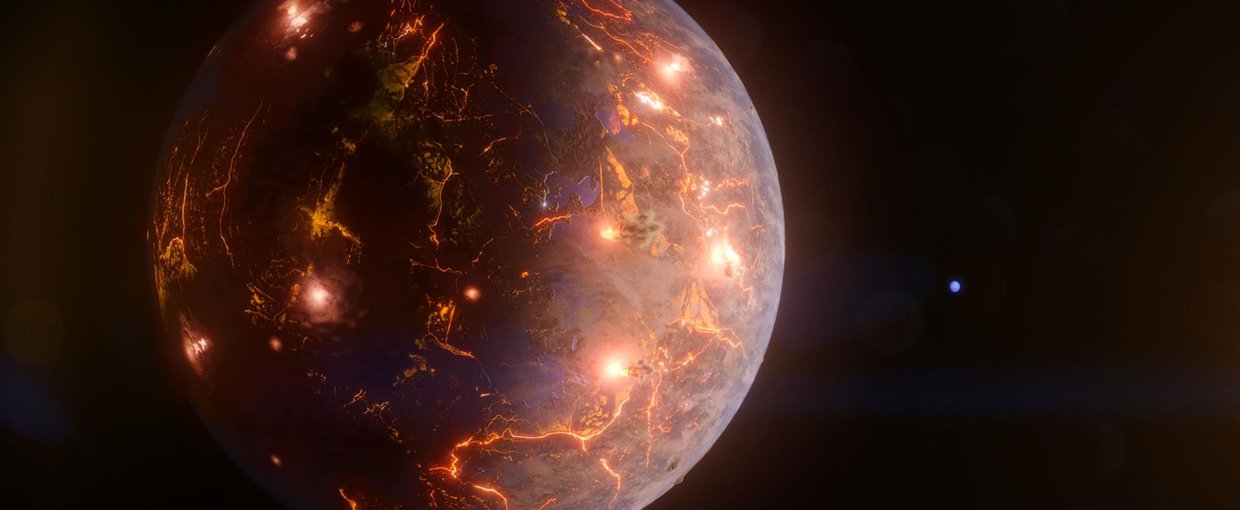
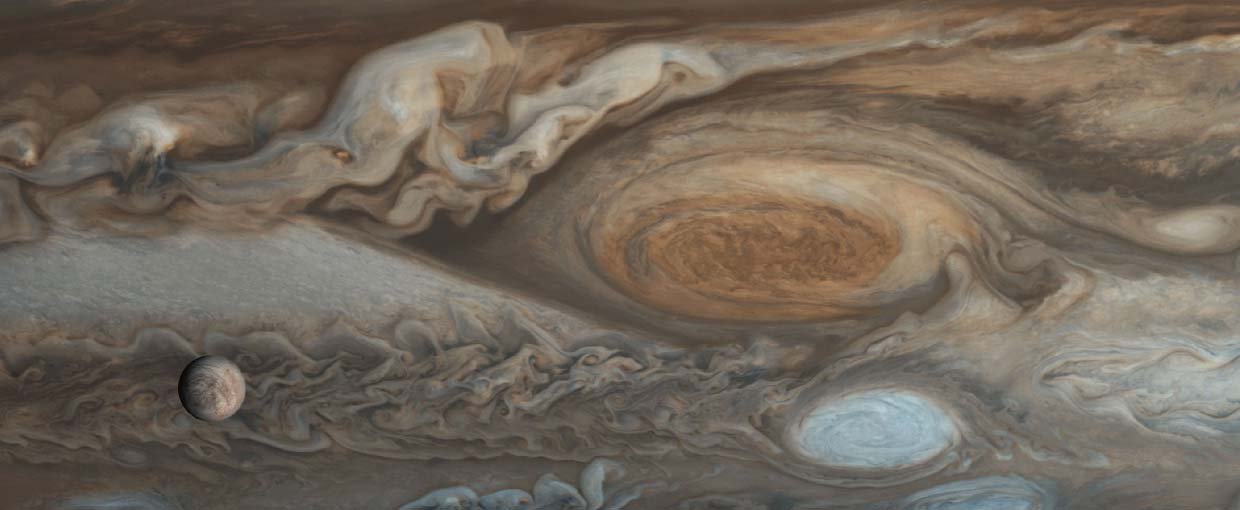
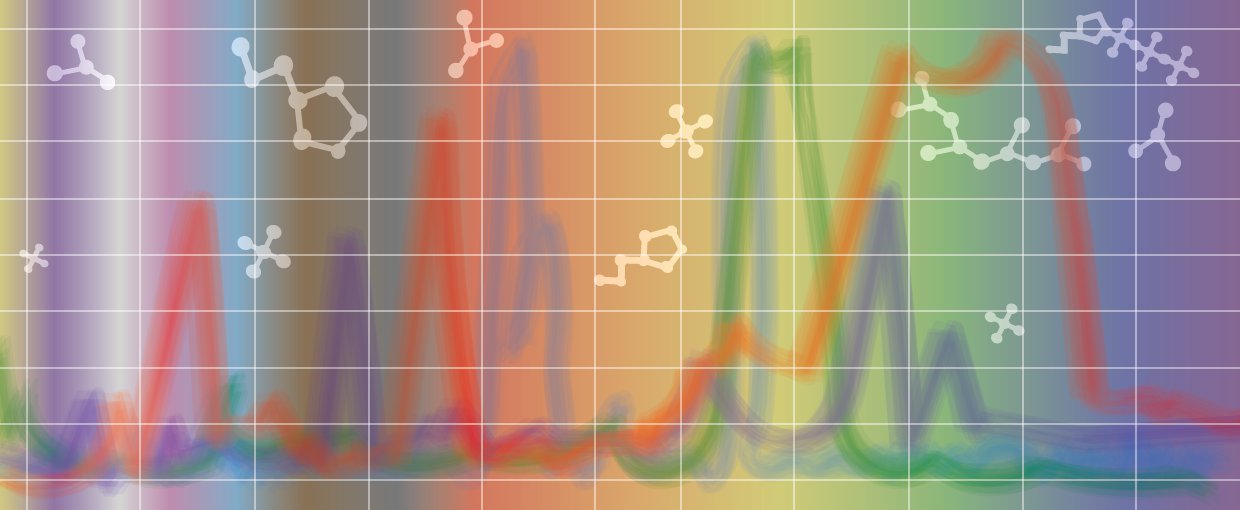
A volcanically active planet is shown in closeup at the left side of the image with glowing eruptions and lines of lava on the surface. To the right and in the distance is a faint blue glowing ball representing the more massive planet in the system.Sixteen frames from Voyager 1's flyby of Jupiter in 1979 were merged to create this image. Jupiter's Great Red Spot is visible in the center. Jupiter's moon Europa can be seen in the foreground at the bottom left of the image.The frame is a horizontal rainbow of color on a grid. Shadows of molecules can be seen through the light as well as the jagged peaks and troughs of spectral lines.
Fizzy Super Earths and Lava Worlds“Fizzy Super-Earths: Impacts of Magma Composition on the Bulk Density and Structure of Lava Worlds.” in The Astrophysical Journal.01/03
Identifying Hydrothermal Activity on Icy Ocean Worlds“Ethene-ethanol ratios as potential indicators of hydrothermal activity at Enceladus, Europa, and other icy ocean worlds.” In Icarus.02/03
NASA Raman Spectroscopic Database"The NASA Raman spectroscopic database: Ramdb version 1.00.” In Icarus.03/03
NextPrevious
Go Explore
December 2022Metabolic Potential of Microbial Communities in the Hypersaline Sediments of the Bonneville Salt Flats

McGonigle, J. M., Bernau, J. A., Bowen, B. B., & Brazelton, W. J. (2022). Metabolic Potential of Microbial Communities in the Hypersaline Sediments of the Bonneville Salt Flats. mSystems, 7(6), None. doi:10.1128/msystems.00846-22

Formation of manganese oxides on early Mars due to active halogen cycling

Mitra, K., Moreland, E. L., Ledingham, G. J., & Catalano, J. G. (2022). Formation of manganese oxides on early Mars due to active halogen cycling. Nature Geoscience. doi:10.1038/s41561-022-01094-y

Rapid formation of massive planetary cores in a pressure bump

Lau, T. C. H., Drążkowska, J., Stammler, S. M., Birnstiel, T., & Dullemond, C. P. (2022). Rapid formation of massive planetary cores in a pressure bump. Astronomy & Astrophysics, 668, A170. doi:10.1051/0004-6361/202244864

Multiverse Predictions for Habitability: Element Abundances

Sandora, M., Airapetian, V., Barnes, L., Lewis, G. F., & Pérez-Rodríguez, I. (2022). Multiverse Predictions for Habitability: Element Abundances. Universe, 8(12), 651. doi:10.3390/universe8120651

Measured spin–orbit alignment of ultra-short-period super-Earth 55 Cancri e

Zhao, L. L., Kunovac, V., Brewer, J. M., Llama, J., Millholland, S. C., Hedges, C., … Fischer, D. A. (2022). Measured spin–orbit alignment of ultra-short-period super-Earth 55 Cancri e. Nature Astronomy. doi:10.1038/s41550-022-01837-2

Limited nitrogen isotopic fractionation during core-mantle differentiation in rocky protoplanets and planets

Grewal, D. S., Sun, T., Aithala, S., Hough, T., Dasgupta, R., Yeung, L. Y., & Schauble, E. A. (2022). Limited nitrogen isotopic fractionation during core-mantle differentiation in rocky protoplanets and planets. Geochimica et Cosmochimica Acta, 338, 347–364. doi:10.1016/j.gca.2022.10.025

Carnobacterium Species Capable of Growth at Pressures Ranging Over 5 Orders of Magnitude, from the Surface of Mars (103 Pa) to Deep Oceans (107 Pa) in the Solar System

Miller, K. M., Tang, F., Li, S., Mullane, K. K., Shelton, B. R., Bui, L., Bartlett, D. H., Nicholsond, W. L. (2022). Carnobacterium Species Capable of Growth at Pressures Ranging Over 5 Orders of Magnitude, from the Surface of Mars (103 Pa) to Deep Oceans (107 Pa) in the Solar System. Astrobiology. doi: 10.1089/ast.2022.0043

Subzero, saline incubations of Colwellia psychrerythraea reveal strategies and biomarkers for sustained life in extreme icy environments

Mudge, M.C., Nunn, B.L., Firth, F., Ewert, M., Hales, K., Fondrie, W.E., Noble, W.S., Toner, J., Light, B., Junge, K.A. (2021). Subzero, saline incubations of Colwellia psychrerythraea reveal strategies and biomarkers for sustained life in extreme icy environments. Environmental Microbiology, 23, 7. doi: 10.1111/1462-2920.15485