


This website is currently being migrated. For the most up-to-date astrobiology news, resources, and community announcements, please visit our new home at science.nasa.gov/astrobiology

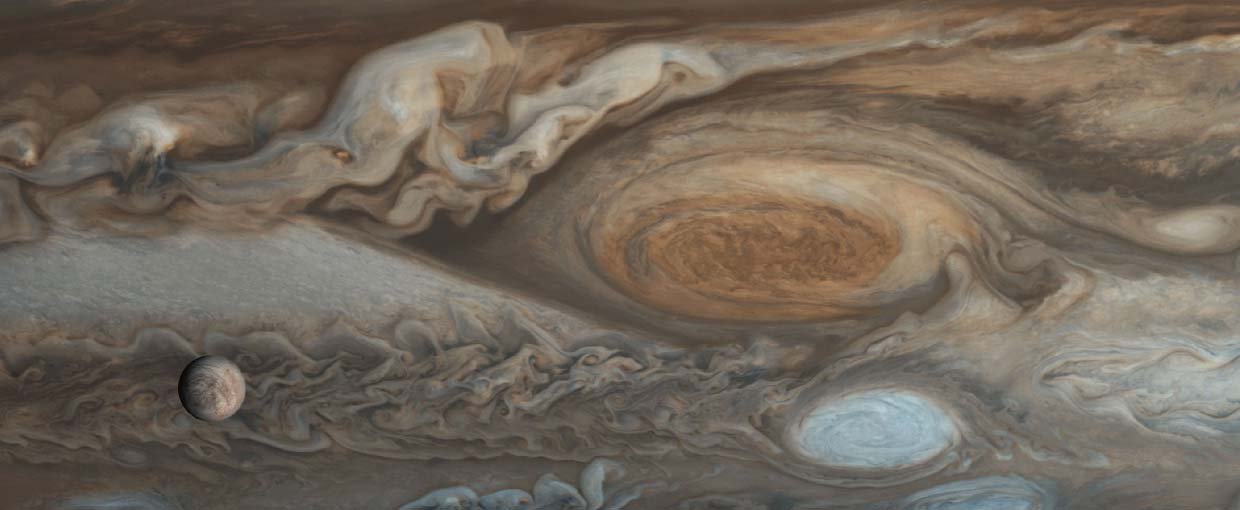
A volcanically active planet is shown in closeup at the left side of the image with glowing eruptions and lines of lava on the surface. To the right and in the distance is a faint blue glowing ball representing the more massive planet in the system.Sixteen frames from Voyager 1's flyby of Jupiter in 1979 were merged to create this image. Jupiter's Great Red Spot is visible in the center. Jupiter's moon Europa can be seen in the foreground at the bottom left of the image.The frame is a horizontal rainbow of color on a grid. Shadows of molecules can be seen through the light as well as the jagged peaks and troughs of spectral lines.
Fizzy Super Earths and Lava Worlds“Fizzy Super-Earths: Impacts of Magma Composition on the Bulk Density and Structure of Lava Worlds.” in The Astrophysical Journal.01/03
Identifying Hydrothermal Activity on Icy Ocean Worlds“Ethene-ethanol ratios as potential indicators of hydrothermal activity at Enceladus, Europa, and other icy ocean worlds.” In Icarus.02/03
NASA Raman Spectroscopic Database"The NASA Raman spectroscopic database: Ramdb version 1.00.” In Icarus.03/03
NextPrevious
Go Explore
March 2008Lunar dust characterization by polarimetric signature

Richard, D. T., & Davis, S. S. (2008). Lunar dust characterization by polarimetric signature. Astronomy & Astrophysics, 483(2), 643–649. doi:10.1051/0004-6361:20079108

April 2007Formation of Tellurium Nanocrystals during Anaerobic Growth of Bacteria That Use Te Oxyanions as Respiratory Electron Acceptors

Baesman, S. M., Bullen, T. D., Dewald, J., Zhang, D., Curran, S., Islam, F. S., … Oremland, R. S. (2007). Formation of Tellurium Nanocrystals during Anaerobic Growth of Bacteria That Use Te Oxyanions as Respiratory Electron Acceptors. Applied and Environmental Microbiology, 73(7), 2135–2143. doi:10.1128/aem.02558-06

February 2007A Reappraisal of The Habitability of Planets around M Dwarf Stars

Tarter, J. C., Backus, P. R., Mancinelli, R. L., Aurnou, J. M., Backman, D. E., Basri, G. S., … Young, R. E. (2007). A Reappraisal of The Habitability of Planets around M Dwarf Stars. Astrobiology, 7(1), 30–65. doi:10.1089/ast.2006.0124

August 2005Biologically Enhanced Energy and Carbon Cycling on Titan?

Schulze-Makuch, D., & Grinspoon, D. H. (2005). Biologically Enhanced Energy and Carbon Cycling on Titan? Astrobiology, 5(4), 560–567. doi:10.1089/ast.2005.5.560

April 2002The Crystal Structure of eEF1A Refines the Functional Predictions of an Evolutionary Analysis of Rate Changes Among Elongation Factors

Gaucher, E. A., Das, U. K., Miyamoto, M. M., & Benner, S. A. (2002). The Crystal Structure of eEF1A Refines the Functional Predictions of an Evolutionary Analysis of Rate Changes Among Elongation Factors. Molecular Biology and Evolution, 19(4), 569–573. doi:10.1093/oxfordjournals.molbev.a004113

January 2001Oxygen-isotope evidence from ancient zircons for liquid water at the Earth's surface 4,300 Myr ago

Mojzsis, S. J., Harrison, T. M., & Pidgeon, R. T. (2001). Oxygen-isotope evidence from ancient zircons for liquid water at the Earth's surface 4,300 Myr ago. Nature, 409(6817), 178–181. doi:10.1038/35051557