


This website is currently being migrated. For the most up-to-date astrobiology news, resources, and community announcements, please visit our new home at science.nasa.gov/astrobiology

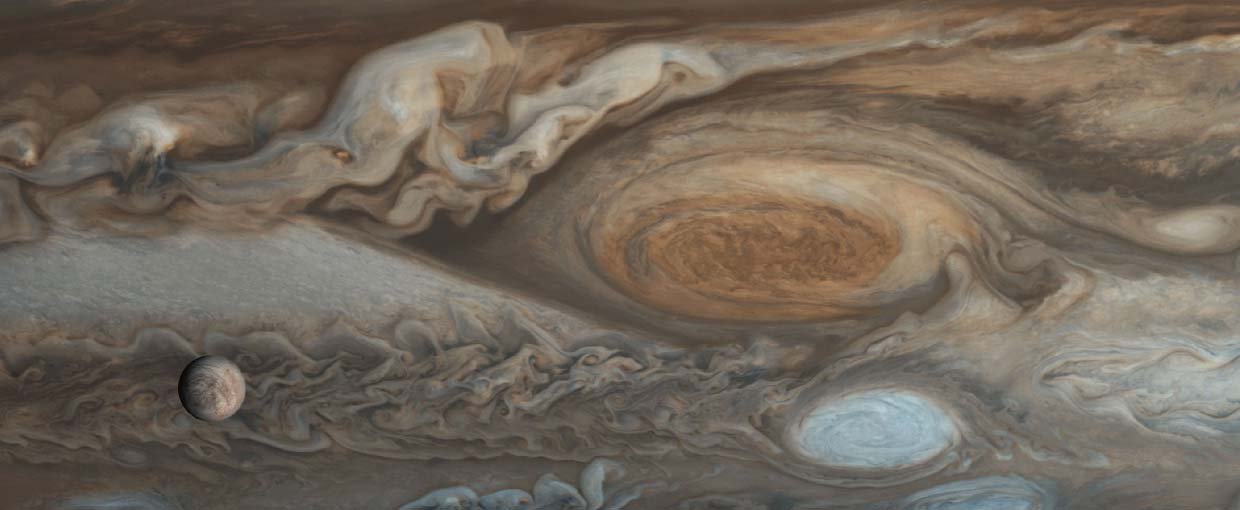
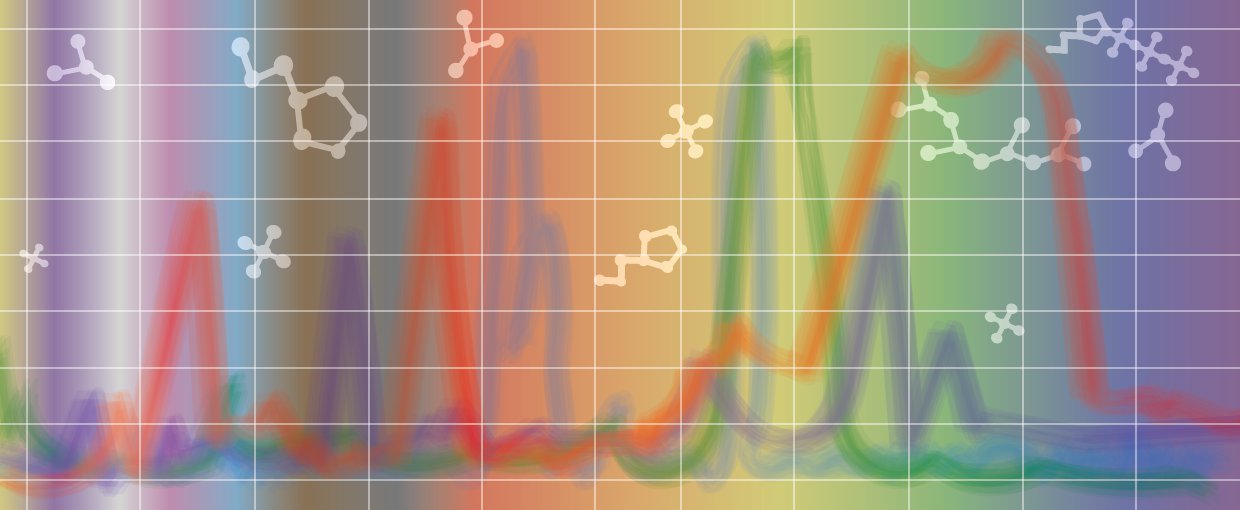
A volcanically active planet is shown in closeup at the left side of the image with glowing eruptions and lines of lava on the surface. To the right and in the distance is a faint blue glowing ball representing the more massive planet in the system.Sixteen frames from Voyager 1's flyby of Jupiter in 1979 were merged to create this image. Jupiter's Great Red Spot is visible in the center. Jupiter's moon Europa can be seen in the foreground at the bottom left of the image.The frame is a horizontal rainbow of color on a grid. Shadows of molecules can be seen through the light as well as the jagged peaks and troughs of spectral lines.
Fizzy Super Earths and Lava Worlds“Fizzy Super-Earths: Impacts of Magma Composition on the Bulk Density and Structure of Lava Worlds.” in The Astrophysical Journal.01/03
Identifying Hydrothermal Activity on Icy Ocean Worlds“Ethene-ethanol ratios as potential indicators of hydrothermal activity at Enceladus, Europa, and other icy ocean worlds.” In Icarus.02/03
NASA Raman Spectroscopic Database"The NASA Raman spectroscopic database: Ramdb version 1.00.” In Icarus.03/03
NextPrevious
Go Explore
December 2015Aerobic and Anaerobic Thiosulfate Oxidation by a Cold-Adapted, Subglacial Chemoautotroph

Harrold, Z. R., Skidmore, M. L., Hamilton, T. L., Desch, L., Amada, K., Van Gelder, W., … Glover, K. (2015). Appl. Environ. Microbiol., None(None), AEM.03398–15. doi:10.1128/aem.03398-15

LOW TEMPERATURE FORMATION OF NITROGEN-SUBSTITUTED POLYCYCLIC AROMATIC HYDROCARBONS (PANHs)—BARRIERLESS ROUTES TO DIHYDRO(iso)QUINOLINES

Parker, D. S. N., Yang, T., Dangi, B. B., Kaiser, R. I., Bera, P. P., & Lee, T. J. (2015). The Astrophysical Journal, 815(2), 115. doi:10.1088/0004-637x/815/2/115

High-resolution SIMS oxygen isotope analysis on conodont apatite from South China and implications for the end-Permian mass extinction

Chen, J., Shen, S-Z., Li, X-H., Xu, Y-G., Joachimski, M. M., Bowring, S. A., … Erwin, D. H. (2015). Palaeogeography, Palaeoclimatology, Palaeoecology. doi:10.1016/j.palaeo.2015.11.025

Rarity in mass extinctions and the future of ecosystems

Hull, P. M., Darroch, S. A. F., & Erwin, D. H. (2015). Nature, 528(7582), 345–351. doi:10.1038/nature16160

A Strategy for Origins of Life Research

Scharf, C., Virgo, N., Cleaves, H. J., Aono, M., Aubert-Kato, N., Aydinoglu, A., … Barahona, A. (2015). Astrobiology, 15(12), 1031–1042. doi:10.1089/ast.2015.1113

October 2015THE CENTER OF LIGHT: SPECTROASTROMETRIC DETECTION OF EXOMOONS

Agol, E., Jansen, T., Lacy, B., Robinson, T. D., & Meadows, V. (2015). The Astrophysical Journal, 812(1), 5. doi:10.1088/0004-637x/812/1/5

July 2015Thick sulfate evaporite accumulations marking a mid-Neoproterozoic oxygenation event (Ten Stone Formation, Northwest Territories, Canada)

Turner, E. C., & Bekker, A. (2015). Geological Society of America Bulletin, None(None), B31268.1. doi:10.1130/b31268.1

March 2015Ongoing hydrothermal activities within Enceladus

Hsu, H-W., Postberg, F., Sekine, Y., Shibuya, T., Kempf, S., Horányi, M., … Srama, R. (2015). Ongoing hydrothermal activities within Enceladus. Nature, 519(7542), 207–210. doi:10.1038/nature14262

November 2011Active formation of ‘chaos terrain’ over shallow subsurface water on Europa

Schmidt, B. E., Blankenship, D. D., Patterson, G. W., & Schenk, P. M. (2011). Active formation of ‘chaos terrain’ over shallow subsurface water on Europa. Nature, 479(7374), 502–505. doi:10.1038/nature10608

October 2008Entry approach into pristine ice-sealed lakes-Lake Vida, East Antarctica, a model ecosystem

Doran, P. T., Fritsen, C. H., Murray, A. E., Kenig, F., McKay, C. P., & Kyne, J. D. (2008). Entry approach into pristine ice-sealed lakes-Lake Vida, East Antarctica, a model ecosystem. Limnology and Oceanography: Methods, 6(10), 542–547. doi:10.4319/lom.2008.6.542