

This website is currently being migrated. For the most up-to-date astrobiology news, resources, and community announcements, please visit our new home at science.nasa.gov/astrobiology

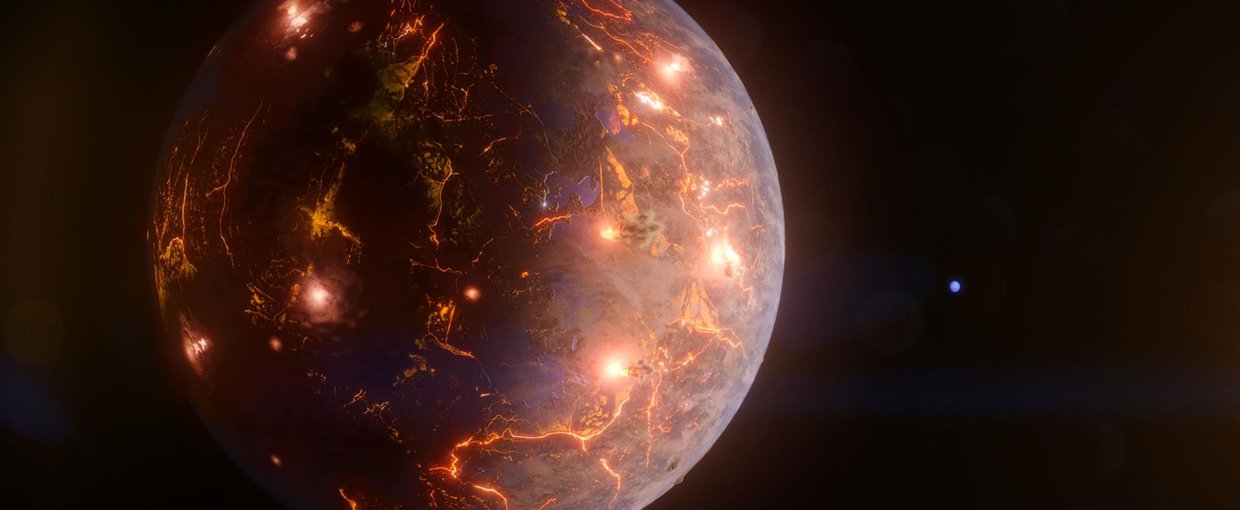
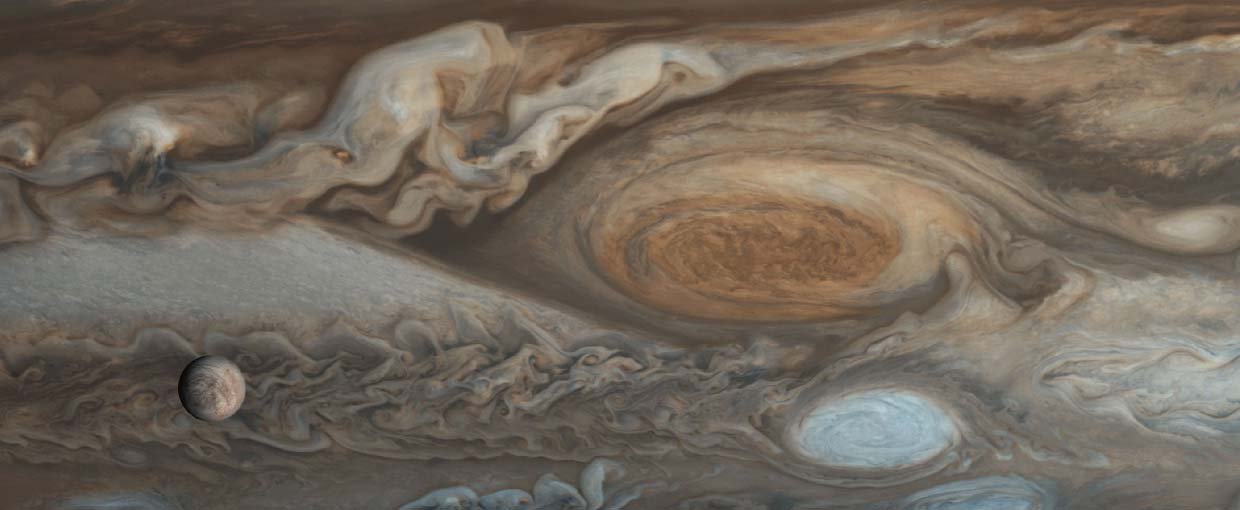
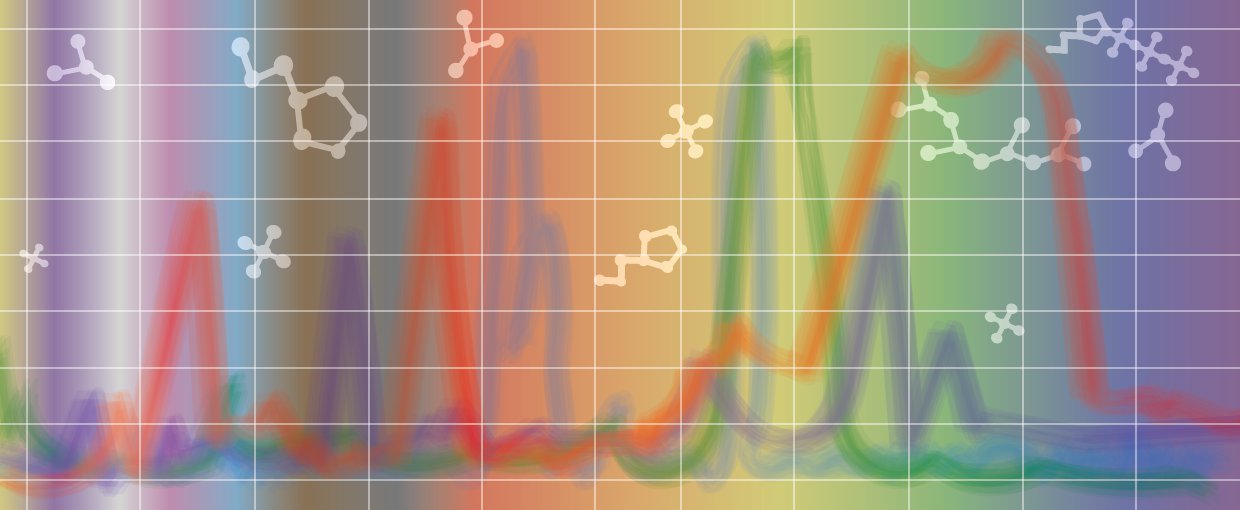
A volcanically active planet is shown in closeup at the left side of the image with glowing eruptions and lines of lava on the surface. To the right and in the distance is a faint blue glowing ball representing the more massive planet in the system.Sixteen frames from Voyager 1's flyby of Jupiter in 1979 were merged to create this image. Jupiter's Great Red Spot is visible in the center. Jupiter's moon Europa can be seen in the foreground at the bottom left of the image.The frame is a horizontal rainbow of color on a grid. Shadows of molecules can be seen through the light as well as the jagged peaks and troughs of spectral lines.
Fizzy Super Earths and Lava Worlds“Fizzy Super-Earths: Impacts of Magma Composition on the Bulk Density and Structure of Lava Worlds.” in The Astrophysical Journal.01/03
Identifying Hydrothermal Activity on Icy Ocean Worlds“Ethene-ethanol ratios as potential indicators of hydrothermal activity at Enceladus, Europa, and other icy ocean worlds.” In Icarus.02/03
NASA Raman Spectroscopic Database"The NASA Raman spectroscopic database: Ramdb version 1.00.” In Icarus.03/03
NextPrevious
Go Explore
May 2016Geophysical controls of chemical disequilibria in Europa

Vance, S. D., Hand, K. P., & Pappalardo, R. T. (2016). Geophysical controls of chemical disequilibria in Europa. Geophysical Research Letters, 43(10), 4871–4879. doi:10.1002/2016gl068547

Prebiotic chemistry and atmospheric warming of early Earth by an active young Sun

Airapetian, V. S., Glocer, A., Gronoff, G., Hébrard, E., & Danchi, W. (2016). Prebiotic chemistry and atmospheric warming of early Earth by an active young Sun. Nature Geoscience, 9(6), 452–455. doi:10.1038/ngeo2719

April 2016Environmental context for the terminal Ediacaran biomineralization of animals

Cui, H., Kaufman, A. J., Xiao, S., Peek, S., Cao, H., Min, X., … Martin, A. J. (2016). Environmental context for the terminal Ediacaran biomineralization of animals. Geobiology, 14(4), 344–363. doi:10.1111/gbi.12178

EVIDENCE FOR REFLECTED LIGHT FROM THE MOST ECCENTRIC EXOPLANET KNOWN

Kane, S. R., Wittenmyer, R. A., Hinkel, N. R., Roy, A., Mahadevan, S., Dragomir, D., … O’Toole, S. J. (2016). EVIDENCE FOR REFLECTED LIGHT FROM THE MOST ECCENTRIC EXOPLANET KNOWN. The Astrophysical Journal, 821(1), 65. doi:10.3847/0004-637x/821/1/65

February 2016Free energy distribution and hydrothermal mineral precipitation in Hadean submarine alkaline vent systems: Importance of iron redox reactions under anoxic conditions

Shibuya, T., Russell, M. J., & Takai, K. (2016). Geochimica et Cosmochimica Acta, 175(None), 1–19. doi:10.1016/j.gca.2015.11.021

January 2016IS THE PALE BLUE DOT UNIQUE? OPTIMIZED PHOTOMETRIC BANDS FOR IDENTIFYING EARTH-LIKE EXOPLANETS

Krissansen-Totton, J., Schwieterman, E. W., Charnay, B., Arney, G., Robinson, T. D., Meadows, V., & Catling, D. C. (2016). The Astrophysical Journal, 817(1), 31. doi:10.3847/0004-637x/817/1/31

Draft Genome Sequence of Janthinobacterium sp. Ant5-2-1, Isolated from Proglacial Lake Podprudnoye in the Schirmacher Oasis of East Antarctica

Koo, H., Strope, B. M., Kim, E. H., Shabani, A. M., Kumar, R., Crowley, M. R., … Andersen, D. T. (2016). Genome Announc., 4(1), e01600–15. doi:10.1128/genomea.01600-15

Microstructure-specific carbon isotopic signatures of organic matter from ∼3.5 Ga cherts of the Pilbara Craton support a biologic origin

Morag, N., Williford, K. H., Kitajima, K., Philippot, P., Van Kranendonk, M. J., Lepot, K., … Thomazo, C. (2016). Precambrian Research. doi:10.1016/j.precamres.2016.01.014

Groundwater flow induced collapse and flooding in Noctis Labyrinthus, Mars

Rodriguez, J. A. P., Zarroca, M., Linares, R., Gulick, V., Weitz, C. M., Jianguo, Y., … Fairén, A. G. (2016). Planetary and Space Science. doi:10.1016/j.pss.2015.12.009

AN INFRARED SEARCH FOR HDO IN COMET D/2012 S1 (ISON) AND IMPLICATIONS FOR iSHELL

Gibb, E. L., Bonev, B. P., DiSanti, M. A., Villanueva, G. L., Paganini, L., & Mumma, M. J. (2016). The Astrophysical Journal, 816(2), 101. doi:10.3847/0004-637x/816/2/101